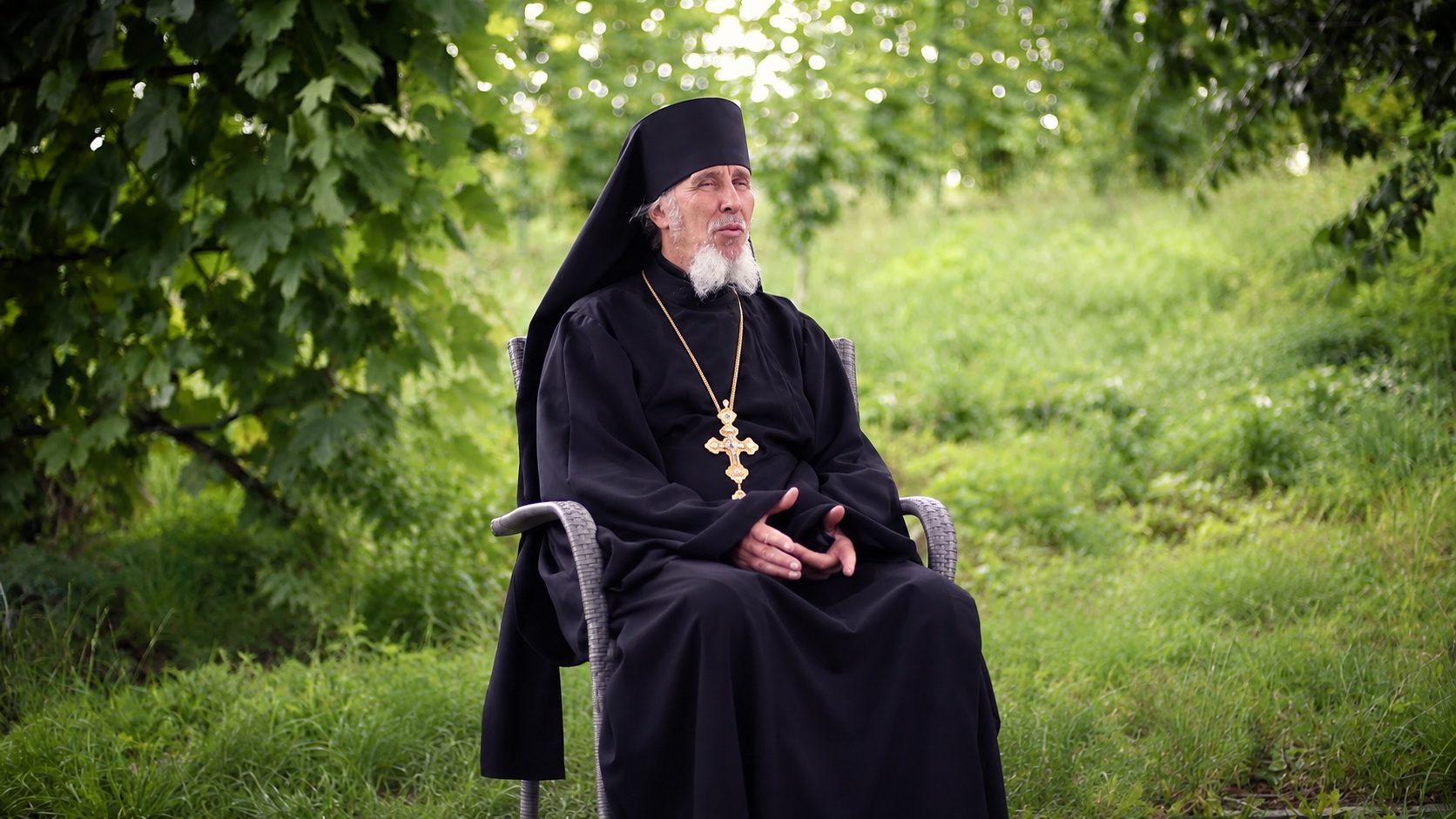
— Father Antoniy, in the 1970s you served as a subdeacon at St Volodymyr's Cathedral in Kyiv. Please tell us about those times, about the seventies and the eighties — what was church life like then?
— You know, one day a boy came to me in the garden, sat down on the bench beside me and said: "Father, was there a Church in Soviet times?" And I said: "There was, I served, glory to Thee, O Lord." There was a Church — how could there not be?! For God is Eternal, and He will never disappear. It is we who will disappear, but no one will defeat God!
I was a subdeacon at St Volodymyr's Cathedral from 1977. On the feast of the Exaltation of the Cross of the Lord they led me and one other lad into the altar and brought us to Metropolitan Filaret for a blessing. He said: "Take your places, stand in the servers' room, and if you are needed we will call you." We stood in the servers' room, and at Matins the late Father Mykolai (he had been there since 1973) called me over and said: "From this day you will serve." They gave me a sticharion and gave me a dish of flowers to carry, and they walked through the church carrying the cross, and water was poured over the cross from two pitchers.
And once I was coming regularly, I learned to fold the vestments. Father Mykolai taught me. I could sing, so I was already singing with the deacons. At St Volodymyr's Cathedral all the priests and deacons could sing: the protodeacon and three deacons — a bass, a baritone and a first and a second tenor — a quartet. And all the priests were musical. Five priests served — only one of them was a mitred archpriest, old Father Mykolai, while the others wore kamilavkas with yellow crosses, and the protodeacon Antoniy alone had a double orarion.
There was a deacon there, Father Vasyliy, now departed, who had been ordered to direct the choir. He was a great specialist, and at times he stood in for Mykhailo Semenovych Lytvynenko. Father Vasyliy taught me to read the canons on the kliros and to sing.
And then we went to Zolotonosha, to the Dormition Cathedral — to consecrate the iconostasis. And there Metropolitan Filaret let me read the 50th Psalm for the first time. From that time on he began to allow me to read the canon at the cathedra — during the anointing. Mykyta Pasenko, now departed, and I read the canon.
The Metropolitan summoned me — there was some conference, there were guests — and said to me: "Do you wish to be a clergyman?" And I said: "Give me your blessing" — and said nothing more. He said to me: "Write a petition, hand it in to the chancellery. Write it and tell no one!"
That was when the security services began checking my family: who lived where, what they did. And for a whole year they checked, and summoned my parents, and my brothers, and my sisters. Nobody understood anything. My mother said: "What have you done there? They are summoning us to the village council..." It was only on 17 August 1980 that the Council for Religious Affairs allowed me to be ordained. A courier came and said: "Yesterday they signed your permission to be ordained to the clergy." That is how it was.
And on the Transfiguration of the Lord I went out to the gates with the staff to meet the Metropolitan. And he said to me: "Do you have a cassock?" — I said: "At home I do, but not here." — "Borrow one from someone." And I borrowed one from one of the cathedral fathers, from Father Mefodiy, and went in the cassock to Metropolitan Filaret to receive his blessing.
And from then on I wore a cassock. And a couple of days later, at the all-night vigil, the protodeacon went up to Metropolitan Filaret (such influence he had with the Metropolitan) and said: "Do not take our Vanya away anywhere, he is our first tenor" — and Vladyka said: "That is not your business. Stand and pray." (He laughs.) And nobody knew that I was to be ordained the next day. I did not know it myself.
The Metropolitan told me to make my pre-ordination confession at the First Hour, "because tomorrow we are going to ordain you." Oh God! They typed out the text of the oath for me on a typewriter. I came home, read the canons, my God, I did not sleep the whole night! And old Father Mykolai said to me: "They will lead you into the altar, and it is like being in the dark — you understand nothing." But glory to Thee, O Lord! The protodeacon took me by the hand, led me around the altar table, and they ordained me!.. And I already knew the particularities of the services, the prokeimena and all the other deacon's exclamations. There were no books then, there was no service book. We learned everything by heart. Mykyta and I used one service book between the two of us. We would come out for the litany: first he would say "Let us all say," and then he would hand me that service book. By the time I had got hold of my own service book, a great deal of time had gone by. And I had no book of the rule either. I had to stay behind at St Volodymyr's Cathedral and read the rule there. Happily, I lived almost next to the cathedral. After my ordination I served fifty days without a break.
— Father, you were ordained while unmarried: was that your own choice, or was it simply how things turned out?
— No. I will tell you how it was. Vladyka Filaret did not ask me. And I had been getting ready to marry. I thought I would marry in the autumn. And then the Lord blessed me in such a way that the Metropolitan said: "Tomorrow we will ordain you." And I said to Father Mykolai: "What am I to do? Here they have blessed me to be ordained, and yet the Metropolitan never asked me about marrying." And he answered: "The Lord Himself told him. And you listen to his instruction and be ordained, and that is all." Because Father Mykolai's wife was a spiteful, vicious woman, and he knew all the "delights" of marriage... And he had also secretly received monasticism. He was a secret monk. This is how it happened. Patriarch Alexy (Simansky) liked to travel to Odesa in the summer, to his dacha. And he liked to invite old men like himself to stay: Father Kuksha would come, or Father Mykolai. Patriarch Alexy gave him a gold cross. And so. This poor Father Mykolai suffered from his wife. And so he asked to be secretly tonsured a monk with the name Spyrydon. And he began to wear a prayer rope in secret. But Metropolitan Filaret noticed the prayer rope. And how he turned on this Father Mykolai: "Are you a monk or not? Own up!" — and Father Mykolai went red. He said nothing. "If you are a monk," the Metropolitan went on, "then I forbid you to serve, since you are an unlawful monk!" Filaret took all these things very strictly. We had a certain Father Tryfyliy. Well, they tonsured him into the schema. And Filaret said: "Did he ask my blessing for the schema? If he was the hieromonk Tryfyliy, let him remain the hieromonk Tryfyliy! And if he received the schema in secret, then it must be known to no one! And he is not to be laid in the coffin in the schema."
That is how they ordained me. They did not ask... They gave the blessing — and that was all...
— You served as a deacon from 1980 until the Lavra opened in 1988?
— Until 1988. Yes. I served eight years there as a deacon.
— And what did you live through or see there in those eight years?
— I was a deacon and a sacristan. Two duties. Our vestments were poor ones. Not like now — even the servers have such splendid vestments! But we had "rags," the very simplest vestments sewn up, even for the bishop. The Metropolitan had no rich vestments, although he travelled a great deal and had been to Greece. There was nothing of the sort about him — that he would buy up materials there and have vestments sewn. No, no... everything was very plain. And — glory to God — Father Avramiy (Kuiava) sewed sticharia and vestments for the priests out of green material.
— Was Father Avramiy also at St Volodymyr's?
— No. He lived in the flat of the expelled nuns whom the Soviet authorities had driven out of the monastery by force in 1961. There was a decree: everyone under thirty was to be evicted from the monasteries. So that only the old women would be left and the monasteries would thus die out of their own accord. There was even a period when a still harsher decree came out — everyone under fifty was to be evicted. But somehow, by God's mercy, it never came to that. But all the young ones were evicted from the monasteries. And so they had to go out to work. They were given a flat. And Father Avraamiy sewed vestments there at their place. But that was only half the trouble. There was nothing to pay for the vestments with. The cathedral's till was strictly controlled by the authorities. An audit commission came constantly with the commissioner and checked the expenditure: "Where have you put the money?"
— Did the primates of the Orthodox Churches visit St Volodymyr's Cathedral in those days?
— Of course they did! And not only the Orthodox visited. Anglicans came, and Lutherans, and Copts, and Hindus, and there were conferences. They would process ceremonially, stand on the solea, and some would sit on the chairs by the kliroses. And we would carry on: "Again and again" — serving our own Orthodox service. But when it was the Greeks, say, bishops or a patriarch, then we would serve together. Americans came to us — Orthodox clergy — and gave us small icons. In those days you could not make such gifts openly. They would say to me: "Over there under the cloth we have put some icons — you can take them afterwards." For the commissioner walked about and looked around him — he was keeping control. He did not go into the altar, happily, but he was always in the servers' room. The commissioner also kept watch over the candles, to make sure that "Moscow Patriarchate" was written on them without fail. That was written on every candle. And candles without that mark could not be kept in the church. If he saw that a candle had no such mark, he would immediately arrange inspections in the cathedral — through every storeroom and cellar: "You are making candles here on the sly."
I remember helping Metropolitan Filaret at his dacha in Pliuty. I understand garden work, so I was busy there pruning and grafting the fruit trees, and mowing the grass. And I was happy there. On Sunday after dinner I would go up to the Metropolitan and ask: "Vladyka, must we go to Pliuty today?" — and he would answer: "Go." I would take a boat in the bay and row about all day.
— And did Metropolitan Filaret speak Ukrainian with you?
— No. He spoke Russian, and I spoke Ukrainian. The language question was not mine. I was busy with the sacristy and served my weekly turn.
— And how did you regard the schism? How did you judge Metropolitan Filaret's act?
— It is easiest of all to condemn. Remember the years of the revolution, when bishops separated themselves from Patriarch Tikhon. How much turmoil there was! Priests remained there whom I knew. Revolts lead to nothing good; it is a dreadful time, when you do not know where to turn. And another thing. I will tell you that everything depends on those in charge. Who has made the schisms? Patriarchs, archimandrites. That is all! Have you not read the history of the Ecumenical Councils? Ordinary people do not make schisms. You know, the late Patriarch Alexy II knew everything about Metropolitan Filaret. I remember how under Kuchma everyone hoped that the "Kyiv Patriarchate" would disappear — they were so elated. And I said then: "Do not leap about, do not dance — no one will destroy it, because that 'church' is a political organisation. And Kuchma will not do such a thing." The "Kyiv Patriarchate" is kept going by Filaret's enthusiasm. He is its founder, and he went against Patriarch Alexy. I will tell you this — the blame for the schism lies with the highest authority. No one will shift Filaret from his place. He is a diplomatic man. I remember how he and I were digging holes for roses at the dacha, and he said to me: "Do you know that the Cuban missile crisis could have broken out into a nuclear war? In Zhytomyr they were already pressing the buttons!" That horror was the doing of Khrushchev, who nearly destroyed the whole world with his folly. And Metropolitan Filaret then organised the entire hierarchy of the Russian Orthodox Church, and they gathered a symposium to prevent the war. So no one dared to remove Filaret... And then he and Kravchuk got up to plenty. And who is without sin? So a great deal can be written about a man...
— Let us come back to your own story. How did you become a monk? After all, you could simply have remained a priest.
— I asked the Metropolitan about monasticism somewhere before the 1000th anniversary of the Baptism of Rus. But I still had an elderly aunt whom I was looking after. She had done me so much good! How could I abandon her? People close to the Metropolitan advised me: "Perhaps you should be tonsured into monasticism, so that Vladyka Filaret may tonsure you." Time passed, and I asked the Metropolitan. He answered: "I shall think about it." Well, he thought about it and took counsel with whomever he needed (he laughs.) And then he called me over in the altar and said: "Now, if you are to be tonsured into monasticism, then you will have to live at the metropolia!" And I thought this was imprisonment — to live there. And I told him that I had an aunt and that I had to look after her until her death. "Well, if that is so, if you will not live at the metropolia — then there is no monasticism for you!" Well, no means no. I submitted.
And just then the celebration of the 1000th anniversary of the Baptism of Rus came round. And the Lavra could be opened. But I will tell you this: Metropolitan Filaret and Patriarch Pimen wept the Lavra out of them. No one wanted to open it. Thanks to Filaret and Pimen the Church managed to get back a small piece of the monastery — there, where the Far Caves are. For delegations were coming from everywhere, the primates of the Orthodox Churches were coming — and they had to be shown at least a small piece of it, that there was at least something here. They herded in lads, military cadets. The grounds were neglected. They raked here, they cleared up, they made paths. It was a wilderness! So the lads worked a great deal. And there it was — on the Day of the 1000th anniversary of the Baptism of Rus there was a service at the Far Caves. The late Father Ihor and I prepared everything for the service. And by the autumn we began living in the Lavra permanently. Several brothers gathered. And the Metropolitan was walking about the Lavra with Father Sofroniy (Shynkarenko) from Kniazhychi (he was the treasurer then). And Vladyka said: "Well, how are you here? Have you decided to be tonsured?" By then I no longer wished to receive monasticism. And Vladyka Filaret said to me: "I have chosen a good name for you. You were not afraid of hardship, you bore your service worthily." And I was sleeping two hours a day! That is how it was! I was skin and bone. And so, in the autumn they tonsured me into monasticism. And in the same year the Metropolitan ordained me to the priesthood in the cathedral. I was the first priest for the Lavra. And I had no forty-day term of daily services then. Straight to the work.
— Tell me, when the Lavra was opened in 1988, which of the old brotherhood came here?
— Father Pafnutiy (Rossokha) came (Feofil in the schema). He was later the superior of the Kytaiv Hermitage. Then schema-hegumen Ahapit. Father Spyrydon was there too. I brought him to the Lavra and introduced him to Father Polikarp. I had known Father Spyrydon for a long time. He used to come to serve at our cathedral for the feast of the Great Martyr Barbara. If you look into it, he never actually lived in the Lavra. He was ordained deacon at the Brotherhood Monastery on Podil, where the Mohyla Academy is now. They served there. And he himself had been a novice of the Ionynskyi Monastery. In 1937 they took him off to prison and sent him into exile to the Vyatka camps. And in 1947 he came to the Lavra, but they would not register him here, and he went to Chernihiv to Vladyka Andrii, and Andrii was thrown into prison. The bishop had been ordered to bury the relics of St Theodosius of Chernihiv. And he refused to do it, and was sentenced to the camps at the beginning of the 1960s. The Trinity Cathedral was closed, the nuns were driven out. There was a godless bishop there, Ihnatiy — he closed everything down there and left only one church, the Church of the Resurrection, for the whole of Chernihiv. There. And then Father Spyrydon moved to Zhytomyr. He bought half a little house and settled there. And I said to Father Ionafan (Yeletskikh), now a Metropolitan, that we had to revive the rule. For no one knew the monastic rule. And they gave us a car, and we went to Zhytomyr. Father Spyrydon was so overjoyed — such a venerable old man! — and how he began to tell us everything! So much information... And he sang us all the Lavra chants; he was a singer, after all. And then in the winter I took him away to the Lavra. We made him a little cell. So he lived with us a while, and then went back home again.
And I brought Father Noy here. He received the schema with us. He was a singer too. Short in stature. And he considered me his spiritual father, although he himself was born in 1905! He read the Psalter in the Lavra. He was a man of God. He went to church to the very end; he was always neat and well kept. There was also schema-archimandrite Isaia, Father Ahapit. He would say: "Straighten my cockade for me! My cockade!" He walks along with his crutch, with a crowd of parishioners around him, and by the time he comes out of the Exaltation of the Cross Church there is a crowd of old women walking behind him. And there was one such woman, Yevfrosyniia, who never left him in peace. We had learned by then to sing in the Lavra chant, and we sang "In Thy Kingdom" with a canonarch. And she kept asking him about our chant — what it was and how it went. And he said to her: "Priska! We could not sing, and they can! The young folk — just look what they are up to! Feodosiy used to hit us on the head with the book, because we sang the antiphons wrong."...
— What would you advise us, young graduates, in order to become priests? What qualities must we have? Are we fit for this service at all?
— You must be zealots for the Church of God. You must love the Church and love God. If you love God — everything will work out for you. A priest must love God. If he does not love the services and forces himself to attend them, if he does not love prayer, then what use is such a priest? Better then not to be ordained and not to put the vestments on. As the old women once used to say to a certain priest: "You, Father, are no Father. You had better take off those vestments and go and tend sheep." So zeal is needed. Knowledge is not everything. Choose your path, my child. If you love God — the Lord will always help you! May the Lord keep you!
Interview by Serhii Epik
