
— Vladyka, you were appointed superior of the monastery at 28. A young man must have needed a good deal of courage to take on such a responsibility?
— At the end of 1998 Archimandrite Agapit (Bevtsyk), our first superior, who had begun the restoration of St. Jonah's Monastery and gathered the brotherhood, became Bishop of Khust and Vynohradiv. When His Beatitude Metropolitan Volodymyr asked whether he had a successor, Vladyka pointed to me. Metropolitan Volodymyr summoned me and, I think, was somewhat surprised, because I looked even younger than my years. At first I was appointed acting superior; for half a year they watched me closely, and then I was confirmed in the office of superior.
Of course it was not easy, above all in building relations with some of the brethren. After all, I had been one of them, had never carried any obedience of leadership before, and suddenly I became their head. There were sorrows and worries, and I had to endure a little. But by God's mercy everything settled down in time, and in the end our relations became good and warm.
— So the obedience did not seem beyond your strength?
— You know, at that age nothing seems impossible. When you are young you have plenty of strength, and somehow I did not agonise over it. From the outside everything was familiar — I had helped before with the household affairs and with organising the restoration work… The only difficulty, as I have said, was to build relations with those brethren who had taken the appointment with some tension. Glory to God, nobody left the monastery over it and there were no open conflicts.
— Where and how did you first come to know monastic life?
— I studied at a medical institute for three years. After the first year I came to the Kyiv-Pechersk Lavra, fell in love with the monastery and with monastic life, and began to help in the Lavra as far as I could. I spent all my free time after lectures and at weekends there, and often stayed the night. In practice I already belonged wholly to the Lavra. And I understood that even if I finished the institute I would not work in my profession anyway; I would go to a monastery. Of course, such a divided life is impossible: you are supposed to be studying, but your heart is somewhere else; I would sit in a lecture watching the clock — when will it end, so that I can rush to the Lavra… In my third year I failed my exams — and left with joy.
— By then did you already have a spiritual father in the Lavra?
— In those days the very notion of a spiritual father, in essence, did not exist. I do not remember anyone seriously being guided by someone's counsel. Of course, there were appointed confessors in the Lavra — those who heard the brethren's confessions, but since confession to particular fathers was not obligatory, the brethren usually went to confession to whoever was known for kindness. At confession a person often needs mercy rather than severity. We had no such notion then as spiritual guidance, let alone eldership, except in those monasteries where at least some continuity had been preserved. The newly opened monasteries were entered mostly by "former Komsomol members". The old monks were either already weak in health or very simple.
Only when books about the Greek ascetics began to appear did we begin to understand at least a little how life in a monastery, under spiritual oversight and guidance, ought actually to look. When I was a novice I probably read far more books than after I had become a hieromonk. All the more so because my obedience was in the bookshop, and I immediately read everything new that came in.
— But is that not also a path — to learn monasticism from books?
— In those years there were simply no other options. Revealing one's thoughts to anyone was not even under discussion. Many were also unsettled by what, for example, St. Ignatius (Brianchaninov) had said in his time: there are no elders, there is no one to be guided by… In the Soviet era, when I was starting out, it seemed all the more that this was so. It is only now that people understand that if, in simplicity of heart and with hope in the Lord, you turn regularly to one spiritual father and seek his counsel, God truly reveals His will through such a person. If you give room for the action of God's grace, the Lord will certainly show you the right path.
— When and where did you meet your elder?
— I did not have an elder as such. We have been friends for a very long time, since 1990, with the present Archbishop Kassian of Ivankiv, who is the superior of the Zvirynetsky St. Michael the Archangel's Monastery. We try to support each other and to share all our perplexities and worries. He became a hieromonk in 1992, three years before me, and it was mainly to him that I went to confession and with him that I took counsel; he was my sponsor at my tonsure.
As for the Athonite elder Gregory (Zoumis), he could be called a kind of catalyst. I never went to confession to him, since I do not know the language. But sometimes it is important to see how a person lives, what he lives by, how he thinks and reasons… Being with such people brings you down to earth — in the good sense of the word: it shows what you really are, what kind of abbot you are, what kind of monk. For us the highest ideal is Christ. The Apostle Paul says: be ye followers of me, even as I also am of Christ (1 Cor. 4:16, King James Version). And here on earth there are people of Christ, and looking at them you understand what you lack; and once you have a sober idea of yourself, you begin to ask for help from the heart. Not formally: "Lord, have mercy," but truly from the heart: "Save me, Lord, I perish!"
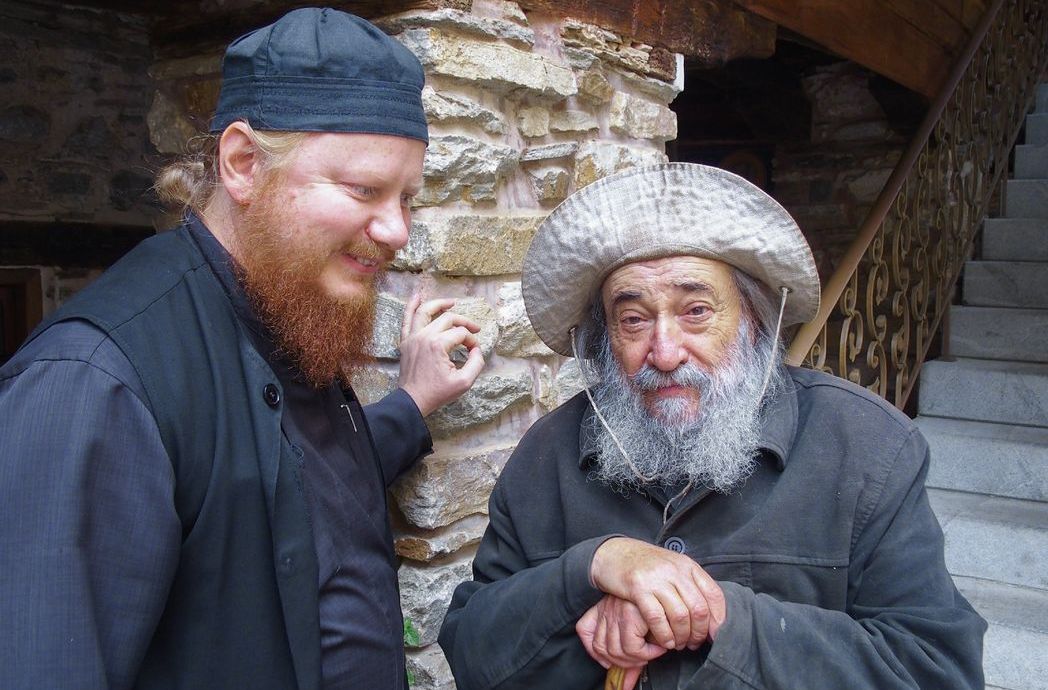
— What especially drew you to Elder Gregory, what won you over to him? Why did you want to have him as a spiritual example?
— I did not come to know him truly at once. At the end of the 2000s, when we first came to Dochiariou, our brethren met Elder Gregory, and he invited us to come and stay at the monastery. Since then these trips became regular. We stayed for half a year at a time, and our monasteries became friends.
At first I was rather afraid of the elder; he seemed to me too stern, too categorical. Much closer to me was Archimandrite Gabriel, his friend and helper (we have no office like his; it is called "the first after the abbot", but it is not a dean in our sense). Both of them had laboured in asceticism since childhood and were spiritual children of St. Amphilochius of Patmos. Modest and gentle, Father Gabriel was spiritually closer to me, and it was easier to talk with him. In time, when I came to know Elder Gregory better, I understood that inside he was a real child, who had kept a child's perception of the world and a child's love for everyone and everything. It became clear that this was a true man of God, a saint of our time.
In the course of my acquaintance with him I witnessed several instances of his clairvoyance. Nowadays the notion of clairvoyance has in many ways been vulgarised and caricatured by various pseudo-elders. But there was one vivid case, which I have told about once before.
On one of my visits to Athos a certain question was troubling me, one that I thought it awkward to ask through an interpreter. I spent a week at Dochiariou but never brought myself to ask the elder. And then, literally on the eve of my departure, I see the elder in the courtyard talking with pilgrims. I came up too; the pilgrims were from Russia and had an interpreter. Elder Gregory is telling them something, and then he says: there is, you see, a monk I know, and he has such-and-such a problem; he thinks it is solved this way and that, but in fact it has to be done like this and like that… Everyone listens and nods, and I realise that he has told it all to me — clearly, setting out the essence of my question literally in my own words.
— Even though you had not asked him the question…
— No. Of that whole group only I understood what he was talking about.
There was another remarkable case, with an icon painter from Athens. Before he became a spiritual child of Father Gregory he was an ordinary artist, with the familiar bohemian habits, most of which he of course gave up after meeting the elder. But the enemy gave him no peace. And one evening some former girlfriend phones him, says she misses him, invites him over… He had already begun to get dressed when suddenly — a phone call: Elder Gregory. And I should say that the elder has no mobile phone, and the only telephone in the monastery is the landline in his cell. And the elder says to him: "Where are you off to? Shut the door, put the key under your pillow and go to sleep"… Imagine, the icon painter told me this himself.
— And did he obey?
— Just try not obeying!
And so little by little I understood that the elder was truly "one of the ancients" — everything we had read in the patericons, everything we had admired in the lives of the Egyptian hermits and the first cenobitic monks, he had fulfilled. He himself said that his ideal was Egyptian monasticism, and he and his brethren strove for it. Of course, now, with the new abbot, some things have changed a little. Before, the monastery lived under constant strain: they worked from dawn to dusk, with no breaks at all, and did everything with their own hands — both the repairs and the building…
Now, of course, it all continues, but no longer with such effort. In Elder Gregory's time the Russians even called Dochiariou "the White Sea Canal". Because the elder really did have this idea: a monk should not rest, he should always be tired, he should spend all his physical strength.
— And is that good for the spiritual life?
— What is good about Athos is precisely that its monasteries are different. There is Simonopetra, where the spiritual life was built up by Elder Aimilianos, and where even now much attention is given to theology, to the library, to the archives… And there are monasteries like Dochiariou. And for those brethren who were guided by Elder Gregory, who came precisely to him, precisely to that monastery, it was good there. For those who came to Elder Aimilianos, it was good under his guidance. The Lord gives every person a choice of path.
— Vladyka, you have experience of media work: St. Jonah's Monastery publishes an Orthodox magazine for young people, Otrok. Tell us, how justified is media activity in a monastery?
— There is the monastic labour proper, and there is handiwork. For us such activity is handiwork, which the monastery, strictly speaking, does not do itself; it only creates the conditions for one undertaking or another to develop. It was not that the monks gathered and decided: let us publish a magazine. There was an initiative of our parish youth, and that initiative coincided with one parishioner being able to support it financially. And so Otrok has now been published for about twenty years.
So we saw that this was a good work. Remember how Gamaliel said: if the work is of God, it will grow however we try to stop it, but if it is of men, it will fall apart (see Acts 5:34—39). We try to follow that principle.
— Why do you need a presence on social media, and how much of your time does it take?
— First of all, I get information there. I stopped reading the news feed long ago, because it really does take up a lot of time; practically all news is manipulative and changes so quickly that there is no point in going into it. But on Facebook my circle of contacts, my subscriptions and friends, is arranged along the lines that interest me, and that is where I get information from. Sometimes I write something myself, but I do not regard it as anything very important.
— So it is not a duty for you.
— Remember how Thaddeus Bellingshausen remarked: "We write what we observe. What we do not observe, we do not write." The motto on my Facebook page is the words of Stepan Pisakhov — a Russian writer, storyteller and ethnographer from the Arkhangelsk lands; one of his tales is called "Не любо — не слушай". That is, my task is to bring my opinion, my point of view, to those who will read it. My friends there are real friends, people close to me in spirit. If they comment, they do so constructively and kindly. Those who try to start flame wars I ban straight away — frankly, the opinion of the enemies of the Church does not interest me.
— And what do you yourself like to read on social media?
— I follow mostly icon painters, cultural historians and the pages of various museums. There is a book by Father Mikhail Ardov, "Мелочи архи.., прото.., и просто иерейской жизни", where he wrote about Archbishop Cyprian (Zernov), who once said: "I am a bishop by misunderstanding; at heart I am a sacristan." And I too am a sacristan at heart; the beauty of the Church is what interests me.
— Vladyka, I have read about how you work with the young generation, and it seemed unusual that you speak of very young people, twenty-year-olds, as highly motivated and active. But how can such people be drawn to monasticism, if by all the laws of human nature a young person is interested in life in all its variety?
— We do have young monastics, and I can tell from concrete examples how they live and what conditions they choose. As for our St. Jonah's Monastery, it stands in the centre of the city, on the grounds of the botanical garden, and we have a very serious problem with premises — so there cannot be a large brotherhood. In general, a large brotherhood creates certain problems for a city monastery: the monks need to be kept occupied beyond their liturgical obedience, since there are not many opportunities for physical work in the city. So at St. Jonah's our community is mature and settled; it has even shrunk somewhat, because we have divided: first a skete at the Zvirynets Caves budded off from us, where three of the brethren were from our monastery. Vladyka Kassian was the head of the skete there; then, when it became a monastery, he became an archimandrite. It already has its own brotherhood, whose core is made up of brethren of St. Jonah's.
We also have a skete 30 kilometres from Kyiv, in the village of Neshcheriv; it is now called the Neshcheriv Transfiguration Monastery, and it was founded at an old church of the XVIII century. The church is very beautiful and stands in a wonderful secluded place — on the edge of the village, on a hill.
The head of the skete there is Archimandrite Ioasaf (Peretiatko). And he began gathering the brotherhood on the very principle that we had seen at Dochiariou. Because in an established monastery it is practically impossible to rebuild anything — the people there are usually older, used to a certain way of life, a certain rule, certain traditions. It is unrealistic to change all that substantially. So the new wine was poured into new wineskins, and firm rules were set from the start.
When Father Ioasaf began to build the monastery, he introduced a strict ban on alcohol — no wine is given even at Pascha, so that there is no occasion (monasteries in the countryside often have problems with this weakness). The residents know: if someone is caught at it, he is sent home at once. Next — complete self-sufficiency: the brethren cook, and clean, and look after the vegetable garden and the orchard, and the bees… Lay people can help only now and then, on the patronal feast, for example. Attendance at all services is obligatory for all the brethren. That is, during the services all obediences except the kitchen are set aside. Everyone confesses only to the head of the skete; that too is a law.
So, the main thing I am leading up to: with all these conditions there are already many young people there. Now there are about thirty people in the skete, mostly young, roughly half of them under thirty, many young men who have just graduated from university.
— So strictness does not frighten them off?
— On the contrary. You know, a believer, and all the more one who longs for monasticism, wants what is real. And they come and see that it is real there. Not an imitation, not a stylisation, but true ascetic labour — it really is hard there, it is difficult, every day at the services, every day obediences, very strict discipline, no absences and no money of one's own…
— In your view, do the events taking place in the world affect people's desire to live a spiritual life? After all, we had an extraordinary spiritual upsurge at the beginning of the 90s, when most of our fellow citizens had a very hard time…
— Perhaps in hard times there is less formality in life, Christian life included, and accordingly fewer opportunities for careerism and more for real work. That inspires people and spurs them to grow. In such conditions a person thinks more freely and thinks more about the things above…
Formalism ruins many undertakings. I think it also matters that our Vladyka, His Beatitude Onufriy is first and foremost a monk and took monastic vows for the sake of ascetic labour. Everyone knows that he spent a long time at the Trinity-St. Sergius Lavra and still enjoys enormous authority there. I think that his example, and freedom without over-regulation, is what draws people to our monasteries today.
— In your opinion, what should a monastery's spiritual father be like?
— In the full sense of the word, a spiritual father is one who guides you wholly through life, to whom you reveal your thoughts… As regards our monastery, it cannot be said that there is such a spiritual father. Rather, in the sense of Ignatius (Brianchaninov), he is a like-minded brother, an elder brother, whose opinion matters to a monk and is at times imperative. In some cases the brethren consult him and accept his opinion.
…We have a wonderful batiushka in our monastery, from the Lavra brotherhood (the core of our monastery all came from the Lavra brotherhood). When he was still in the Lavra, probably half of all the Lavra monks went to confession to him, and even now many of our brethren confess precisely to him. A man remarkably full of love, a true man of God. And towards lay people he has taken on himself this ascetic labour — to listen to everyone. Our parishioners already know that you can stand in line for him for several hours while someone recounts their whole life to him — and yet they love him, and very many come to him for confession.
— Being the superior, you are not the spiritual father of the monastery?
— No, because we have brethren who were both tonsured and ordained before me and are considerably older in years. There are only fifteen of us, and almost all are in holy orders. Among them are several hieromonks who are spiritually experienced and discerning, and the brethren go to them for confession — each to whomever his heart inclines. Where something new is being founded, as in our skete, people really do come to a particular spiritual father from the start. That is possible, it seems to me, only in newly founded monasteries.
— Do you think today's young monks need to be brought up, or are they brought up by the Lord, the rule and obedience?
— In our skete the head of the skete is very diligent and zealous. Besides hearing the residents' confessions, he holds meetings of the brotherhood, explains what the monastic life is, analyses and discusses various cases. With every brother who has problems he makes a point of talking and goes through everything in detail. He works very seriously in this direction.
—Vladyka, what do you think the next monastic generation will be like? How will people of "20+" differ from the present brethren?
— In nothing. As monks — in nothing. People always say that the young are worse, and that "in our day", you see, they were different. I do not think any noticeable degradation of the young is taking place, the monastic young included.
One must understand that the monastic life, like life in Christ in general, does not depend on us in everything. His Beatitude Metropolitan Onufriy, in a now old but remarkable video interview with the sisters of the St. Elisabeth Convent, says that when a person comes to a monastery, the Lord strengthens him with His grace like one newly baptised and carries him in His arms, but then withdraws His grace, and the person is now obliged to do by himself what he used to do easily with the support of the calling grace. And everything turns out wrong; the fruits come out somehow crooked and stunted… But the Lord accepts it, because, as Elder Gregory used to say, it is enough for a person to take three steps towards the Lord, and the Lord will take the rest of the steps to meet him.
In monasticism, as in the Christian life in general, a person needs to keep this direction towards the Lord, and then the Lord will surely take the steps for us…
—What would you wish young people who are not yet monks but already long for the monastic life?
— See now! what is so good, or what so pleasant, as for brethren to dwell together? (Ps. 132:1, Brenton's English Septuagint). For three decades now I have held these words to be relevant and alive, eternally alive. Because there is no better life than the monastic one. But, of course, not everyone is called to it. Yet if you have heard the call, do not put it off, do not be afraid, go to Christ. And the younger you are, the better. Elder Paisios of Mount Athos used to say: "Either marry in your youth, or be tonsured while young." Because in youth, for want of ingrained egoism, there is a blessed recklessness, when a person makes strategic decisions without thinking much about the consequences. Why do people start serving in the army when they are young? If a person — a young officer or soldier — is in the army from the age of 18, he will grow into an experienced commander. Blessed recklessness leads him into battle and raises him to the attack, without which victory would be impossible.
So too in the spiritual life one must have such a blessed recklessness. If the Lord has called, one must go, without making excuses and without putting it off.
— Of your younger self you said that in the Lavra you felt at home at once…
— When I first happened by chance to attend a service in an ordinary parish church and stood through the all-night vigil, I understood that this was mine, that I had to be here. In the same way, when after my first year at the institute I first came to the Lavra for an obedience (an acquaintance had invited me to help there): I worked, I was at the brotherhood's meal, I saw how the brethren pray together and listen to the lives of the saints, and I understood that I liked it and wanted to be here. I think, if one could ask the apostles on Tabor why it was good for them… to be here (see Matt. 17:4, King James Version), what would they say? They thought neither about that nor about themselves — they simply felt good. So I too cannot say what brought me to the monastery: I am happy there, and I am happy there still. For thirty years now I have been rejoicing and giving thanks to the Lord.
Interviewed by Ekaterina Orlova

Comments