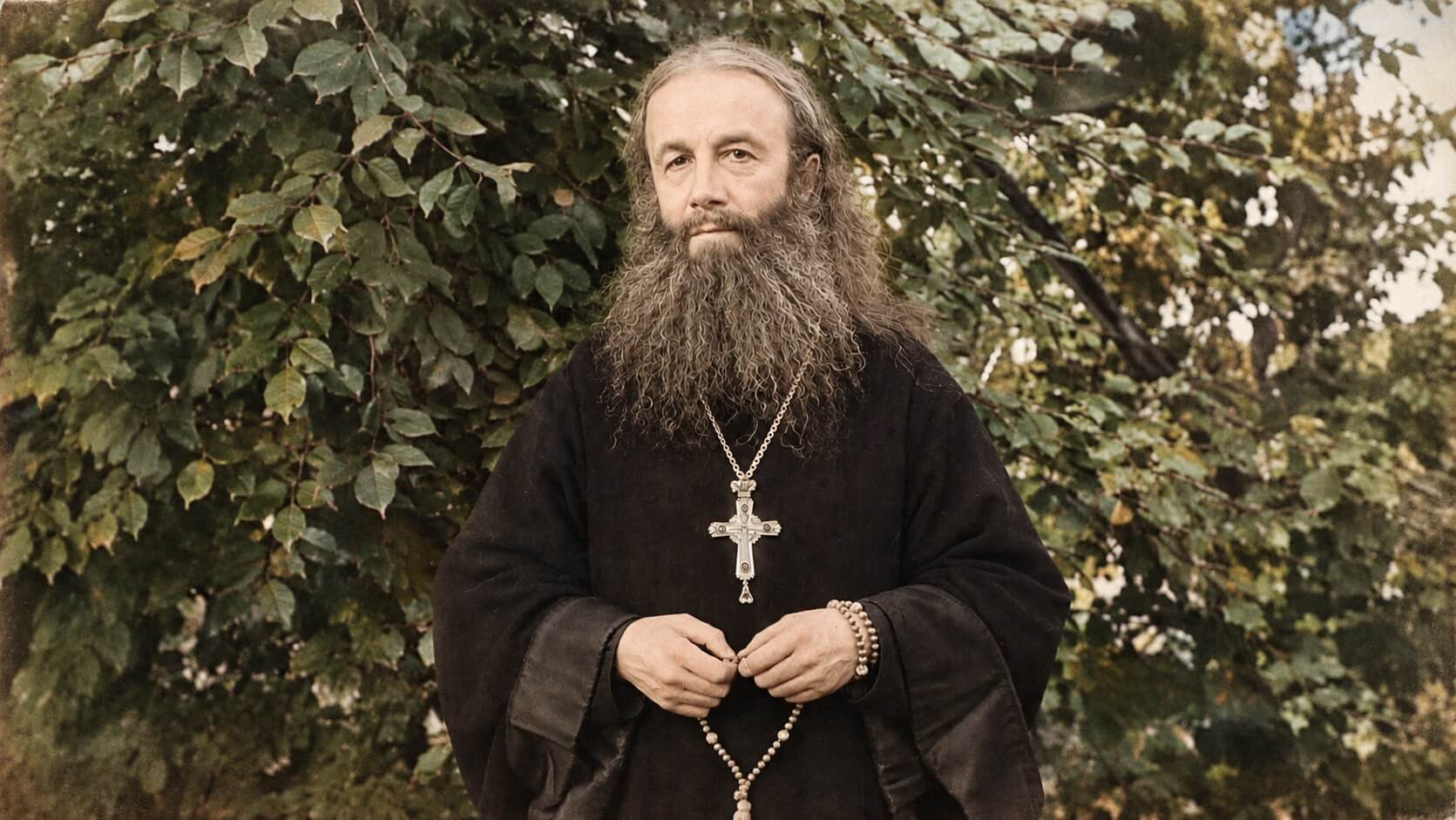
A young novice of St. Jonah's Monastery
The childhood of Father Spyridon (Kyrylo Mykolaiovych Lukych) was spent in Kyiv and was darkened by the events of the First World War. His father was taken to the front, and after his return, when an epidemic of typhus was raging, the head of the family fell ill and died. Hard family circumstances made it impossible for Kyrylo to continue his studies at the Sixth Gymnasium of Kyiv. Having studied there only three years, he asked his mother, Mariya Serhiivna, to let him go to a monastery.
Pascha of 1921 the 12-year-old Kyrylo already met as a novice of the Holy Trinity and St. Jonah's Monastery in Kyiv. Here, under the direction of the well-known artist Ivan Sydorovych Yizhakevych, he carried out his obedience in the Painting Workshop, which was at the same time a school for boys. And in the summer months he laboured together with all the brethren at the general agricultural obediences.
Besides this, Kyrylo Lukych became the closest helper of the schemamonk Vissarion, who had formerly been the cell-attendant of the founder of the monastery — Saint Jonah of Kyiv. This elder was already advanced in years, but he remembered Father Jonah well and told much about him. For example, such an incident: once the saint was walking through the monastery, and towards him came a novice with a whole stack of plates. Not knowing how to take a blessing, he was at a loss, and the elder said to him: "Drop them!" The novice, without a moment's thought, threw the plates on the ground, and the elder blessed him. The plates, of course, were broken, for which the novice was punished. But soon Father Jonah himself petitioned that for such unconditional obedience the man should be tonsured a monk. And once Saint Jonah made them turn a novice upside down with the words: "Well, how is it for you? Do you like it?!", after the man, while tidying his cell, had set one of the books upside down. It is quite possible that Kyrylo Lukych himself could in part feel upon himself the echoes of such an upbringing.
It is interesting that in St. Jonah's Monastery even the youngest novices were allowed to wear monastic dress, with the exception perhaps of the prayer rope. To the end of his life Father Spyridon remembered the happiness he felt when he first put on the inner cassock and the belt. True, at the same time, besides the joyful experiences, there was also something like despondency or disappointment. For a while he was tormented by the question: "Why have I done this?" And although such a mood passed off fairly quickly, the memory of it stayed with the father for a long time yet. He spoke of it more than once, especially to those who were seriously considering the choice of the monastic path.
In the brotherly union of the monks of the Kyiv Caves Lavra
After five years of bearing obediences in St. Jonah's Monastery, in December 1926, Kyrylo Lukych entered the brotherhood of the monks of the Kyiv Caves Lavra. On the one hand, such a decision was prompted by his original wish to enter the Caves monastery precisely, which had not come about at the time because of a refusal of temporary registration. On the other — by his close acquaintance with the spiritual father of the Lavra, and later his own personal guide as well — Vladyka Antoniy (Abashidze).
The abbot of the Lavra in those years was Archimandrite Yermogen (Golubev). In spite of his office, he became for the young Kyrylo a "spiritual friend", and after the death of Schema-Archbishop Antoniy (Abashidze) — his spiritual father.
Already in the spring of 1927 the novice Kyrylo was obliged to set out for the Kitayevo Hermitage, where by that time both Archimandrite Yermogen and Schema-Archbishop Antoniy were living. Without going into detail, let us recall that from the end of 1924, because of searches and oppression by the authorities (the GPU), many monks had been obliged to move to the Lavra's hermitages, chiefly to Kitayevo. The remaining part of the brotherhood had to celebrate the services in the St. Olga church not far from the Lavra, since after yet another refusal to recognise the Renovationists all the Lavra's churches had been handed over for the use of church structures loyal to the authorities…
But let us return to the story of Kyrylo Lukych. In the Kitayevo Hermitage he was appointed to the obedience of sacristan and, strange as it may seem, of subdeacon to Archimandrite Yermogen. The point is that by the ancient tradition of the Lavra an abbot elected by the brotherhood (not a vicegerent!) in the rank of archimandrite "had precedence over all the Russian metropolitans" and celebrated the services with the distinctions of a bishop. That is precisely why Archimandrite Yermogen chose for himself two pairs of subdeacons, among whom was the novice Kyrylo. All of them were tonsured into monasticism in 1929 on the Sunday of All Saints, receiving the names: Spyridon and Nykodym, Herontiy and Leontiy.
Grasping the Lavra's rubrical particularities
The persecution of the Lavra's monks did not cease even after their eviction. The authorities forbade tonsures and ordinations, and after 1931 began to make arrests outright. That is precisely why Father Spyridon received the rank of deacon outside the walls of the monastery. This happened in 1930, after which followed an appointment to a new obedience – singing on the kliros.
In those days the monks performed all the liturgical chants from memory. There was even an expression, "to learn from the lips of the typicon master", when new singers listened to the precentor of the choir, memorised, and then sang the service from memory. It was in just this way, under the direction of the typicon master of the Great Church, Hegumen Kharalampiy (Pechenia), that Father Spyridon thoroughly learned not only the traditions of the singing but the liturgical rubrics of the Lavra as well. What is more, when on 6 November 1933 the Kitayevo Hermitage was closed and all its inhabitants moved to the neighbouring Saviour's Transfiguration monastery, Father Spyridon made the acquaintance of one more typicon master of the Great Church — Archimandrite Flor (Honcharenko). Under his direction he began his forty-day cycle of liturgies, now as a priest, which he had to finish in the St. Olga church because of the closing of the Transfiguration hermitage in the spring of 1934.
Without going into detail, let us note that the liturgical discipline in the Lavra had been substantially set in order back in the time of Archimandrite Serhiy (Lanin). He, having been brought up in the Moscow theological academy and changing nothing fundamentally, in only four years of his vicegerency (1892–1896) attained an exceptional exactness in the performance of every sacred action, which is for the most part preserved to this day.
The move to Zhytomyr and the arrest
In 1934, after Kyiv became the capital of Soviet Ukraine, all "socially unreliable" citizens began to be evicted beyond the 100-kilometre zone. Moreover, in September of that same year the Renovationists seized the St. Olga church. Father Spyridon, as one deprived of electoral rights for his religious convictions, had to move to Zhytomyr. Having settled on the outskirts of the town, he earned his bread by repairing houses and painting roofs, since, as he himself wrote, "I did not wish to make of my rank a profession and a means of material existence". It is also notable that the father always went about in an inner cassock and changed only for work.
Apart from a cousin and two or three more priests, among them Father Leontiy (Filippovych), who lived here in secret and with whom he had received monasticism, Father Spyridon visited practically no one. And indeed it was not safe, in a country at war with "religious prejudices".
Nevertheless, on the night of 29 to 30 August 1937 Father Spyridon was arrested. For two days he was held in a cell beneath the building of the NKVD, and then transferred to the Zhytomyr prison. He was called for interrogation only two weeks later. "It lasted from 8 o'clock in the evening until 8 o'clock in the morning", the father remembered. "I will only say that so many persons questioned me, interrupting one another, that I find it hard to answer who exactly was conducting the investigation… in the end they brought it all to one position — that I had supposedly been recruited by Bishop Maksym (Ruberovskyi) and was a member of the underground counter-revolutionary organisation headed by him."
Incidentally, Father Spyridon had known Bishop Maksym since 1935. Vladyka had only just returned from exile then, and having nowhere to live, the father gave him half of his own room. Life became harder. The curtain that divided the room did not help either. Vladyka took offence, was angry with Father Spyridon, and sometimes their conversation ended in mutual vexation and hurt feelings. So at the first opportunity the father found himself other lodgings and never once visited Vladyka again. Yet even this circumstance did not save him from imprisonment.
Besides the supposed counter-revolutionary collaboration with Bishop Maksym, Father Spyridon was also charged with having twice come from Kyiv in 1932 with food to pass on to his old friend from the monastery, the monk Nykodym (Filippov).
"In the Zhytomyr prison there were 113 people in our cell.", the father remembered, "All slept on the floor side by side, in a herringbone, as they say, like parquet. If you went out at night, you could no longer squeeze back in, your place had closed over… The cells were so overcrowded that the windows were not shut either by day or by night, and steam always poured from them as from a bathhouse."
On 17 November 1937 the bill of indictment was signed. It stated: "in the town of Zhytomyr a c-r grouping of monks consisting of 7 persons has been uncovered, who were carrying on c-r activity…" On the same day the Troika issued its ruling: "Lukych, Spyridon Mykolaiovych, to be confined in a corrective labour camp for a term of 10 years."
Vyatlag
"I ended up in places sufficiently remote. But, glory to God, not in Kolyma, only in the Kemerovo region, Vyatka. We arrived in the winter of 1938, in the month of February. Outside it was 52 degrees. But that is a rare case, and otherwise it never went beyond 40… The camp was new. Plots of forest had only just been felled, with the stumps still under the snow. And already in our time canvas tents on wooden frames for 200 souls had been put up. In the middle was the so-called burzhuyka, such a queer little stove. But of course the 'urkas' surrounded it and drove everyone away from there with logs. So that, having come back from work, one could neither get warm nor dry oneself. We slept on the bunks in wet clothes, without undressing, and therefore often at night one's cap froze to the boards.
The chief work was felling timber: 9 km — to work and 9 km — back. With the appalling food people were brought to death by exhaustion. The mortality was heavy especially in the first year… And of the majority, those who had no support, more than half stayed there in the first year… I thought that in such conditions nobody could live through 10 years, and that my fate was already decided… With my weak health I should hardly have survived."
By nature Father Spyridon was weak and sickly. His medical record showed that he had a heart defect, scurvy, avitaminosis, anaemia, rheumatism… Of the first 23 months of his stay in the camp he did not work for twelve because of illness. And at times he "could not walk at all and moved about on crutches". After petitions submitted more than once, the father, as an invalid, was assigned instead of heavy work at the logging to a workshop painting toys.
Release and then service in various eparchies
After ten years of imprisonment, on 30 August 1947, Father Spyridon was released and some two weeks later had already arrived at his own Lavra. Old parishioners used to tell how, when the father came to the service in the Exaltation of the Cross church for the first time after his return and stood by the icon of the Saviour, the brethren scarcely recognised him. Registration was refused him as a man with a conviction. Having lived several years in Zhytomyr, the father moved to Chernihiv. But here too his stay was not so long. With the closing in 1962 of the Holy Trinity and St. Elijah convent the father worked for about 10 years more in the Penza eparchy, and then in 1970 returned once again to Zhytomyr.
It is curious that when Father Spyridon was arrested in 1937, the faithful took his library and personal belongings away to their homes. And when he returned to Zhytomyr, they gave back almost everything.
The furnishing of Father Spyridon's little house deserved particular attention. Besides a multitude of books, there was here a holy corner, whose centre was a large Tikhvin icon of the Mother of God. Before the icons a multitude of lampadas glimmered. Everything was kept in ideal cleanliness. Views of Kyiv and of the Lavra, photographs of people spiritually close to the father — of fathers and brethren, furniture of old Lavra workmanship. One may say that history lived here, a fragment of the former Kyiv and a corner of the former Lavra.
Only strive, as far as there is strength, to keep your spirit in a prayerful disposition and reverence, wherein lies the chief substance of the Typicon
The consequences of camp life told not only on his health. After the exile Father Spyridon suffered from an impediment in his speech and because of this practically never celebrated the services: "I do not serve", the father used to say, "because I am afraid of answering before God for every word left unspoken." God's calling flowed also through the father's other gifts. Thus in Chernihiv he restored the wall paintings of the Holy Trinity cathedral. Experience of this kind of work had been acquired back in the time of his living in the Kitayevo Hermitage, where he had himself carried out the artistic renewal of the painting of the seven-tier iconostasis of the main Holy Trinity church.
Besides all the rest, Father Spyridon succeeded in literary work as well. Of great interest are his notes on liturgical questions, in particular the pamphlet "The Proskomedia, or a Practical Guide to the Celebration of the Divine Liturgy", written for the students of the Saratov theological seminary at the request of its then rector, Archimandrite Feodosiy (Pohorsky). In addition he wrote articles for the Journal of the Moscow Patriarchate, commentaries on the work of Metropolitan Manuil (Lemeshevsky) "Russian Orthodox Hierarchs of the Period from 1893–1965", and also notes on questions of monastic daily life, the common chant and liturgical order. These last works arouse a particular interest today, since in the settling of certain sharp questions of a liturgical nature years of discussion and argument pass among the inhabitants of the Lavra. Not everyone understands the liturgical intuition with which Father Spyridon arrived at his conclusions. For the sake of clarifying the circumstances let us give several extracts from his personal correspondence.
Work on the rubrics
Law or grace? One would think that this question had been settled in favour of grace back in the days of the preaching of Jesus. Yet by no means everyone has the resolve to live so. You will agree that to act according to an instruction is considerably easier. This is especially noticeable in liturgical practice, when, lacking a "liturgical intuition", all that remains is to make use of special directions. It is precisely to the intuitive sense that Father Spyridon assigns a particular significance. He calls it a kind of compass, without which it is difficult "to find one's bearings in the Typicon, to find the right solution in the 'dark places' and to see the errors in a text in which the 'letter-eaters' see a dogma: as they say — it is printed!".
And here there naturally arises the question: "why is there such a quantity of 'dark places' in our liturgical directions, what is the reason that they have not been corrected to this day?
Here are several reflections of Father Spyridon on this subject: "I have again discovered not a few contradictions between the Markian chapters and the temple chapters, and the ordinary text of the services of the Triodion, the Menaia and the Typicon. Once more I have had to be convinced of the very low quality of the Nikonian reform and the slovenliness of the work of his 'correctors' — the editors, who created a hotchpotch out of various rules: cathedral, monastic (and those of various kinds: coenobitic, sketic, of the monasteries of the unsleeping ones and others), local Rus' ones and ones of their own invention. The Typicon itself testifies to the crying imperfection of its own directions (in much self-contradictory and unfounded)… The errors sometimes reach the point of absurdity. It was not for nothing that Metropolitan Peter Mohyla said of 'correctors' of this sort — not correctors but corrupters: they do not correct, they spoil."
Pursuing this line of thought, Father Spyridon comes to the conclusion that the Typicon, like all the liturgical books in the matter of rubrical directions, stands in need of serious critical analysis and considered correction.
"Before Nikon — any new edition came out with one correction or addition or another (perhaps not always right ones; but, above all — there was no dead template). And in 1720 Peter the 1st also 'put his hand' to the Little Russian editions: to print in everything in conformity with the Moscow press… And wherever they stopped, that is what they began to stamp out stereotypically, for 300 years now… There is no need to turn the Typicon into a Tupicon and to make canons of liturgics out of the errors of the editors of the present text."
At the same time, right here we find a warning against haste in introducing corrections of any kind: "Be restrained in your enthusiasm for introducing anything new and unusual in your own places. Do not seize too much at once; do everything gradually, carefully and, above all, tactfully (without touching anybody's self-esteem or a firm local custom)… Beware of making enemies, which always happens with reformers who are too insistent and do not keep a sense of proportion. By this you may ruin the whole matter: 'shaft-bows are bent with patience, and not all at once!' (Do you remember the bear in Krylov?). Patriarch Nikon by the haste and insistence of his reform provoked a schism that has remained unhealed to this day… People hold very tenaciously to what they are used to. Correct chiefly what is a matter of principle… This same thing (if not to a greater degree) must be borne in mind in a monastery too, where there are always one's own settled traditions, even if not always right ones."
Worthy of attention also are Father Spyridon's notes on the shortening of the services. On the one hand, on this question there is no categorical refusal. The father writes: "of course, with a heavy heart, and, as they say, 'at the worst' one may allow some abbreviations in the service (proceeding from the fact that the Typicon was written for monasteries chiefly, and no separate Typicon has been written for parish churches)". On the other hand, Father Spyridon warns against excess in such an enthusiasm: "Those who love to shorten usually appeal to the people, saying that the people must not be burdened with the service. They lie, masking their own laziness with care for the people… And Metropolitan Antoniy (Khrapovitsky) writes rightly in his lectures on Pastoral theology: 'It has been learned by experience that the more they shorten the service, the more it becomes a burden.' Because power has been given to the spirit of negligence and the spirit of love and zeal has been driven out."
Finally the most important thing, and perhaps the only thing necessary in divine service, in Father Spyridon's view, is the building up of the spirit of love:
"Only strive, as far as there is strength, to keep your own spirit and that of your fellow celebrants in a prayerful disposition and reverence, wherein lies the chief substance of the Typicon, its inner content. Read into the Typicon more carefully and you will see how much and how imperatively it speaks of this, which many zealots for the Typicon in its form let pass without attention, caring only for its outward side… and beware, that such a disposition should be constant, with God's help (and not presumptuously!) and should not be stolen away by being exchanged for formal trifles; although these last do make up the beauty of the services, in the whole totality of their reasonable system. But this building is not a brick house but a breathing organism, and its breath is the spirit of prayer and the sense of reverence — of a joyful fear of God. Without this the most 'rubrically correct' service outwardly is an uninhabited, unheated house where there is no light in a single little window: it is empty, cold and dark."
When you read into these words, you come to the understanding that the Liturgy is not an order of actions but a way and an ascent to the Kingdom of Love. And that only in this relation to the Kingdom of God does the structure of divine service acquire both sense and significance.
Prayer
Without exaggeration one may say that Father Spyridon gave most of his time to prayer. Sometimes whole nights passed in this labour:
"There has appeared in me some peculiar (probably of a neurasthenic character) infirmity in the writing of letters… I think that this is the consequence of two causes: 1) overwork, in the course of a year (when I bound myself to read the whole Psalter every day for the repose of the nun Serafima, besides the usual rule), with almost sleepless nights; 2) the multitude of letters with which Penza and Chernihiv, and (a little) Kalinin, deafen me; which grew and grew in their number, which in itself oppresses… Glory to God that this 'infirmity' does not exist along the line of prayerful disposition and labour. On the contrary: over that year, in spite of the overwork, I became so drawn in that I easily occupy more than half the night (until about 3 o'clock) with the reading of the Psalter and the rule, along with the daytime services. The repose of Vladyka Yermogen naturally moved me to the same rule for the departed as for the nun Serafima; but I read the Psalter sitting down because of the swelling of my legs. Besides that, I now do not read it through in full, but as much as I manage and am able — on average about 3 times a week; at the least — 3 kathismata in the morning and 3 in the evening, towards night. I have given in!.."
And here are a few more important pieces of advice for those who love the labour of prayer:
"In particular, it is quite definitely and unconditionally forbidden to read with the eyes alone without the participation of the lips, to read, though without voice, to oneself, yet pronouncing all the words with the lips. This is the common patristic tradition, preserved by the elders of the monasteries; and among the Catholics — even a written official rule, by which the tradition of the ancient Church is undoubtedly reflected. Unfortunately, many read in such a way as to get through it formally the sooner, with the eyes alone, like a newspaper, so to speak — they 'run over' it… But one should not take an example from such people… The aim is not to read out formally the whole appointed rule (although this too is necessary) and to rest content with that; this alone is still too little: the rule is a means to creating in oneself a corresponding prayerful, reverent disposition, and therefore for this there is additionally needed a watchfulness over one's own thoughts and feelings."
Guidance
Besides his rich spiritual experience Father Spyridon was distinguished by a particular discernment. His counsels and instructions were not confined to banal and sparing phrases. The father, or more exactly the elder, as he should be called, spared for this neither time nor words. Vladyka Yevmeniy (Khorolsky) of Zhytomyr sent many people to Father Spyridon with the words: "One can talk with him, one can learn from him." It is notable too that the elder was able to find in imaginative literature something that those who asked him needed. In this respect he was altogether a very living person and was not like the typical monk. For example, he recommended acquiring the collected works of Dickens, so that children should be brought up by the example of those novels. And when he was asked how and what it was best to read to their children, Father Spyridon would say: "Now, I do not advise you anything of Leo Tolstoy, but his 'Childhood. Boyhood. Youth' — by all means." According to the recollections of L… Chuvykina, "during a conversation the father went entirely into the talk with the person before him. He could converse the whole night through. To a single question put to him he could answer for an hour and a half… usually all the conversations went on at night, until the very early morning, and then Father Spyridon, without lying down to sleep, would already begin to read the rule. And somewhere in the daytime he would rest a little."
At the same time Father Spyridon had very few spiritual children. If anyone asked to be under his spiritual guidance, the elder always refused categorically. And this is not surprising, if one considers that Father Spyridon himself needed spiritual guidance to the very end. How touching it is to read his letters to Vladyka Yermogen, where, for example, for the year 1969 one may find such lines: "To turn to you with this question I consider my moral monastic duty, and I feel an inward need to receive your blessing upon it — as from my own 'tonsuring' father and elder, and the Abbot of our monastery in the past…"
Father Spyridon found the last spiritual guide for himself in the Korets monastery. After the death of Vladyka Yermogen this became the elder Parfeniy (Nevmerzhytsky). Incidentally, the Korets monastery was one of the favourite places of Father Spyridon. Having visited it at the beginning of the 1980s, he began to come here often, sometimes living in the monastery for a month at a time, and even left instructions to be buried here.
In the Kyiv Caves Lavra
The question of opening the Kyiv Caves Lavra began to be raised in earnest as early as the beginning of the 1980s. A working group was then gathered from among its former inhabitants and a list drawn up of the Lavra's monks who were still alive. This list numbered as many as thirty people, and even then, it must be noted, only fourteen of them lived to see the monastery opened. Father Spyridon himself greatly doubted that the awaited event would ever take place. He would say: "Even if they do open the Lavra, who will go there — the Komsomol members and the Young Pioneers?!" But when, after the opening of the Lavra in 1988, he came for the first time and saw a multitude of young people, he wept with tenderness. "Where", he asked, "could so many young people who wished to enter a monastery have come from in the Soviet Union?"
The vicegerent of the Lavra, Archimandrite Jonathan (Yeletskikh), proposed that the elder should move to the Lavra for the spiritual guidance of the brethren. For some time the father would not agree, since after all he had lived through he did not trust the Soviet authorities. He said on this subject: "As they have opened the Lavra, so they will close it, whenever they wish…" But after long persuasion he did after all begin to live in the Lavra for periods at a time. The elder was at once appointed spiritual father of the monastery and given a separate little house, a cell opposite the Exaltation of the Cross church at the Near Caves. Usually he would come here before Great Lent, spend the whole of the Forty Days, meet Pascha and only after that go away. During this time the father talked at length with the young inhabitants and instructed them, received the brethren at their tonsures, and heard confessions. It is notable that at such an advanced age Father Spyridon had not lost his musical gifts; he could easily sing out any chant, showing, for example, the young novice Volodymyr Linenko (the future typicon master Archimandrite Polikarp) how they used to sing in the Lavra of former days.
The schema
For the last time the father came to the Lavra during Great Lent of 1991. On his return to Zhytomyr severe pains in the stomach suddenly began. To this must be added a constant swelling of the legs from heart failure, to the point of forming sores that would not heal and needed frequent dressing. Father Spyridon took his illnesses very calmly and attached no particular significance to them, although his condition worsened to the point that he had to remain constantly in a half-sitting position. He could even sleep only sitting up, from which, indeed, large bedsores formed.
The elder had long been thinking about the schema and had even written on this subject to Vladyka Yermogen: "I am afraid of putting off for long the intention I have spoken of, since I should like to receive the tonsure from one of the old brethren of our Monastery (continuing, so to speak, the spiritual bond with it and with its past, by succession), while some of the elders are still alive." But it did not come about then… Now, however, with the worsening of his illness, his close spiritual children decided to address a letter to the vicegerent of the Lavra at that time, Archimandrite Yelevferiy (Didenko). Father Yelevferiy, taking singers with him, came to the father in order to perform the tonsure. But he, having asked forgiveness of the father vicegerent, refused, explaining this by the fact that according to monastic tradition only a schemamonk may tonsure into the schema, and since the vicegerent is not one, he "cannot give what he does not himself have". Father Yelevferiy and the brethren served a moleben for health and departed with that, and a week later three schema-hieromonks came and tonsured the father into the schema.
The priests who came to tonsure the father had not agreed beforehand what name to give him; they thought to decide it on the spot. There everything was decided. Father Spyridon met those who arrived with the exclamation: "Christ is Risen!" — those familiar with the Paterikon stories of the Lavra will understand why he was named Dionysius.
***
After the tonsure Father Spyridon's health, to the joy of those around him, clearly began to mend, but the father did not share this optimism. On the third day a sharp deterioration set in, and he asked for a priest to be called. "Father, read the prayers for the departing", Father Dionysius said to him. "What are you saying?" the priest answered. "Let us first commune." "I have already taken my tablets", said the father. But the priest insisted, and the elder obeyed and communed. After which he again asked for the prayers for the departing to be read.
As those present remember, the father, vested in the schema, sat on the bed, his eyes closed. His breathing grew rarer and rarer, quieter and quieter, then he opened his eyes, looked at those standing before him, a tear rolled from his eyes, he sighed for the last time — and reposed. This happened in the morning of 2 September.
It is symbolic that the 9th day after the repose of Father Spyridon fell on the celebration of the Synaxis of the Venerable Fathers of the Far Caves, and the 40th — on the Synaxis of the Venerable Fathers of the Near Caves
