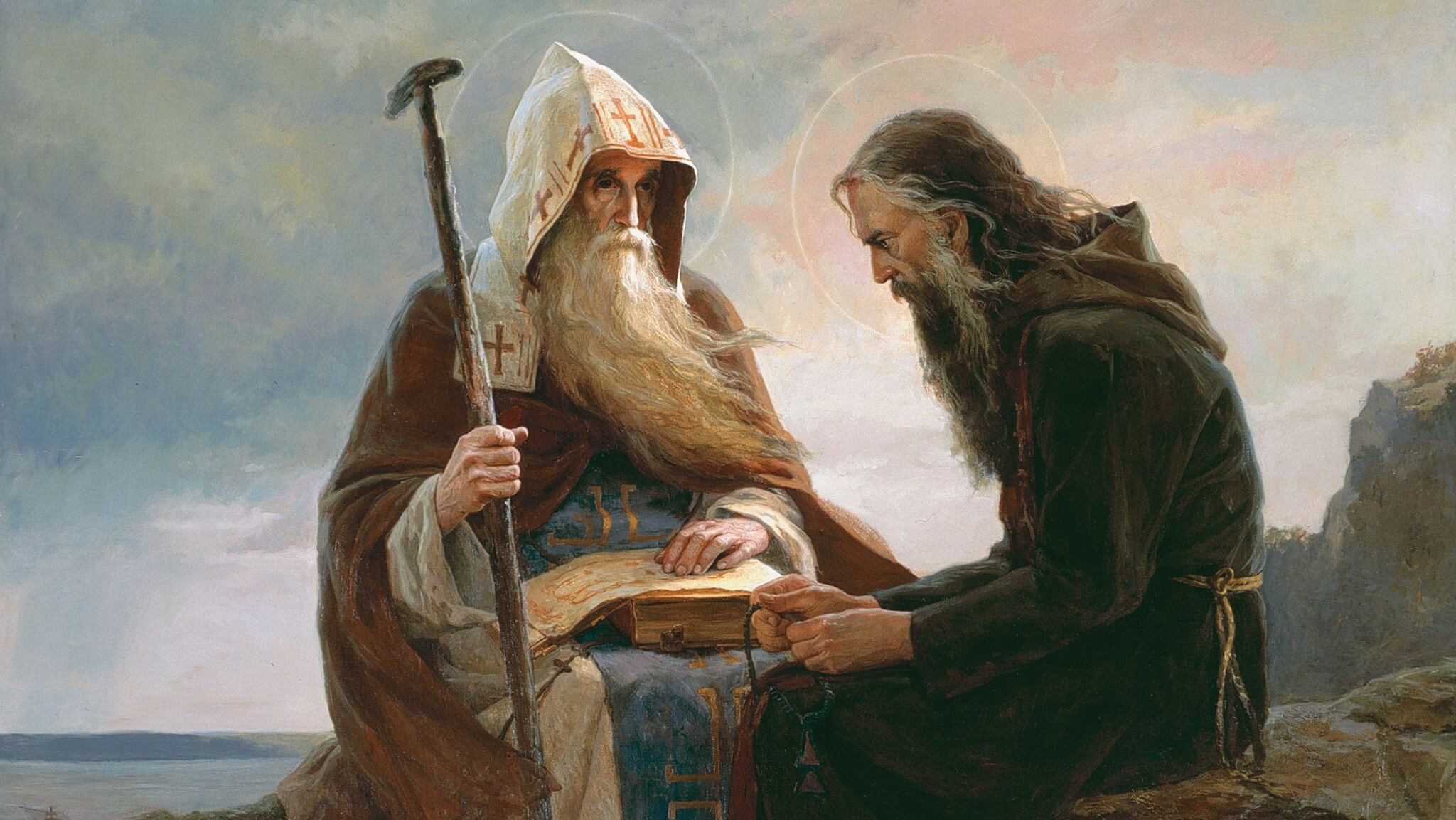
1. Evagrius as a spiritual child of the holy fathers
No one can become a spiritual father if he has not himself first been a spiritual son. This applies even to the venerable Anthony the Great — the founder of monasticism and “the first of the hermits”. It is known that before his departure into the desert he turned for spiritual counsel to an experienced ascetic who represented the ascetic tradition of the early Church which preceded the rise of monasticism as such.
Afterwards the venerable Anthony, whom even the followers of the venerable Pachomius the Great reverently called “our holy father Anthony”, regarded himself as the “father” of the young monastic communities that had arisen under his direct influence, and others too received him in that capacity. His spiritual direction of the monastic communities was carried out not only through oral instruction but by means of written contacts, to which the seven genuine letters of the venerable one that have come down to us bear witness.
In the teaching of Evagrius Ponticus on spiritual fatherhood this particular type of the spirituality of “the first of the hermits” is set out in detail. The aim of Evagrius, as he himself wrote of it, was to convey as faithfully as possible the teaching of the elders, at least so much of it as can be communicated to others.
As for Evagrius himself, he was an educated Greek, fully at home in the philosophical and theological culture of his time. In mature years he entered the school of the great spiritual instructors of Egyptian monasticism and from about the year 383 lived and wrote in the Nitrian desert, and afterwards in the more remote Cells. Among his instructors were both of the Macarii. And Macarius of Egypt (the Great), who had still known the venerable Anthony and was renowned as “the heir of the grace-filled power and spiritual perfection of the blessed Anthony”, Evagrius to the end of his life considered his chief spiritual teacher, honouring him equally with St Gregory the Theologian — his former instructor in “the higher love of wisdom”.
It is notable that the desert fathers were often simple Copts and had no Greek education. Thus there was a link between two worlds only at first sight opposed to each other — the Coptic and the Graeco-Roman. This harmonious and undoubtedly fruitful link was a characteristic feature of the Egyptian monasticism of those times (above all in its eremitic form). This link was even traditional. As examples one may mention the venerable Anthony the Great, a man “unlearned” in the sense of Greek culture, and his beloved disciple the venerable Serapion, afterwards bishop of Thmuis, one of the most learned men of his time. Or, in the following generation, abba Pambo, who could not even read, and his disciple Ammonius the Tall, whom his contemporaries praised for his wide theological and biblical learning.
Evagrius soon became a true abba — an instructor whom many valued and whose company they sought. Yet to the end of his life he remained an obedient disciple of the elders of the desert. So that even in the decline of his life he confessed that St Gregory, in the apostle's word, had once “planted” him, and that now the holy fathers “water” him in the desert with their instructions.
Of these Evagrius names by name the venerable Anthony the Great, with whose life and seven genuine letters he was evidently well acquainted, the venerable Macarius of Egypt and Macarius of Alexandria, Didymus the Blind, the venerable John of Lycopolis and John Kolobos, and also the venerable Theodore the Sanctified. From the “Lausiac History” one may add to this list the venerable Ammonius the Tall, whose ascetic virtues Evagrius admired, and the deacon Albinus, known for his meekness, and from the “Sayings of the Desert Fathers” — the venerable Arsenius the Great.
2. Evagrius as an abba
A living picture of the activity of Evagrius as a spiritual father has been left us by his disciple, Palladius, bishop of Helenopolis:
Such was his custom: the brethren gathered at his place on Saturdays and Sundays. All night they opened their thoughts to him. Until the rising of the dawn they listened to his words, filled with power, and they went away filled with joy, giving thanks to God, for truly his teaching was meek.
When all had already assembled, he would entreat them: “My brothers, if any one of you has a deep or a sick thought, let him be silent until the other brethren have gone, and then he will freely put his questions in private. Let us not speak before the brethren, lest any of these little ones perish or lest the pain of the heart swallow anyone up.”
Of his exceptional hospitality the fact speaks that every day he received five or six guests in his cell.
Palladius bears witness also to this, that Evagrius was granted the gift of the discernment of spirits. This meant not only exact knowledge of the working of the demons and of the passions that correspond to them, but also the discernment of truth and falsehood in matters of faith. Moreover he possessed the gift of wonderworking, to which, besides “signs” such as the opening of a locked door by the sign of the cross (in the case of the lost key), belongs also the uprooting of a false way of thinking in his spiritual children.
3. Spiritual fatherhood: the general outline
A spiritual father is above all a man who has devoted many years to asceticism, that is, to the fulfilment of the commandments. The foremost virtue of such a man is love. According to Evagrius, genuine love always takes a concrete form, showing itself as meekness. Meek, by the witness of Holy Scripture, were Moses, David and Christ Himself. These three great images give ground for asserting that meekness is that form of love which constrains the one who possesses it not to lord it over another man but to grant him room for his own being, even if this be through self-sacrifice.
Love filled with meekness is not only “the limit of practice” but also “the door into natural knowledge”, while the proper aim of such love is “the knowledge of God”. “Knowledge” and “wisdom” are gifts of the Holy Spirit, which Evagrius therefore always calls spiritual: God sends them down only to those whom He finds worthy of them.
The very fact that what is in question is an unsearchable gift of the Holy Spirit says clearly enough that the spiritual father, as Evagrius understands him, acts in no way in his own name. He merely occupies a certain place in that God-directed human history which we call the history of salvation.
4. Christ as father and spiritual fatherhood
The custom of calling Christ father, foreign to the modern mind, was widespread in the ancient Church. Evagrius too mentions it: “It is not children who should lay up goods for their parents, but parents for their children. And since you are fathers, imitate the father Christ and feed us with barley bread, teaching us the correction of manners. Bear with our coarseness until we are delivered from beast-like manners and are made worthy of that spiritual ‘bread' which comes down from heaven and feeds all rational beings according to the measure of their state.”
In another place Evagrius says, having spiritual instructors in view: “It befits fathers to teach their sons virtue and the knowledge of God, and the Lord to send down wisdom to their children.”
The spiritual father does not himself “beget” his children in the proper sense — this is accomplished by the action of that grace of God of which he is the bearer. It is that grace which “has power to beget many through virtue and the knowledge of God”.
Thus in the ministry of the spiritual father the heavenly fatherhood of Christ is made manifest among men. For it is to the spiritual father first of all that the words of the apostle Paul apply: “I live; yet not I, but Christ liveth in me”. The spiritual son in his turn lives through this fatherhood of Christ by experience, submitting in obedience to the directions of his spiritual father.
5. Meekness
Meekness is in the highest degree a kingly virtue. Holy Scripture calls meek only Christ and His Old Testament prefigurations — the prophets Moses and David. Meekness is the virtue of the righteous man who is ready to stand up for another, forgetting himself, even if that other has grievously sinned, as did the people of Israel when they fell away from God during their wandering in the desert. Some of the finest pages in the letters of Evagrius are devoted to this labour of the prophet Moses, whose figure serves him as a favourite example in portraying the ideal of meekness.
Tell me, why does Scripture, wishing to praise Moses, take no account of all the miracles [he worked], mentioning only his meekness? For it does not say [in doing so] that Moses subjected the Egyptians to punishment by twelve plagues and that he led the chosen people out of Egypt... But it says that he stood alone in the desert before the face of God, when God wished to destroy the people of Israel, and prayed that he himself might be destroyed together with the sons of his people. He set before God love for man and the transgression [of the commandment], saying: Forgive them their sin, and if not, blot me also out of Thy book, which Thou hast written. Thus spoke this man meek in disposition. And God chose rather to forgive those who had sinned than to deal unjustly with Moses.
Scripture passes over the famous feeding [of the people] with manna and the unexpected coming of the quails, [passes over] the fasting of Moses that surpassed human nature… but praises only this, that Moses was a man meeker than all men.
Mindful of this virtue, David too cried out to God, saying: Lord, remember David, and all his meekness (Brenton's English Septuagint, 1851). [He mentions] not that his knees were weakened through fasting and his flesh wasted for [lack of] oil, and not that he was like a lonely bird upon the housetop, but says: Lord, remember David, and all his meekness.
Let us then imitate this meekness, so that He who said: Learn of me; for I am meek and lowly in heart, may teach us His ways and lead us to salvation.
After this praise it becomes clear why Evagrius says that no virtue makes the mind so receptive to knowledge as meekness does.
6. Teacher and physician
The spiritual father is physician and teacher in one person, after the image of Christ, whom Evagrius often calls “the Physician of souls”. It is the spiritual father who knows as no one else “what medicines lead from evil to virtue and from ignorance to knowledge”.
The medicines are the means of practical asceticism: “fasting, thirst, vigil, withdrawal from the world of men, and prayer”. By their help the passions of desire and of anger are cleansed and healed. Sometimes, however, Christ, as “the Physician of souls”, has recourse to stronger means also, such as humiliations and insults, which Evagrius himself experienced at the hands of his own instructors.
In this way the spiritual father takes part in the life of the individual man, becoming like a personal guardian angel, and his angel-like activity is not limited to “this age” but continues in “the age to come” as well.
7. Tact in spiritual matters
Instruction must be measured to what the disciple can contain. One cannot entrust anything whatever to the first comer. In this respect Evagrius is particularly strict. “The mysteries of God” remain inaccessible not only to those who are sunk in coarse passions; they will remain hidden for ever also from those who try to master them only by the “outward wisdom” of this world and by dialectic: “The Kingdom of Heaven does not require a soul skilled in dialectic, it requires a soul that contemplates.”
Those things of which one may not speak with everyone and not at all times must be the subject of reflection alone with oneself, Evagrius advises, and likewise in the circle of those “who have been granted knowledge”.
8. True knowledge
For Evagrius there is no “true knowledge” which does not rest upon “right faith” — upon “right faith in the Holy Trinity”, as he makes precise. This right faith, which the true contemplative must nurture in his disciples by means of “spiritual teaching”, is, as the apostle Paul says, that very precious “good thing committed”. And what is extremely important — this true faith is possible only because the Holy Trinity Herself “is revealed” to the human mind, “inclines towards it as though out of mercy”.
The pillar of truth, Basil of Cappadocia, says: the knowledge that comes from men is strengthened by exercise and by the diligence of attention, while the knowledge born of the grace of God is strengthened by righteousness, freedom from malice and mercy. The first knowledge may be received even by [men] subject to passion; the second is accessible to the reception of the dispassionate alone — of those who during prayer contemplate the proper radiance of their own mind shining upon them.
Evagrius insistently exhorts us “not to theologise rashly”, that is, not to pronounce judgements about God and not to give Him definitions. A man attached to the material world is in fact unable to speak of God without the danger of erring. And he who, in spite of the imperfection of his own mind, plunges into theological problems exposes himself to the danger of saying something perverse about God and, through his own delusion, of losing “spiritual knowledge”, namely that supra-rational grace-given knowledge which is the pure gift of the Spirit.
9. Spiritual mystagogy
It is no secret that monasticism understands itself as a “second baptism” in the font of the tears of repentance. It is therefore not surprising that it worked out a kind of typology which deepens the understanding of the Christian spiritual path in this renewed state.
Thus Evagrius transfers the sacred biblical events to the level of the spiritual life, thereby setting forming the general outline of his interpretation, in which Egypt signifies evil, the desert — practice, the land of Judea — the contemplation of bodily things, Jerusalem — the contemplation of bodiless things, while the symbol of the Holy Trinity is Zion.
This symbolism, which is met with in all the writings of the Pontic monk, may if one wishes be unfolded further. Egypt, by reason of the 430-year sojourn of the chosen people in it, invariably stands as the symbol of “this world”, the world of sin, and therefore of evil. Pharaoh, who held the people in slavery, symbolises the devil. The exodus from Egypt thereby becomes an “exodus from [the state] of evil and ignorance”, while the entry into the Promised Land signifies entry into the state of knowledge (the knowledge of God and of His creation).
Only he who has successfully endured the “dwelling in the desert” can cross the “Jordan” and proceed to the second stage of the spiritual life — abiding in the sphere of knowledge or contemplation.
Thus, from the spiritual point of view, in the events of the exodus of the people of Israel from Egypt, of their forty years' wandering in the desert and, finally, of their entry into the Promised Land there is reflected the way of an ever deeper approach to the mystery of the Holy Trinity.
On this way full of dangers, as in the days of ancient Israel, guidance is needed, for the warfare with the “foreign nations” (the demons and the passions) settled in the Promised Land must be waged “knowingly”, that is, with an understanding of the essence of this complex process. As in the events of the Old Testament, such guidance is in principle taken upon Himself by God, yet He always carries it out through His servants: in the Old Testament these were the angels who went before the people under the appearance of the pillars of cloud and of fire, and besides them Moses and Aaron, and at the end of the wandering — Joshua the son of Nun.
In the age of the New Testament the guidance is again carried out by angels, namely by the personal guardian angel, then by the apostles, as for instance the apostle Paul, through whom Christ Himself speaks; and in the life of the individual Christian by the spiritual fathers, as “helpers of the angels”. By their spiritual teaching “they lead the ungodly to virtue”, and in the end to knowledge. Their angel-like ministry is a likening to Christ as father. For our Saviour, God the Word, came to send fire upon the earth, that is, His spiritual teaching, and to “burn up” evil human habits, and to “put to the test” those who are pure, so that in the end He might return to God His creation.
