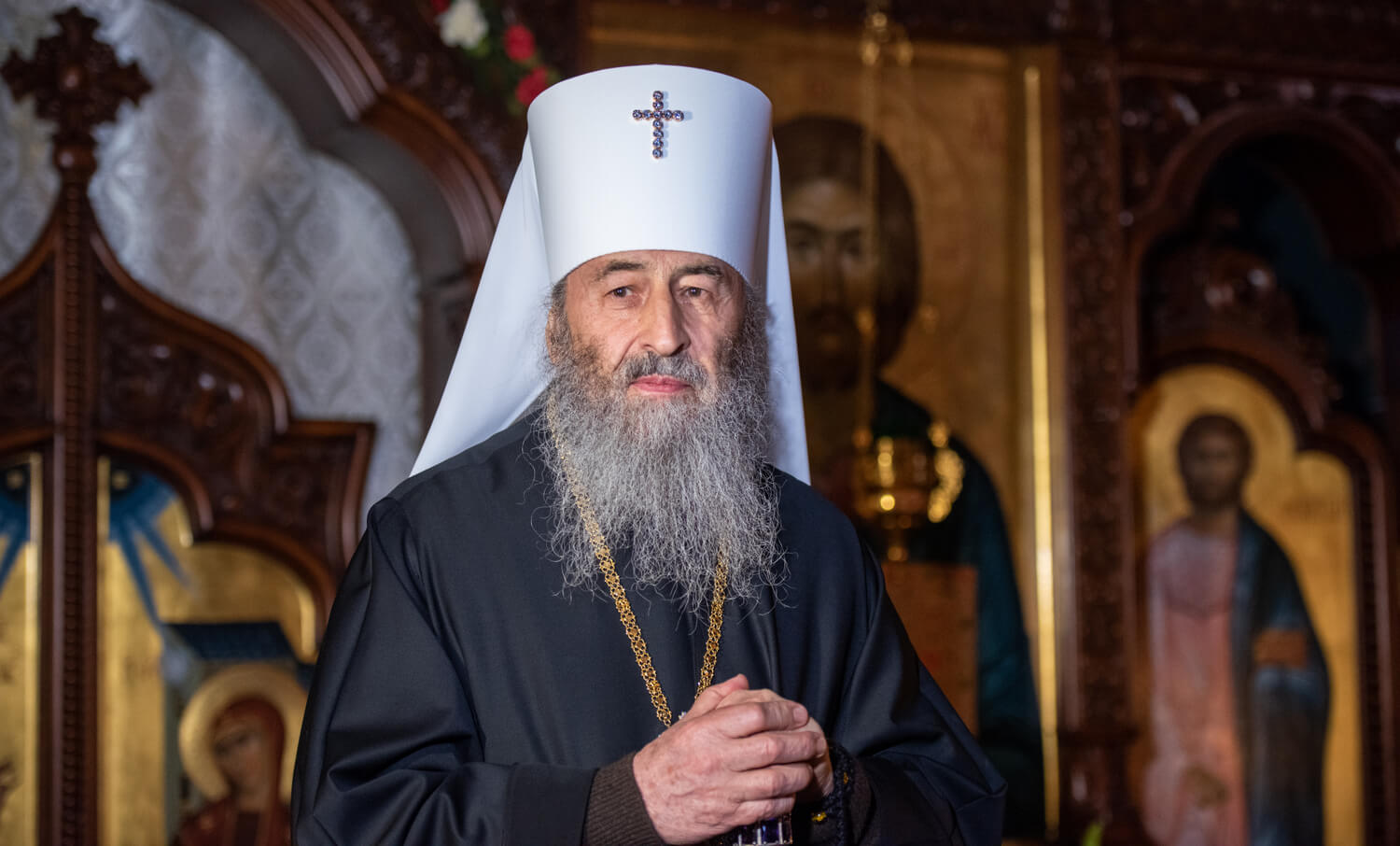
— Your Beatitude, how can one define what monasticism is?
— There are a great many answers to this. Some say that it is constant prayer. Others say that it is a fast for the whole of one's life. Others say that it is service to God and to people. Others say it is non-acquisitiveness, separation from everything: from riches, from all the treasures one can possibly have in this life. A certain venerable father was once asked: "What is monasticism?" And he answered: "Monasticism is blessedness." "Why blessedness? — the elder was asked — for monasticism sets narrow bounds and restrictions, and what blessedness can there be in so small a space?" Then the elder explained: "When a man comes to a monastery he begins his life by giving himself up to obedience, living not by his own will but heeding what the church authorities tell him. A man begins to limit himself by fasting, by prayer, by prostrations, to struggle with that old man who is in each of us." As a consequence of this struggle, which lasts not one day and not one year, there arises in a man the knowledge of who he is and Who the Lord is. A man learns by experience that without God he is nothing. This very awareness of one's own nothingness and of our complete dependence upon God is called, in spiritual language, poverty of spirit. And the Lord says: "Blessed are the poor in spirit: for theirs is the kingdom of heaven" (King James Version). That is to say, a man who receives the monastic tonsure and comes to the knowledge of his spiritual poverty proves to be not unhappy but, on the contrary, he proves to be blessed.
— Tell us, please, what you experienced during your own monastic tonsure?
— There was a feeling of baptism. It all seems simple: they took scissors, cut off the hair, well, I read out there, my vows, they read the prayers over me, and there was felt some renewal of the soul, as though I had become another man. How this is — I cannot explain it to myself logically; it is explained only by faith, for the holy fathers also call monasticism a baptism. And blessed is that monk who preserves in himself this new grace.
— Is it possible to preserve this inspiration in the monastic life, and what is to be done when it is lost amid bustle and temptations?
— When a man enters a monastery, as a rule this happens by an inspiration from the Holy Spirit. It is no merit of our nature; it is simply that Divine Grace calls a man to the monastery. But in the course of his monastic labour this inspiration, this grace, withdraws from him. The Lord does this for a man's sake because He wants us to show our own effort. If the Grace of the Holy Spirit shields us all the time, then there is no merit of ours in it. And when the Lord hides from us — He does not withdraw, He simply hides from us — then this inspiration departs from a man, disappears, and then he must show his own good efforts, he must compel himself, he must constrain himself. As a rule, a man does this very badly. When the Grace of God accomplishes any work together with a man, everything comes about beautifully and harmoniously. But when only human efforts and self-constraint are at work, then everything a man does comes out clumsy, crooked, awry. Yet God loves this crooked, even awry effort of ours, because it is ours, it is our personal sacrifice to God. And every monk must without fail pass through this period. With different monks these periods are different, but they are there without fail. And here one must not be afraid, one must not panic that the feeling and warmth of prayer is being lost, the sense of spiritual joy, that hope is being lost — everything is being lost. Here one must compel oneself to every good work, compel oneself to read spiritual books and, especially, one must force oneself to pray. Here one must work not according to feelings, not according to one's own thoughts and state, but work looking to the Law of God, looking to the Holy Fathers, who laboured all their lives and are an example for us, and we must go forward. After this period there comes for the monk his own personal Pascha. What he experiences then — read of it in the holy Fathers.
— Your Beatitude, in what do you find inspiration, and who is an example for you in the spiritual life?
— Prayer. The greatest inspiration is prayer. Prayer is the breath of the soul. If the soul breathes, it means it is alive and wants to labour and does labour. But if one does not feed oneself with prayer, then of course it goes hard with a monk. And the model of such a true monastic life for me personally was Father Archimandrite Kirill (Pavlov), who abode constantly in prayer. He prayed and bore the heavy labour of a spiritual father, that is, he constantly received people and helped them to resolve the spiritual questions of their lives. This was not missionary work in the pure sense; different people came to him: both those who had some inward questions, and people with outward problems came as well. And Father Kirill helped them all. He was a shining example of a true Christian.
— Nowadays many look to Athonite monasticism. How relevant is the possibility of a revival of the Russian monastic traditions?
— Athonite monasticism has much from which one can learn, but history itself has already placed the accents. Over the last centuries Russian monasticism has crystallised, that is, a monasticism that is readily acceptable to people who live in Rus', in our climatic zone, in our conditions. External conditions, the climate, the character of the peoples of Rus', mental particularities — these are what brought it about that Russian monasticism took shape. I think it is closer to us and that it must be revived. But something useful can and must be taken from everywhere: from the Athonites, and from Palestinian and from Egyptian monasticism. They have much from which one can learn.
— What is especially important for a monk at the present time? How is one to struggle with thoughts directed against one's neighbours?
— For all monks it is very important to reproach oneself and to teach oneself to pray. If a man acquires this, it will become the sword with which he will cut down the many tares of those enemies who war against man. Against thoughts there are two strong means: prayer and self-reproach. One must pray and rebuke oneself, reproach oneself: here, I think about such a one that he is this and that, but if I myself were not such, I would never have pinned such a label on my neighbour. If I pin a label on him that he is a fornicator, it means that I am a fornicator myself. If I pin a label on him that he is a drunkard, it means that I am a drunkard myself; or that he is a thief, it means that I am a thief. Since I think badly of a man, it means that I am certainly bad. And whether that man is bad or not — God alone knows. Therefore one must reproach oneself, persuade oneself and pray, and in prayer drive away all these thoughts. Such warfare brings peace into a monk's soul.
— How is one to overcome the temptations that come from one's neighbours?
— The warfares against us come either from the world, that is, from people, or from the dark spirits, or from ourselves. All these warfares are permitted by God. If God has permitted someone to revile us, then this must be accepted. One must look to God, Who permitted it, and not to the man. He permitted it, which means He wants us to humble ourselves. Therefore one must humble oneself, and if they have called me a thief, say: "Though I have not stolen, yet I am worse than a thief." If I am reproached for what I have not done, then one must bravely endure it and say to oneself: "Yes, I did not do this, but I am worse than the one who does it." One must reproach oneself; then these warfares will play the part they ought to play for a man's spiritual development. But if we grow embittered, indignant, condemning, then we ourselves shall wound ourselves still more. Of such it is said: "He inflicts wounds upon himself."
— How is one to feel, how is one to be assured, that one is going by the way of salvation; can one pray about this?
— Do not try to do this, there is no need. Feelings are categories that cannot be trusted. It is more correct to know and to remember that I stand condemned before God and that in my salvation I hope not in my own deeds, not in my own labours, but only in the mercy of God. To do all that is possible for me in order to keep the Commandments of God. Of course, we shall not fulfil everything as it ought to be fulfilled, but even if someone fulfils all God's commandments to perfection, he must all the same say: "Lord, I am Thy servant and I have done what I ought to have done. Forgive me, Lord, and grant to me, the unworthy, that grace and strength which brings a man into Paradise." This saving grace is a special gift of God, for which all must entreat God: both those who live holily upon the earth and those who cannot yet conquer sin.
— How is one rightly to discern the will of God?
— The will of God is known by several ways: there is the way of knowing the will of God through a spiritual father. And it happens that a certain measure of spiritual perfection is already in a man, and he asks this will of God himself in prayer, as Saint Silouan the Athonite prayed and God revealed it to him. But this is not revelation in the literal sense, that God appeared to him every time and said: "Do this and that." Those with experience can tell what is from God, what is from the flesh, and what is from the devil. But a question arises: what are we, the inexperienced, to do if we find ourselves in a difficult position and want to act according to the will of God? We, the weak and inexperienced, must likewise make the choice of God's will through prayer, that is, pray as we are able. Even in that confused state in which we are, we must ask: "Lord, Thou Thyself knowest how", and God guides. So it happens that there are not even any clear thoughts, and yet God so directs that in a moment — and it is done rightly. God knows how to do this.
— What is Christian freedom? Can a monk, a Christian, have despair?
— Christian freedom is freedom from sin. This is the truest freedom of all. But that freedom which is preached today from television screens is the freedom of sin; it works to subject man to sin. Christ came to earth in order to show man the true field of his life, the bounds of his activity. If a man is in the middle of this field, he is free. If he goes beyond the limits of this field, then he is already a slave of sin. And the consequence of sin is unbelief, despair. Despair is a spiritual paralysis, that is, that state of the soul which leads a man to death. If a man submits to despair, he becomes a spiritual paralytic. The feeling of despair can come at times to every monk, to every man. God permits it so that we may see for ourselves how unlovely and hideous spiritual death is. But the Lord permits despair to a man according to the measure of that man's spiritual level. And the Lord wants a man to struggle with despair, not to listen to and not to believe those thoughts and feelings by which despair binds a man. If we pray, humble ourselves and labour, despair will not overcome us; and if we come to love the Lord, despair will not draw near to us.
— How is a monk to preserve peace of soul and sobriety in the modern flood of information?
— Today far too much information comes crashing down upon a man. In this information there is something positive, but more that is negative. A man, by reason of his position, his obedience, has to acquaint himself with certain things, to pass a certain amount of information through himself. Some, out of curiosity, try to pass everything through themselves. This greatly disorders a man: imagine that a clean man has passed a portion of filth through himself; it all the same remains on the walls of the human soul. In order to safeguard oneself from this influence of information, so far as that is possible for a man, one must form in oneself a Christian spirit; one must without fail pray, one must without fail read Holy Scripture and the Holy Fathers. And these sound teachings enlighten, illumine the human mind, and it acquires the capacity to judge more rightly the information it receives. For there is information that speaks plainly and clearly: "This is good and this is evil." But there is another kind, more subtle, in which evil is presented in such a form that you cannot properly recognise it: some specious pretexts, some slogans, appeals, to all appearance highly spiritual, while within, evil is hidden there. When a man has a mind enlightened by prayer, by Holy Scripture and by the Holy Fathers — he senses this evil, he does not accept it. It is this mind that one must form in oneself. The chief thing, even for a missionary, is not information but prayer. And if one dissolves everything in prayer, information included, then perhaps we shall somewhere admit a certain gap in our information, and it will not hinder us. If you have a gap in your information for the sake of prayer, and if you are asked about the essence of the matter, then you, not knowing the information, will answer better than if you had known it.
— Today both in the world and in Ukraine in particular there are church moods, pharisaism, legalism; all this drives people away from the Church and leads to disillusionment. Your Beatitude, how do you strengthen people in a time so difficult for Ukraine?
— Each will answer for himself. Of course, a man always wants to see an example. Well, if God gives one, look at him, imitate him; and if He does not give an example, there is the Gospel, there are the Holy Fathers — this is the example we must follow. I do not strengthen — God strengthens a man. We must try to direct a man towards God, to turn him to God. For this we first look at the state a man is in. If he is going towards God, he must be supported, helped in this labour. If he has turned away from God — by 180 degrees or less — he must be turned back, directed and told: "Go that way." And we are only like signposts. In the spiritual life there are no prepared templates. But God gives wisdom in every case. A man comes, and something must be answered to his question. And the chief substance of all answers — the common thing that all answers pursue, what all spiritual fathers must strive for — is to kindle in a man hope in the Mercy of God, so as to lead him away from despondency, from a falling of spirit. People often lose hope; this is the most terrible thing for a man. He becomes a paralytic. But if hope rises again in a man, then little by little he gets up and begins to live.
— How is it possible for a monk to stand fast, to keep himself from unbelief in this time? How is he to make himself love his neighbour?
— When a monk, like any man, loves his neighbour with a Divine love, that is, when his love for his neighbour bears the likeness of love for God, then this man loves with a sacrificial love. Sacrificial love is that love which only gives, when we expect nothing in return, and upon this love the world exists. How can we know that we love our neighbour? The Lord says: a man must love his neighbour as himself. That is, if I have some dispute with my neighbour, some unpleasantness, and want to do something to him, then I must put myself in his place and him in mine. And ask myself the question: "How would I want to be treated in this position?" Just as I would want it to be done to me, so must I do to my neighbour. In earthly life there exist the laws of human decency, of human vengeance. The most just human vengeance is an eye for an eye and a tooth for a tooth. They have knocked out my eye — and I knock out an eye; they have knocked out my tooth — and I knock out a tooth. But this most just law of human vengeance increases evil twofold. If, for example, I have been struck once, the blow is some form of evil, and if I have avenged myself on him with the same blow, then I have already made one more form of evil, which means that evil has increased twofold. That is, the most just human vengeance multiplies evil twofold. But when I have endured, that is, have not struck back, then I have stopped the evil. And when I have been struck and instead of that have done good to the man, then I destroy the evil. So human just vengeance multiplies evil twofold, patience stops it, and love destroys it. We must, dear brothers and sisters, try in our lives at least to bear with one another, if we cannot love. And this will already be a good for us, for the Lord said: "In your patience possess ye your souls" (Luke 21:19, King James Version).
Prepared by Archimandrite Pafnutii (Musiienko)
