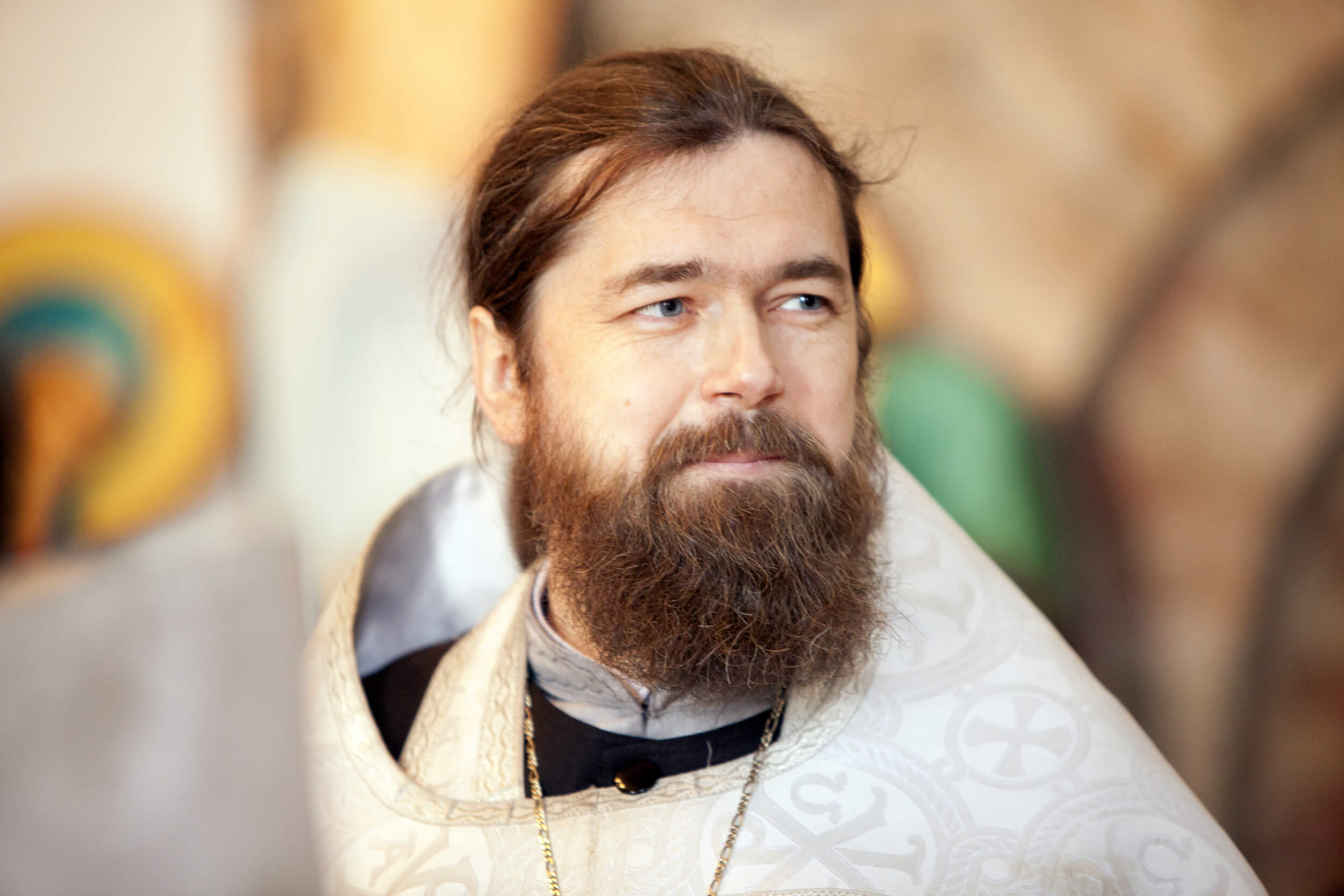
Childhood and youth
Vitaliy Chernukha spent his childhood in a military settlement in the city of Rivne, though he was born at quite the other end of the Soviet Union — in the city of Ussuriysk. Naturally, moving house was an ordinary matter for a major's family. It added to the household a shade of striving towards the unknown, with a thirst for new achievements. At any rate, it was in such a burst that Grigoriy Mikhaylovich would often wake his son: "get up, sir, great deeds await you!" And how else, since Vitalik had been named after the Komsomol hero Vitaliy Bonevur. In general, one could have painted the portrait of a typical Soviet family cell from the Chernukha household — father a soldier, mother a teacher. And judging by how richly Vitalik was gifted with tenderness, gentleness and an incredible delicacy, all of that must certainly have been there in the family too.
This wonderful world, however, somehow collapsed all at once. Vitalik was only 11 when his mother fell ill, after which she hardly ever left hospital. Over the years the illness wore her down so badly that she stopped recognising her own son. His father withdrew into himself — those familiar with the twilight of the Soviet era know well how that usually ended. And since his elder sister was by then already living with her husband in Germany, Vitalik was left practically alone.
There was, though, one more old woman, Olga. She once saw Vitalik on a trolleybus and, perhaps out of pity, invited him home, gave him tea and helped him for many years: she sent "parcels" both to Dubno, while Vitaliy was studying at the local teacher-training college, and to Kyiv, when he was already a seminarian. His own home gradually slipped into the background, until it left his life altogether… Even so, it was the city of Rivne, or rather an event that took place there, that proved in many ways decisive for Vitalik.
Out of the embrace of atheism…
A person may call himself an atheist and yet, quite without noticing it, come step by step closer to faith. And equally the other way round — he may consider himself a believer while slipping swiftly into the abyss of unbelief. The first of these was close to Vitaliy. And indeed, the way he came to faith may seem in some things very familiar. There is the secret baptism, when his grandmother took her four-year-old grandson to church early in the morning so that his parents would not notice. And the Young Pioneer zeal, with indignation at why on earth his grandmother had done it. And the unanimous condemnation of one of the pupils for believing in God. And the fierce arguments, at college by then, that there is no God and cannot be. And an utterly sudden illumination.
Vitaliy was 18 at the time. He was a primary-school teacher at Rivne School No. 27. It was the after-school hour, the children had run outside, and he had stayed behind in the classroom to finish drawing up the registers. And then, as Father Longin himself recalled: "The children came running to me with frightened faces and told me that one of the boys had fallen off the swing and was not breathing. I tore off, I run up, I look — the child, thank God, is alive, but he turned out to have a serious head injury. My colleagues at the after-school class ask me: 'When did you last receive Communion?' I say: 'Never.' 'But are you even baptised or not?' I answer: 'Well, yes, I am baptised.' 'Then off to church with you, at the double!'… I prayed as it came out in me. As best I could. Of course, not knowing much, and perhaps even breaking the order established in the Church, but all the same I came to confession and then came to the Chalice and received Communion. When I got back from church I telephoned the hospital, and they told me that the child had regained consciousness and had been moved to neurosurgery. And a month later, by God's mercy, he was back at school for his lessons. There, from the moment of that tragedy I was simply afraid not to go to church."
It is hard to understand what kind of magic works upon a soul that has come to know God. Seized by heavenliness, it is ready, like a woman in love, to do anything for the Beloved. Here there is poetry too. Yes, it is at just this moment that a wonderful quatrain is born in Vitaliy:
And in this world we are not by chance,We live to please God,To love Him and to believe the mystery,Acquiring the grace of the Spirit.
Here too there is the impossibility of living as before.
Every believer knows that feeling at least once, yet few venture to go further. The fear of losing what has already been gained, of breaking off old ties and giving oneself up to the unknown, stops many. But with Vitalik it was otherwise…
At the gates of the Lavra
At that same time the UOC itself was going through a decisive trial. In May 1992 the Ukrainian bishops at the Kharkiv Council of Bishops resolved to elect a new Primate in place of Metropolitan Filaret (Denysenko), who had thoroughly discredited himself. The latter, however, had plans of his own. Having secured the support of fighters from the ultra-nationalist UNA-UNSO, he decided to take back by force the power he had lost. About two hundred thugs led by Dmytro Korchynskyi, and under the cover of the police, tried to storm the Kyiv-Pechersk Lavra. On the night of 18 to 19 June they ransack the superior's house and demand the keys of every church and building in the Lavra. The unarmed monks sound the alarm bell, gather the people and call in the OMON riot police, who detain both the fighters and the police who had been covering them. The reinforced watch in the monastery went on for more than a day. And there, at the lower gates of the Lavra, by the wells, a slight young man is trying to defend the holy place. His name for the moment is still Vitaliy, but very little time will pass before he is called Longin, after the Gatekeeper of the Caves… And then he and his new friends read prayers together, while their thoughts are on entering the seminary. For where else can one slake the thirst to know so boundless a world as Christianity, if not among others just as young and just as thirsty.
The seminary
The entrance examinations went well for Vitaliy, though not without some bewilderment: "How can this be? We are enrolling in order to gain knowledge, and here the demands are such that it seems we have come not to learn but simply to repeat." It has to be said that the 1992 intake was a special one. The scale of the missionary work that his classmates Vitaliy Chernukha, Andrey Tkachev and Sergey Hovorun managed in time to unfold is quite astounding. Doors opened easily before them into university lecture halls, onto public television, into the editorial offices of secular magazines and newspapers, to say nothing of the Church media. Each, of course, chose his own road in the end, but at the beginning they were one family of friends.
If one tries to answer the question of what lay behind such success and how it is to be achieved (for since then, to be honest, nothing of the kind has been repeated within the walls of the theological schools), then several things must be noted: their closeness, which is precisely Vitalik Chernukha's doing, as we shall yet see — for the moment let us only note that he was one of those people for whose sake it is worth entering a seminary; the off-the-scale hunger for knowledge in every one of the lads; and, of course, the teachers' support for all their undertakings. Incidentally, it was just in this period that Father Viktor Smakouz (now Bishop Iov) was among the teachers. It was he who organised a Sunday school for adults and children within the seminary walls, so that the best of the students could there and then perform the feat of a small but real missionary work.
It goes without saying that Vitalik Chernukha too was drawn into this work. And that at the same time he was also carrying out the obediences of librarian and assistant to the secretary of the correspondence department.
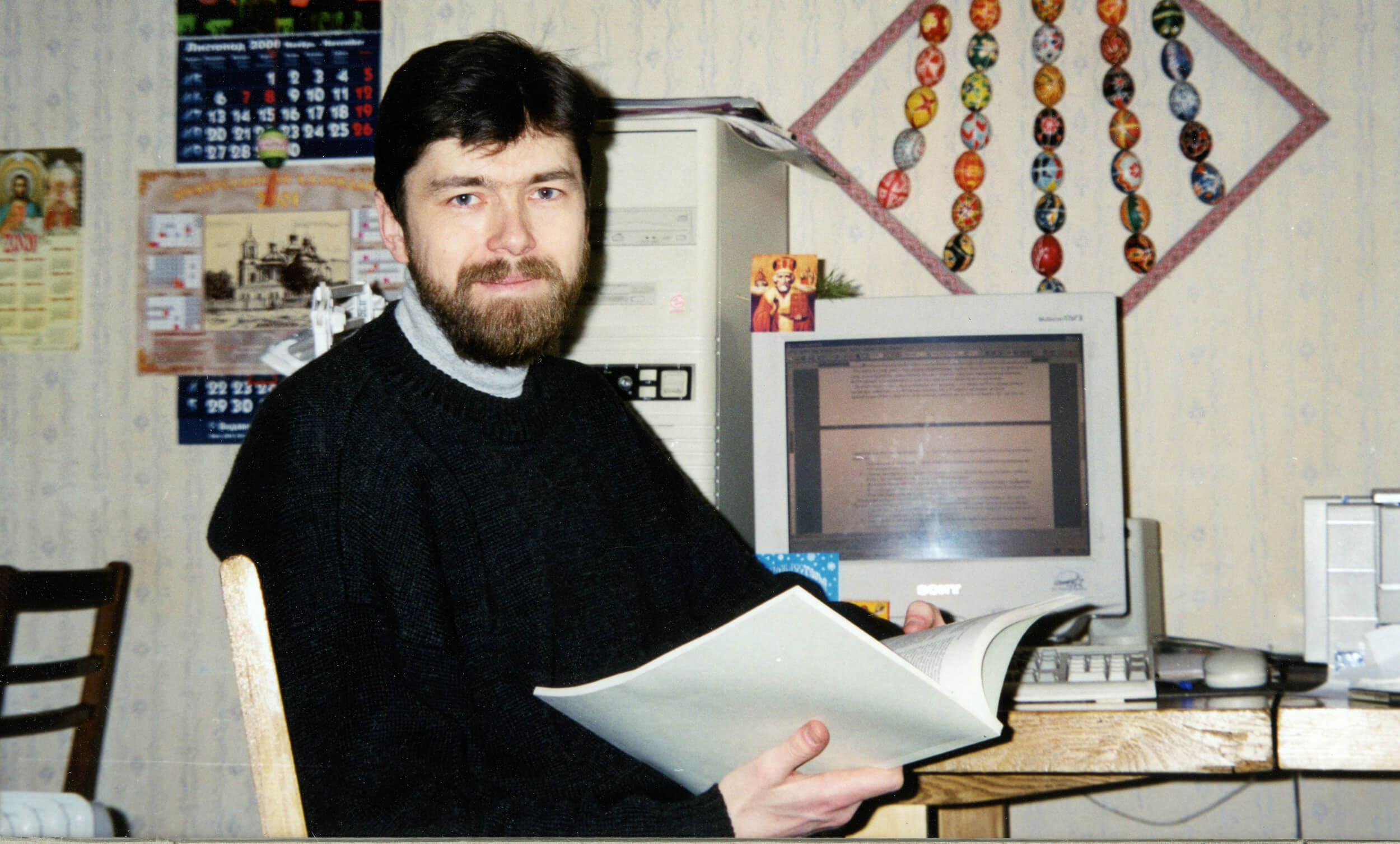
The Sunday school
One of the signs of a fine person is the ability to talk with children. More exactly, to be "one of their own" to them. And in essence, to be grown-up and at the same time an absolute child. Perhaps it is in this childlikeness that the meaning of the divine call to "become as little children" is revealed. At any rate the very touch of the world of childhood, as Vasily Rozanov writes of it, "scrapes off the grown-up his worn old rind, and so cleans the man out from under the citizen".
Vitaliy was literally covered in children. And the secret was not only in his radiant smile. Even without it he was extraordinarily interesting. He could draw, he wrote poems, he loved and understood music, played the piano and the guitar himself and gladly taught others. As Vitaliy's close friend Mykola Lysenko later recalled, his love for children was a very active one, and it passed through his heart in several astonishing episodes, about which a film could certainly be made. "Just picture it: winter, Dubno, a 15-year-old boy is coming home, and something pushes him to go not by the usual road from school but through some yards: to come down to the river…, strangely, a dog is running round an ice hole, something has happened, his heart lurched, he came closer and saw that under the ice there is a little girl — she is drowning. The ice is thin. There is every chance of going through. But he crawls carefully up to the child and pulls her out of the water, presses her to himself, tries somehow to warm her and runs several kilometres to that little girl's house, and so saves her… And all his Sunday classes were not just stories about the history of the Church, not just a catechism for grown-ups and children. No. They were that same winter run from the ice hole to the house. He had to press a person's soul to himself, warm it, tell it about God and carry it home. He had to save."
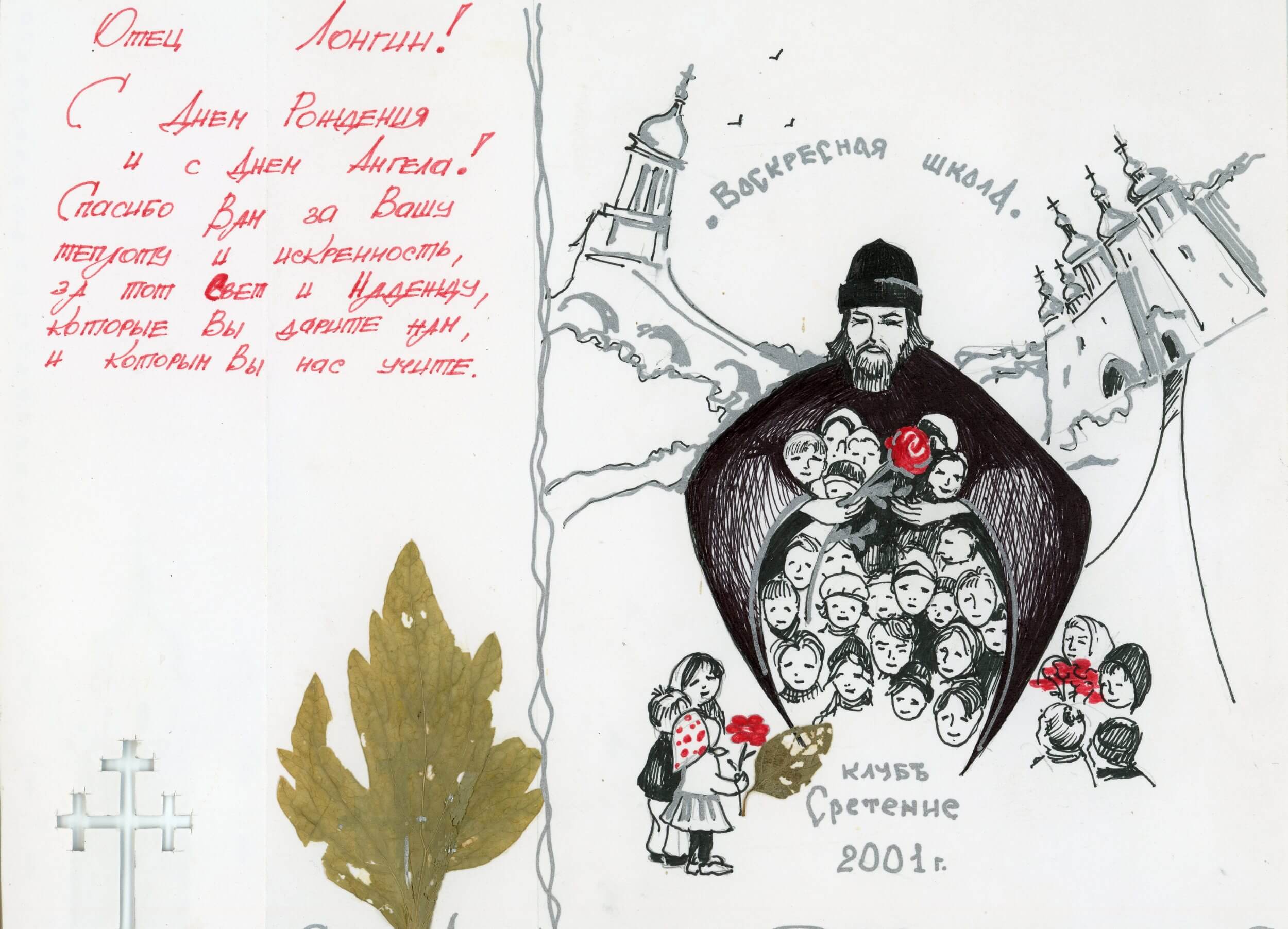
And this is a recollection of one of the pupils of that school, Kateryna Diatlova: "Our close little group of young people liked to stay behind after the classes and simply talk over tea. The life and soul of the company was always Vitaliy. There were seminarians among us, students of various institutes… There was no such broad field of information then as there is now. We drew a great deal from one another. We discussed everything most interesting that was going on around us. Vitaliy was always up with the latest in cinema. He shared his impressions with us. We used his finds in our classes with the children. We went together to the theatres, to the philharmonic… When Orthodoxy was being revived in the 90s, it often came out as a distortion in the direction of burying oneself, of not daring to rejoice, of smiling so that no teeth could be seen, and so on. But Vitaliy was genuine, he put on nothing, he was joyful… In the classes at the Sunday school for adults he might read Chekhov, then discuss what had been read together with the pupils, and they would draw their own conclusions. He loved to read the stories of Nikiforov-Volgin. He comes to the class, opens the book and does not merely read it but savours it. Then he shares what impressed him most… One day Vitalik suggested that I teach the foundations of the Orthodox faith with him at a school outside Kyiv. We went there for more than three years. I to the junior classes, he to the senior ones. On weekdays. I cannot imagine how Vitaliy managed to combine those journeys with his obediences and his studies at the seminary and the academy. I remember one occasion… We had arrived at the school early, we are standing by the classroom waiting for the break. We are talking. Vitaliy draws my attention to a display board on the wall. On it are the rules of the road. He asks: 'What parallel could be drawn in a lesson, starting from that picture?' I say: 'Well, you could compare them with the commandments. They are like a rule to be guided by. If we keep them, it will be the better for us.' He says: 'Exactly! That is how you should build your classes. Draw parallels with what everyone knows well.'"
Thoughts of monasticism
The seminary was followed by entrance to the academy. New obediences were added, new acquaintances made… By this time Vitaliy was living together with Father Tikhon. Let us note in parenthesis that when we spoke of his seminary family of friends, it certainly also included the Sofiychuk brothers, Vladyslav and Vasyl (the future Bishop Tikhon). And despite their close friendship, Vitaliy always addressed him formally. Sometimes one could see a touching scene, when Vitaliy is telling Father Tikhon off for something, and he, with the calm that was his own, answers jokingly: "Well, that is the sort of cell-attendant I have."
In 1996 Father Tikhon was appointed editor-in-chief of the publishing house of the Kyiv Metropolia. He took Vitalik along as his assistant. For the most part these were small errands, more to do with household matters, but at the same time Vitalik was trying his hand at editing and at design.
At the beginning of February 1998 Father Tikhon, together with several of the publishing house's staff, decided to travel to the island of Zalit (Pskov region) to see Father Nikolai Guryanov. He took Vitaliy with him, since Vitaliy had already more than once sent notes to the elder through the Lavra's pilgrims. One question would not leave him: to marry or to take monastic vows. He saw himself clearly as a priest, but in which rank? Among his friends in the same year it was Oleksandr Pliska who was especially taken with asceticism. He infected the others most of all with monastic aspirations. Of course this was still romanticism, and it must be said at once that there is hardly anyone who has sat on a seminary bench and not caught himself thinking about monasticism. Yet, as often happens, it is the most ardent zealots of the ascetic life who are the first to marry, which is just what happened with Oleksandr. True, Oleksandr and his chosen one came to live as brother and sister, which is far more ascetic than monasticism itself. Vitaliy was somehow more restrained in this matter. All the more so because the girls were all in love with him — and how could one not fall in love with so good-looking a teacher at the Sunday school.
As Mother Evtropia (Bobrovnikova) recalls of that journey — she was one of the publishing house's staff and was travelling to Nikolai Guryanov with a similar question: "when Vitaliy came up to the elder and asked, 'What is your blessing: to marry or monasticism?', he heard in reply: 'I cannot bless you to marry, because you will bear a grudge against me… but monasticism is a good thing.'… That answer did not console Vitaliy at all. On the way back such a struggle came over him that in the heat of it he even said, 'That is it, I am getting married!' But the story did not end there. At that time there lived at the Florivsky Monastery a holy fool, Valentin (who in time took monastic vows with the name Yermil). Out of the blue he came up to me and asks, 'And who did you go to Father Nikolai with?' I say: 'Well, with Father Tikhon,' 'And who else?' — 'Well, Tatiana was there too,' 'And who else?' — 'There was one more student…' 'Ah, a student!' said Valentin with an undertone, 'Then give this student a message…' and then came the fool-for-Christ's speech that not everyone could follow, which translated into plain language meant: do not marry. I passed on to Vitalik exactly what the holy fool had said. There was something personal in those words too, at which he was strangely taken aback and even said: 'And this is what I have been afraid of since childhood…'"
But even after that the doubts would not go away. He wanted to speak with the holy fool directly, but it was not so simple, and it came about only several years later, when Vitaliy was already a monk. For now he went to see his favourite teacher, Bishop Iov, who by then was in Kherson. The bishop, however, did not advise him at all and only assured him that he would pray. Remarkably, only a day later Vitaliy came running to the publishing department on wings. It turned out that the Lavra's dean, who was also a teacher at the seminary, Father Iriney (Semko), had summoned him and, without asking anything, told him to write a petition to join the brotherhood.
Work at the seminary
Vitaliy regarded Father Iriney as more than a teacher. The dean entrusted him with the keys of his cell, and Vitaliy and his friends often came there. Even so, after finishing the academy — by then it was 1999 — Vitaliy decided not to part with the theological school just yet and to stay on here as a teacher. It is easy to guess that his main subject was pedagogy (in the academy course he also lectured on psychology).
More than one of Father Longin's pupils lives among the present-day brotherhood of the Lavra. Without exaggeration — for Hierodeacon David (Semenchuk) at any rate, then still the seminarian Kirill — these were the best classes in the whole curriculum. It is not clear why, but one wanted to prepare for Father Longin's lessons, although he never made anyone do so and never even asked. Only at the last class would Father Longin suggest writing down what had stayed in the memory most from all the material covered, after which each pupil gave himself his own mark for the year. Such was his perfect trust in every student without exception. Perhaps the success of the teaching process depends in great part on just this… And there was a joke going round the seminary corridors that if you do not know the works of Chekhov, you had better not turn up to Father Longin's examination.
As a teacher, Vitaliy Grigorovich was given a room on the first floor of Block 60, next to Father Aristarkh (Lebedev). It had once been a single cell, but for lack of space it had had to be divided by a brick wall along the diagonal, so that two adjoining triangles came of it. It is no wonder that Vitaliy Grigorovich called his own half "the Bermuda triangle". The cell itself was on the first floor, directly above the boiler room. Once the heating season began it was so hot there that on one occasion, when Vitaliy decided to redecorate and set about hanging wallpaper, the paper not only dried out at once, before it could properly take to the wall, but literally the next day the whole lot fell off. And when a canopy was built over the way down into the boiler room, the luckless cell lost a great part of its light and air, since the window vent would no longer open fully. But the troubles did not end there. When the radiator water had to be drained on the floor above, the far end of the hose was accidentally aimed straight into that unhappy vent… All of this was discovered only when the water in the "Bermuda triangle" was ankle-deep.
And here is how Father Lukian (Korshunov), who visited his teacher and friend at the moment of the flood, recalls it: "Vitaliy, rather downcast, sat down on the bed and began to enumerate: '1. The cell is a "Bermuda" triangle", 2. There is no light, 3. The wallpaper has fallen off, 4. There is no life at all…', — and then, with a face lit up, he comes out with — 'I think I shall go to the monastery.' 'Where?', —I ask — 'To the Lavra.' 'To the Lavra?', — I say in surprise, for the Lavra at that time was not renowned for a strict keeping of the rule, whereas we often dreamed of monastic feats, of asceticism… 'And why not, it is not the place that saves. Besides, what is hidden, and therefore most precious, is not so easily seen. In the summer I was here on obedience, and I would never have thought that there were so many people in the Lavra striving spiritually, from whom there really is something to learn.'"
In the summer, when the students went off home, Vitaliy stayed in the Lavra — he had nowhere to go. Here he came to know the Lavra brotherhood more closely, and what he wanted was not so much an academic monasticism as this, a somewhat more natural one.
In the monastic family
As soon as Vitaliy Grigorovich had written his petition to join the brotherhood (4 April 2001), he was at once put in charge of the Lavra's printing house. It was then in the basement of Block 60, not far from the boiler room already known to us.
Life spun on faster still. In that same month came both his tonsure as a rassophore monk and his ordination to the diaconate. New obediences were added one after another — in time Father Longin was supervising the work of the Lavra's publishing house, its official website, its photographic studio and even its documentary film studio. Because of such a load the school for adults, which by then also lay on the young monk's shoulders, had to be entrusted to Archimandrite Aristarkh. That school, as it happens, grew in time into the Orthodox Catechetical Courses that exist to this day.
The printing house, however, remained his main field of work. The first thing produced there was a series of little books about the sacraments and rites of the Church, after which guidebooks, photograph albums and calendars began to appear...
The time of his monastic tonsure was drawing near. Father Longin decided to visit the family of his elder sister Lilya. He stayed a while, helped as always with the chores and left. And then, as Lilya herself recalls, "he suddenly comes back and says: 'Lilya, you know, this time I could not get to the train quickly, though before I always managed it… Let us have a talk. Just now, when I found myself by the wood and there was no one about, I began to wonder why that should be. Probably because I have not told you that I am going to take monastic vows,' — And I was not yet churched, and I say: 'How can that be? And what is it, and why monasticism? What about our family line and its continuing?' And he says to me then: 'Lilya, a family line has to be prayed for above all. And a family — that is a monastery…'"
On 3 April 2003, in the cave church of the Venerable Anthony, the monastic tonsure took place. The name was not changed, but his heavenly patron was now the Venerable Longin, Gatekeeper of the Caves. (It is curious that an aunt on his mother's side, who lived in Poland, was also called Longina.) "I felt a kind of inward trembling," Father Longin recalled, "as though I still could not take in fully what was happening to me. Can this really be happening to me!.. For all that I tried to follow those prayers, that order of the monastic tonsure, tried to pray, still, perhaps on the level of thought a struggle was going on and a multitude of thoughts of every sort were rushing past. Somewhere there may even have been a doubt — shall I be able to bear it? On the other hand, there was the answer at once, that everything is in God's hands."
In the evenings Father Longin liked to withdraw to his office on the second floor of Block 39. There he could be found and talked to. And once, in one of those conversations, he said: "It is as though we are in a state of schizophrenia — we think one thing and do another"... It seems that this is not about duplicity at all, but about something peculiar to a monastery. For two things are always very important here. First, the law and the traditions by which a monastery lives; second, and more important, love. Law and tradition, so as to know how to act; and love, so as to know the moments when those laws and traditions may be broken. And so it turns out that the more love there is in a monk, the more of this "schizophrenia" there is in him.
Children's stories, and not only
"A fairy tale is a wonderful literary bridge… a child reads it and a grown-up writes it, that is, it occupies them both and makes them kin to one another." These words of Vasily Rozanov convey with perfect accuracy the "Longin" attachment to children. It went nowhere even after he took monastic vows, though in some things there were changes. In the monastery, for instance, it was noticed that Longin was becoming somehow more careful and less talkative. But that change did not touch the children.
"Before stepping onto the monastic path," the father recalls, "I thought about the fact that I would no longer be able to have a family of my own, would not be able to have children of my own. Those thoughts were not always of one kind. But as of today (a year after the tonsure — Ed.), I feel no defect or lack in having no children of my own… I have to be with children in any case in our Sunday school. That being together very often brings joy, when you see that the seeds of faith you have put into a child's soul begin in time to sprout."
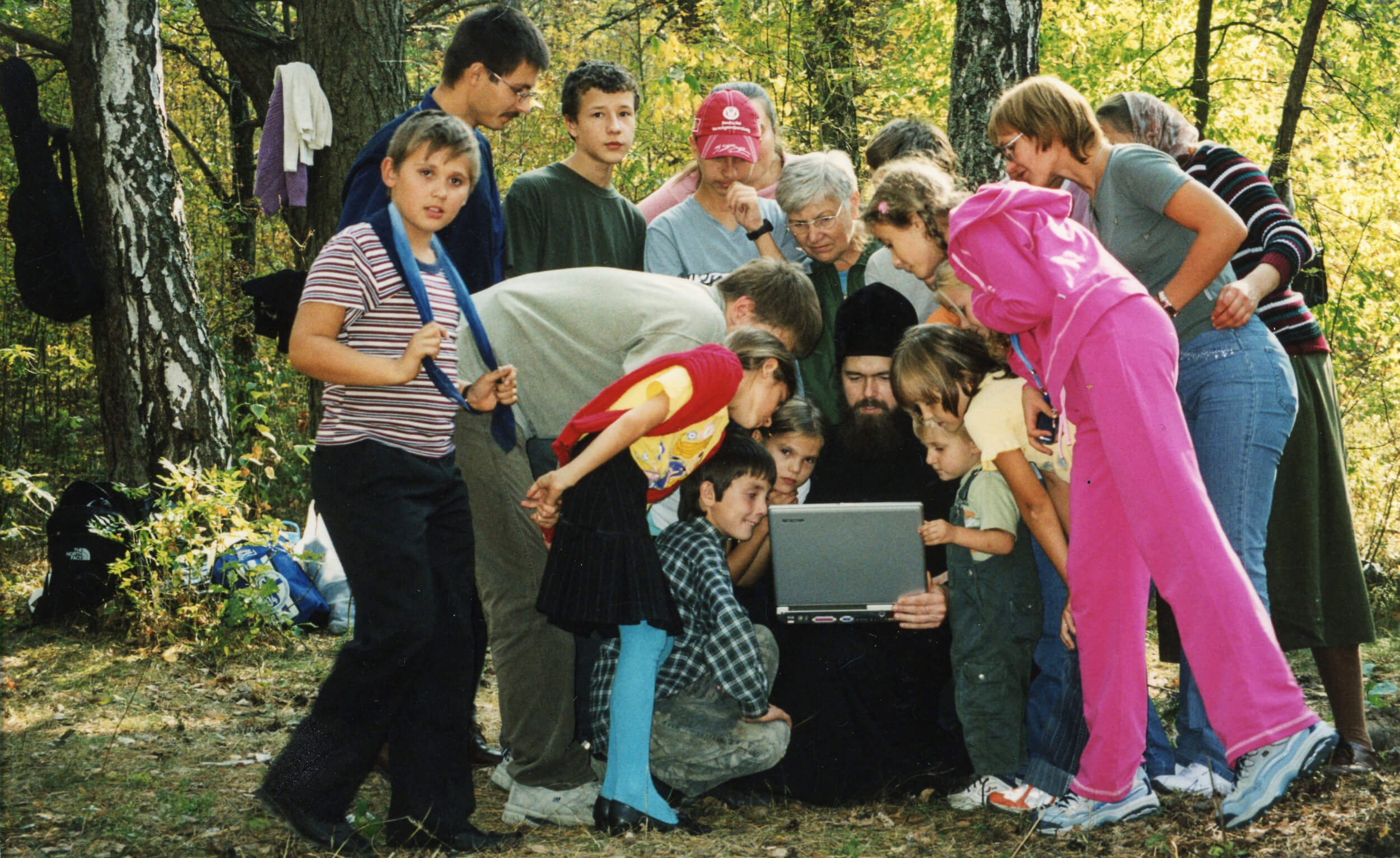
Besides, Father Longin had fairy tales of his own, or rather a series of children's stories about an inquisitive boy called Nikitka, under the title "Lord of the World". Of course this is not Clive Lewis with his wonderful Narnia. Notes of romanticism and a certain enchantment with Orthodoxy still slip through here. But who knows: had Father Longin lived to Lewis's age, perhaps we too would be devouring another series of instructive tales.
Father Longin was also a co-author of the programme of textbooks and teaching guidelines for the course "Christian Ethics in Ukrainian Culture" for grades 1–4 of general secondary schools and for kindergarten (five-year-olds). It is in great part thanks to him that the ministry of education began to listen to the Church's side.
Friends
The news of Father Longin's monasticism came as an even greater surprise to his friends. They all saw a family man in him. "In the world I find very few people so warm, so made for family life," Father Andrey Tkachev recalled of his friend, "it was good to sit with him, to talk about the most varied subjects. He was very good in the sense that he was constantly searching in culture. For there are a great many people who, when they come to Christianity, dry up, fold in on themselves, read nothing, take an interest in nothing, and there is on the whole nothing to talk about with them and no interest in it. But this was a man who searched, found, made merry, laughed like a child… It seems to me (for we do not really know anything properly even about ourselves) that he was a very family man and very little a monastic one. In that sense it is very surprising, and evidently divine, that he became a monk."
Most of those around Father Longin, whether subordinates or superiors, were always his friends. With them he would go out into the countryside, on hikes, on pilgrimages, to the cinema… And this was not so much about resting, seeing something new, being entertained… No, it was rather one more missionary labour.
"Our family owes him a particular debt," Yuriy Chornomorets recalls of one such expedition, "because while Father Longin was still a seminary student he managed to turn my future wife's spiritual searching into a clear resolve to cross the threshold of the Church itself. Of course my wife did not yet guess that this would determine her whole life. Of course Vitalik Chernukha did not think so either. He simply denied himself everything — food and sleep — and persuaded, understood, persuaded again. And the most important Rubicon was crossed."
And there were several families in which Father Longin was not simply a friend but almost a full member of it. There was something special in this. It was like a fresh draught from quite another life, both for Father Longin and for those he visited. And of course one cannot pass over the Sofiychuk family here, whose flat in Darnytsia was the father's favourite place.
It was the children who met Uncle Longin first, and for a while they turned him into a horse. How interesting he was to be with, especially out of doors: "look, here is a little worm, and over there, what a bird…", after which there would be a story about that worm and about that bird. And how many fairy tales and stories were read together: the beloved Chronicles of Narnia, the books about the Moomins… Then, when the children were older, a culinary story would begin as well, and the kitchen turned into one more children's amusement. And how he loved it! It usually began with the words: "I found a recipe on youtube…". Or he would bring with him a whole box of discs of the British cook Jamie Oliver… And never once was it without presents, which always surprised by their originality and by something even magical about them. In other words, they were alive — not done just to get it over with.
It is curious that Metropolitan Anthony of Sourozh had practically the same attitude to children. When he visited his friends on feast days, he was drawn no less than by the feast itself by the chance to be with the little ones. "He played with them like a real grandfather," one of the bishop's acquaintances recalls, "he would sit down on the floor, and he liked it, and somehow it suited him, at any rate it did not lower him in the least. The children climbed on his back, romped about, that was the game they had. "And we never saw a bishop in him, if you understand what I mean. He would come here, play and behave like their grandfather, not like a bishop. And yet I always addressed him as Vladyka, and the children as Bishop Anthony… The children loved him very much. My wife and I tried to teach them to respect the bishop's rank, to treat him as a bishop, to ask his blessing and so on, but he practically would not accept it, and preferred to run about, sit on the floor, give them presents and play with them."
And then the familiar kitchen conversations with the grown-ups awaited Father Longin, where songs were sung, and here it is worth saying that in presenting his own songs, of which there were many, Father Longin was somehow shy… And meanwhile the children would come running into the kitchen. They wanted to be there and to listen… Needless to say, every visit of his was a feast for the children — sunny and merry.
"It is good for us to be here" (Matt. 17:4, KJV) — that cannot be said of the place where you live all the time. From such a place one must certainly return, or habit will turn it into the everyday. Perhaps that is why these journeys were so dear to Father Longin, journeys which, incidentally, grew fewer and fewer after his tonsure, which cannot be said of his new acquaintances. The circle of friends only widened with the years, and the father would say: "I am always lucky in good people."
The publishing department
From 2007 Father Longin headed the publishing department of the Kyiv Metropolia. The Church Orthodox Newspaper began to appear once again, though now it was quite a different paper. Father Longin added to it a news feed with a short account of the most needful and important events, and there were also columns on the history of the Church, children's pages…
The number of subscribers grew before one's eyes, and in time the paper became a weekly. Alongside the paper there continued to appear the magazine The Orthodox Herald, The Orthodox Calendar and Liturgical Instructions…
It is astonishing what a fine director he was at the same time. He had a particular gift for building a team and for finding people, even though those people had often never had anything to do with publishing before. His staff were an ensemble. He trusted every one of them, and that trust drew a response. He held a meeting about once a week. He made coffee for everyone, and at the end washed up after them all. His colleagues shared their proposals and Father Longin diligently wrote those ideas down, and out of them the general conception in the end took shape.
And with what attention he treated his staff — he helped them with money, visited them in hospital. And yet it sometimes happened that those to whom he gave himself without stint left him bearing a terrible grudge. How much there is that is Christian in this — to be rewarded with a gob of spit for a hand held out in help. Vitaliy's fine nature took other people's meannesses as its own. Perhaps that is why there was no one he did not console.
And once he took the whole publishing department to see The Chronicles of Narnia. In general, if he liked something, he wanted everyone he knew to see it. Sometimes, when something new appeared, he would invite his staff to watch it even in his own cell.
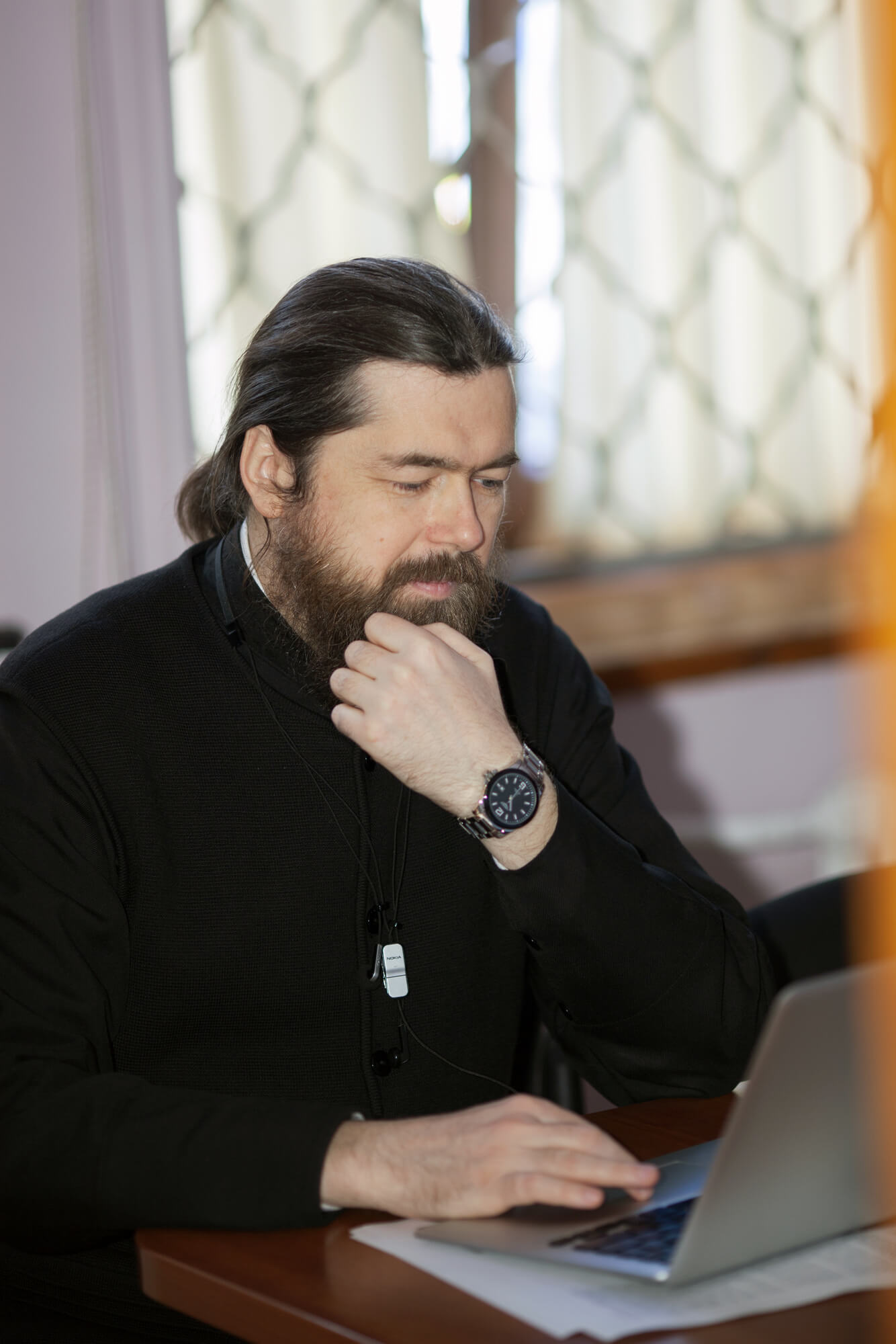
He wrote articles rarely, and never did finish his own candidate's dissertation in pedagogy. One of his staff deleted it by accident while clearing space on a computer. "Never mind" the father said then, "evidently it is not needed, if it is written with such difficulty." Perhaps this unwillingness to write had to do with an absurd scandal around his article I Believe in Man, written as though in God's own voice. Or perhaps he simply had no time for it. For there was hardly anything the father was not keen on. He loved classical music, was learning English and German, loved to read Chekhov and Karel Capek, and never ceased to marvel at the books of Sergei Fudel. And there were many television programmes, for which he prepared meticulously — he would speak his text through within the time allotted for the broadcast and ask Mother Evtropia to correct his inexact pronunciation (he had come, after all, from Western Ukraine). At the First National they called him the heart of the channel, so many big projects were organised with him.
And how many lectures he gave. For the father taught not only at the seminary. There was also Iryna Barmatova's private school and several ordinary secondary schools. Besides that, he was invited to the Borys Hrinchenko Pedagogical University to run classes for teachers. And once, after a lecture at the Military Institute of Communications, Father Longin was surprised to find his own father's name on the roll of honour. It is notable that Grigoriy Mikhaylovich had never told his son how well he had done in his own studies, and that Vitaliy was never top of the class at school, though he was able and did well. Evidently, then as now, the cause of it all was that enthusiasm for other things which was so much his own — and for many, indeed very many things…
The Kinburn children's camp
The year 2007 was marked not only by a new post. There was something sad as well — the children's Sunday school ceased to exist. The seminary's new management asked that the classes be held in another building, and the basement rooms of Block 55 were offered for the purpose. After looking them over, Father Longin said only: "Children of the dungeon — that is not about Orthodoxy, which is light." So that school had no continuation. By then, however, the Kinburn children's camp (as Father Longin called it) had already been in its fourth year on the shore of the Black Sea. And it had all begun here with a half-ruined little house on the edge of the Kinburn Spit landscape reserve, which had been given to Father Longin back in 2003. Everything here was thought out down to the last detail — in everything one felt the father's careful, housekeeping hand: from the cook's work to the mosquito nets fitted at every window.
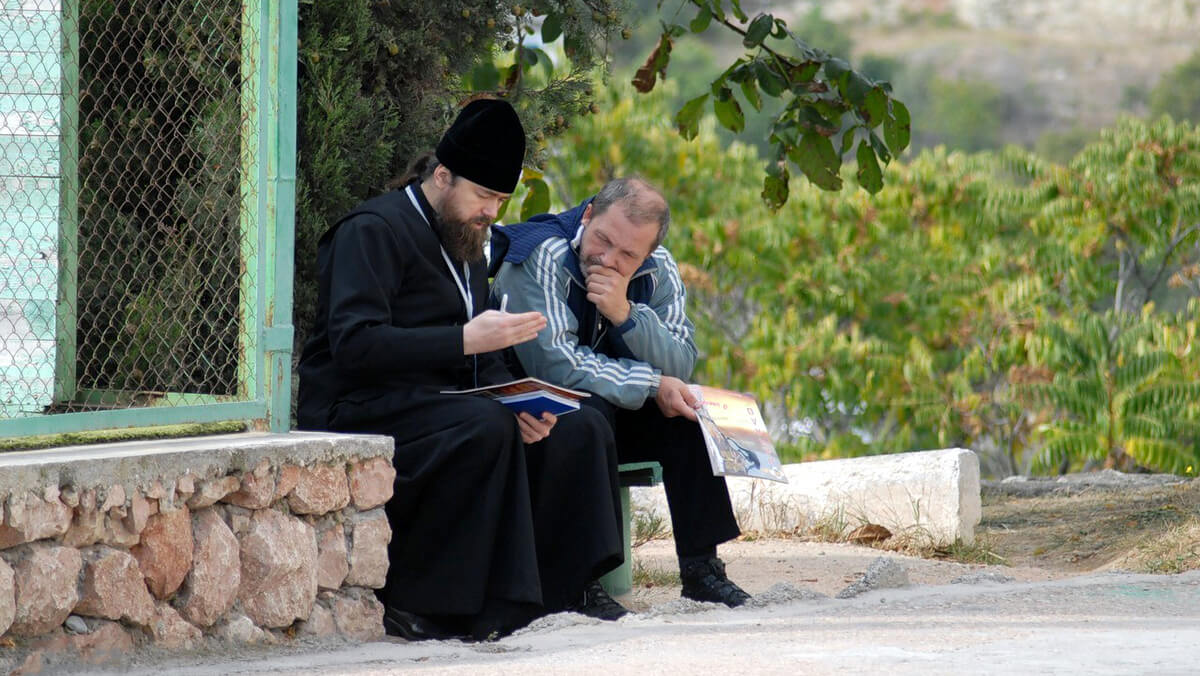
Father Longin was an advocate of separate schooling. "Girls develop biologically faster," the father explained, "they suppress the intellectual and sometimes the physical activity of boys." So in the first half of the summer it was boys who came to Kinburn, and they were replaced by girls right through to the autumn. Because of this there were fewer quarrels and fewer fights in the camp. True, in the last years there were joint intakes too, and even adults could come here with their little ones.
***
It was on the way to the camp that the terrible car crash happened — on 7 August 2013. At 41 the father was gone. It was like thunder out of a cloudless sky! It could not be believed and it appalled. — Who should live if not Father Longin.
That same holy fool Yermil had said prophetically in farewell back then: "You must work on yourself like a madman," and the father worked as if for two. And if one adds together the age of Longin the monk and Longin the teacher, one gets 82. He was never untrue to those "professions". Both were his calling.
Not long before his death a film crew from the television channel Glas visited Father Longin. And who knows why, but he said then: "Time would have no meaning, it would be meaningless, were there no eternity. For what is all this flowing of time for, what are all our temporal labours for, our anxieties, if there is to be no eternity, if there is to be none of that where, properly speaking, time will not be needed, will no longer be required…".
The memorial evening
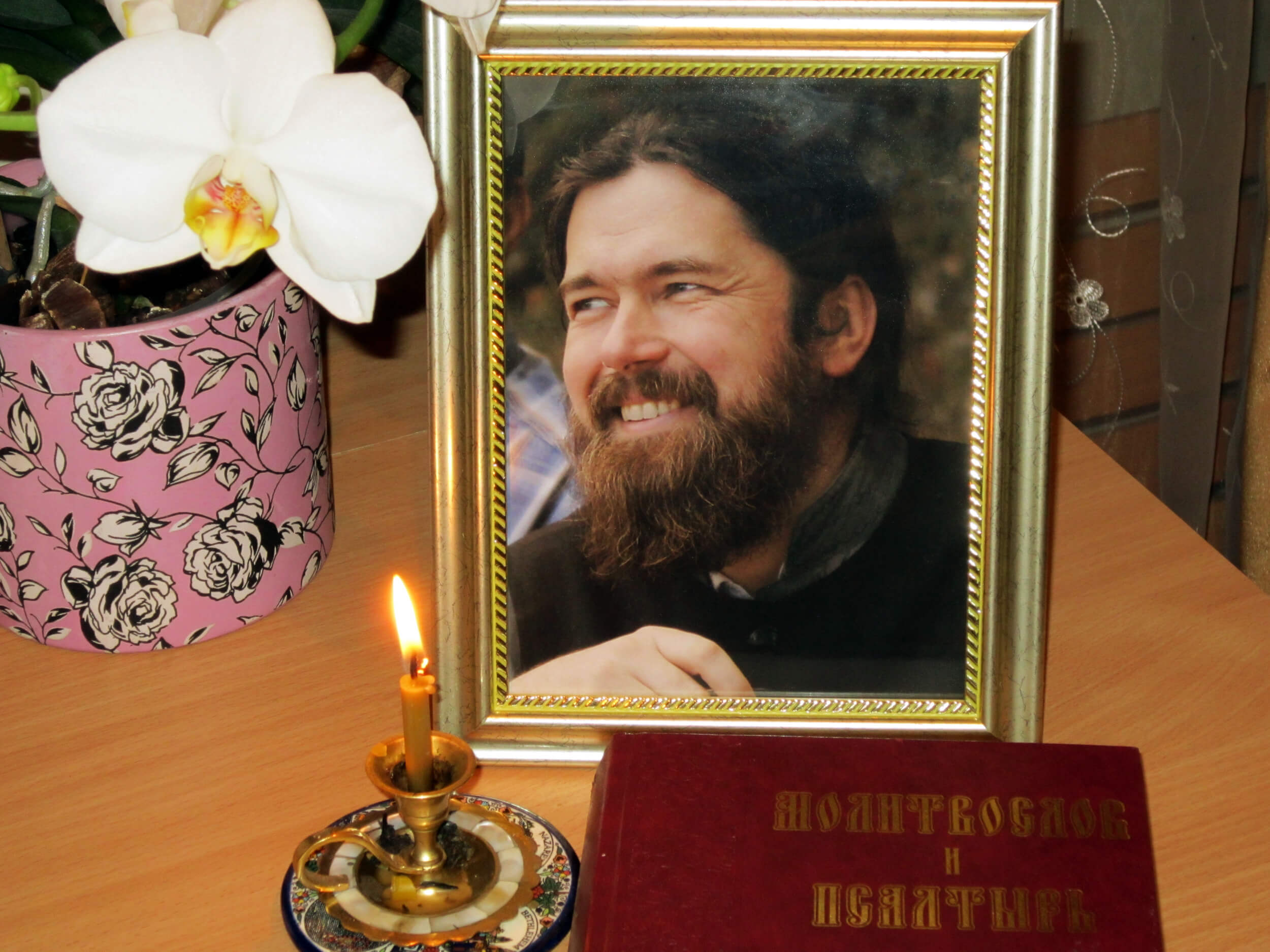
A year after the tragedy, at the Teachers' House, Kateryna Diatlova organised a memorial evening, at which many of those (not all, of course, they would simply not have fitted in) who knew and loved Father Longin gathered. His family and friends shared their memories. In between there was music from a variety and symphony orchestra and of course Father Longin's songs ("And I Shall See You Again…" he wrote not long before his death).
And how much is still untold… Now and again new notes about Father Longin appear among his friends, like this recollection of Kateryna Diatlova: "In the last years it was good simply to be silent beside Father Longin and to listen. To listen in to his depth. God knows by what efforts and struggles that depth, that wholeness, that strength of faith were given him. Outwardly he was always collected and cheerful. The depth in him went wonderfully together with childlikeness and lightness. With him it was always easy. As one of the great said, 'The sea is great because it does not disdain even the smallest rivers'…
You bring a shell home from the sea, put it to your ear and hear the surf. Sometimes one longs so much to hold such a shell, through which one could hear a dear friend's voice again. When it is very sad I put on the recording of Father Longin's memorial evening. There I hear the father through the people into whom he put his love.
'The sea is the best thing that can happen to a person,' so Max Frei wrote. Father Longin is the best of the people with whom we had the good fortune to talk, to work, to baptise children, to pray for our families, to go through life from our young years, to mark birthdays…
In our family there is an expression that has settled over many years — 'somehow in Longin's way'. Joyfully, vividly, genuinely, purely, without thought of gain, with a touch of humour and with little rays at the corners of the eyes — that is what in Longin's way means. Whenever we meet such a combination of qualities we remember our friend, Father Longin.
And it would be good to live so that people could say of us: 'There is something of Longin in them!'"
