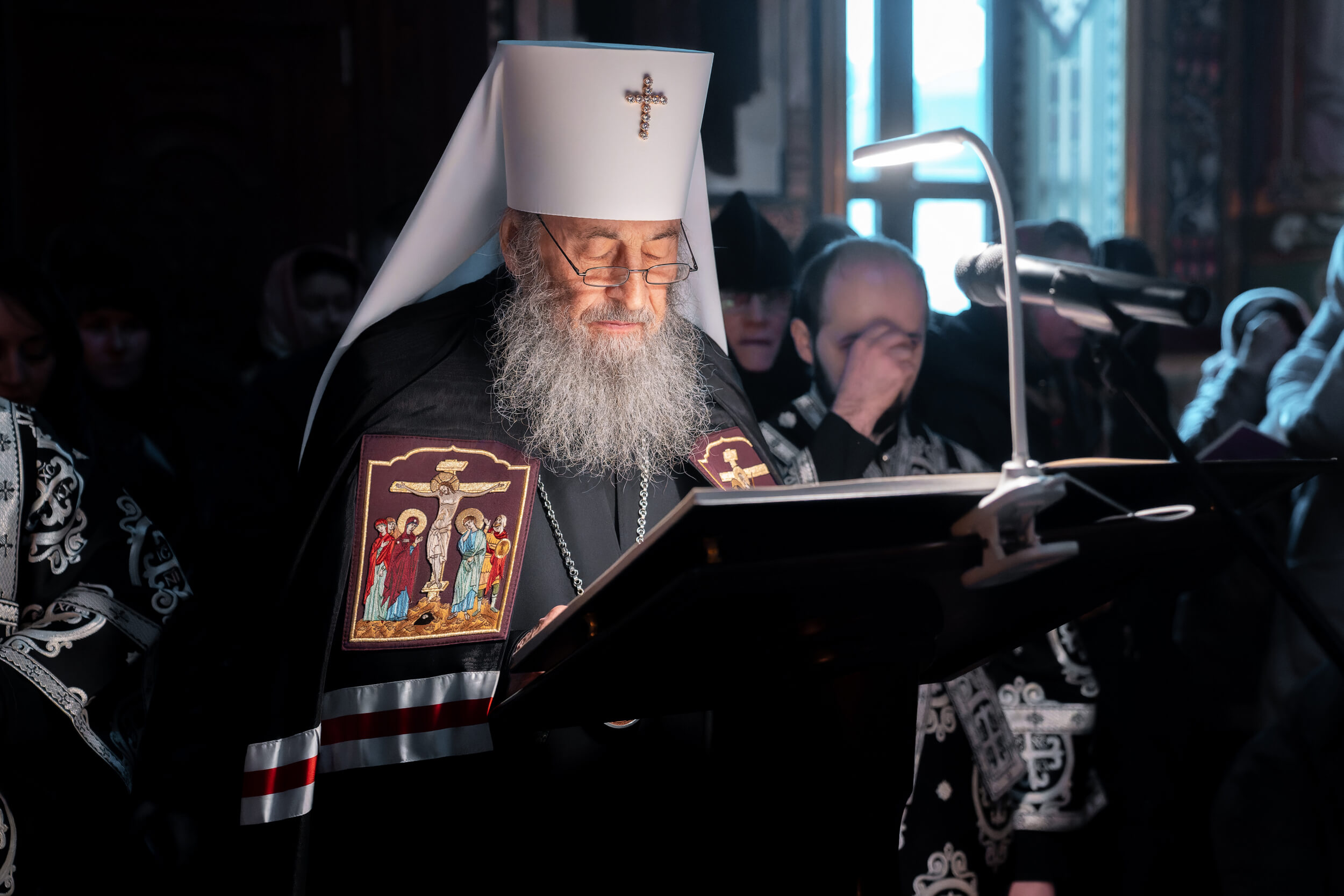
Your Beatitude, in what frame of mind would you advise us to keep the fast during Great Lent?
— In a cheerful frame of mind; one must not be downcast. The fast is a special time of active struggle with one's own infirmities and passions. When a man pays no attention to his inner state, it seems to him that everything about him is more or less well. But if he enters into himself, into his soul, into that inner room of his heart, he will see how many faults and infirmities are there — those spiritual beasts gnawing him from within. Then a man begins to be horrified and falls into despondency, but there is no need to despair: one must struggle with oneself. For this struggle the Lord has given us the bodily fast, and also the word of God, the reading of which corrects our thinking, and prayer. The fast brings harmony to the powers of the body, and prayer unites the soul with God. A man who has a link with God stands as it were beneath a ray of light and sees his own faults, and sees also when a friend is drawing near to him and when an enemy. But if a man has no link with God, then he sees none of this. He may feel something in his soul, but he is not able to make sense of those feelings and becomes easy prey for the enemy. Though at times it seems to him that all is well with him.
— What is it important to do during Great Lent in order to draw nearer to God, and why does the fast begin precisely with the remembrance of Adam's expulsion?
— Adam lost paradise through intemperance, through the breaking of the fast, and we can win back the paradise we have lost only through temperance and the keeping of the fast. A man who tries to live devoutly and wishes himself real good always remembers the paradise that was lost. This thought leads us to repentance, which makes a man pure and able to receive the grace of the Holy Spirit.
In one of the books of the Fathers there is a story about a hermit who from time to time would come to a certain monastery, sit down by its gates and weep bitterly. People looked at the weeping hermit in bewilderment. They could not understand why he was weeping. And one monk from that monastery came up and asked: "Why are you weeping, Father? Have robbers perhaps plundered you in the desert?" — "No, no one has robbed me." — "Are you perhaps ill, and feeling unwell?" — "That is not it either." — "Do you perhaps want to eat, are you hungry?" — "I have no need of that either." — "Then why are you weeping?"
And the hermit answered: "I weep because once my forefathers and I had a very rich and splendid house, and I had the glory of a king. Then I had to lose all of it, and now I am forced to drag out this pitiful, sorrowful and mournful life." But the monk found out that this man was not of the rich but of the simple folk, and understood that the hermit was weeping not for his earthly house, supposedly lost, but for the eternal house, the house of paradise, which he had lost through the transgression of the Divine commandment.
The memory of the paradise that was lost brings forth in a man the spirit of repentance, and repentance directs us to live with God in the house of God and to receive those gifts of grace which are given in the temple of God. It is precisely the lost paradise that we must remember and grieve over during Great Lent; then it will be easier for us to pray and to fast, and then the Lord too will be close to us.
— What matters more at this time for an Orthodox Christian: diligent prayer asking the Lord to forgive our "sins voluntary and involuntary," or asking forgiveness of those we have offended, forgiving those who have offended us and doing at least one good deed?
— During the fast everything matters: prayer for the forgiveness of one's own sins, and forgiveness of one's neighbour, and good deeds. But the most important thing is to acquire the grace of God. It is grace that helps us to set the right priorities in life and to go in the right direction, the one that leads to God. As a man draws nearer to God, his soul grows more joyful and more peaceful; but when a man withdraws from God, his soul is full of confusion, uncertainty, irritation, discontent and unease.
Before the beginning of Great Lent, preparing the faithful for the labour of prayer and abstinence that is within their strength, the Holy Gospel reminded us of the parable of Zacchaeus, who showed his determination to see Christ in deed, because he was short of stature and was not ashamed to climb a tree. And what does the tree symbolise? It is the fast, abstinence not only from bodily needs but also from desires, thoughts and sensations. And the chief achievement of every fast is the drawing nearer to God. It may be that we shall not reach a certain height at the first attempt, so as to feel the Divine grace, but it will certainly happen — the second time or the third. The one thing that matters is that a man should not despair in his desire to see the Lord.
— What else should there be in our preparations for the Bright Resurrection of Christ — the feast of Pascha?
— It is very important to find time to come to the temple of God, where we shall find that peace and stillness which begins for a man while he is still in his earthly life, all the more since the services of Holy Week touch upon the greatest and most important questions of all: the essence of Christ's Passion and Death, of Redemption and of eternal life. These services differ from the services of the rest of the year, and many Orthodox Christians wait for Holy Week with a particular reverence, in order to feel once again that deepest grief and compassion for Christ in His sufferings for the sins of the world. But at the same time to be granted the consoling hope of His coming glorious Resurrection. And whoever for some reason has not managed to cleanse his soul in the sacrament of repentance and communion should try to come to confession and to receive communion before the feast.
— Is the man of today capable of sharing in the sufferings of the Saviour, of living through His Resurrection? How is one to prepare for this?
— We are not those people who in the literal sense condemned Christ to crucifixion. But when a man sins, he becomes an accomplice of those who crucify Christ. And so, as we call to mind the tragic events that took place on Golgotha — the crucifixion, death and burial of the Saviour as Man — we must put this question to ourselves: what are we to do so as not to crucify Christ within us? For this a man must stretch out a helping hand to his neighbour, turn his heart away from iniquity and seek in life not his own personal truth but the truth of God.
— What contribution does the Church make to the work of peacemaking? What does the restoration of peace in our country depend upon?
— Before the last week of Great Lent the Church reminds us of the raising of the righteous Lazarus, in order to prepare us for the Resurrection of Christ and to remind us that there is nothing impossible on earth. Even if a man falls into the hardest and most hopeless circumstances, there is always a way out and it is always possible, with God, to celebrate victory, even victory over death. And today we pray that the Lord may send peace to our land, that the Lord may pacify human hearts, because peace in society begins with the pacification of the human heart, and then that peace pours out further, over the whole of society. And it is the same the other way round: if a man's heart fills with malice, then that malice, pouring out of the heart, turns into ruinous and deadly war. Of course we should like peace in Ukraine to be established in a single day, but the Lord did not raise Lazarus at once, only on the fourth day, when everyone had lost hope and the body had begun to decay. The Lord is showing us: Divine help comes only when human self-reliance is gone. May the Lord bring us to our senses, that we may always hope in His help and may not believe that without it we can achieve anything at all in our life
Source: Онуфрий, Митрополит Киевский. Ответы на вопросы. — СТСЛ, 2017.
