Germany is being made a Judas
The Germans themselves did not guess at the horrors of the war ahead, which took almost ten million lives from mankind. They were far more gripped by the presentiment of success. Their reliance on the strength of their own weapons and on the recently worked-out tactics of the blitzkrieg only warmed their suddenly awakened appetites. A mighty predator-empire with a highly developed industry, with iron discipline in daily life, where there was too little of the human and far too much of the soullessly mechanical, astonished the imagination of the world with its guns, its ironclads, its airships rising into the clouds. And no one particularly concealed that all this grandeur and wealth rested on the plunder of other peoples. Take, for instance, that same indemnity of five billion francs from France, defeated in 1871, or the continuing colonisation of Africa. The Germans suddenly came to believe that "the robbery of one's neighbours is lawful and even good for their health". And having lost all measure in their glut, their general staff set about drawing up a plan of action on two fronts at once: the rout of France was to be followed by a swift conquest of Russia. And it was important to strike as quickly as possible, while the Russians had not yet recovered from the war with the Japanese.
Meanwhile in Kyiv the smell of war drifting over from a hastily arming Germany was still not taken seriously. The imperial courts were joined by ties of kinship: would a brother really go against his own brother? Even after the Sarajevo assassination the city did not turn a hair: "Some Serb schoolboy has killed an Austrian duke… so he had it coming! There was no call to hold military manoeuvres right beside the Serbs… And it is hardly a reason for a war… Look, not so long ago an Italian killed the French president, and yet no Franco-Italian war came of it…".
No one believed that the war had begun, even when at the end of July the Austrian guns shelled Belgrade. Nicholas II did not believe it either, and sent the German emperor Wilhelm a telegram begging him to keep the Austrians from "going too far". And only Germany's reply, with the note declaring war on Russia, destroyed every hope of peace in an instant. Yes, we are all brothers — if only one could work out who is Cain now and who is Abel.
In the pages of "Свет Печерский" an appeal was placed to help the brother people: "The Serbs are not a people foreign to us. They are of one Slavic stock with us and of one Orthodox faith with us… Once the Turks took the Serbian people captive. And they would have remained in Turkish bondage for ever, had not Russian people, in fulfilment of their Christian duty, helped them some fifty years ago to beat off the Turks and to form their kingdom anew… Since then the Serbian kingdom has been as a child to our great Russian kingdom and, like a child, it has always sought and still seeks protection and help from us… So it has happened now as well… The war has begun, and God will judge between us and the insolent and unrighteous oppressors in this war…".
The first "swallows" of the war
"In the beginning of any war its first casualty is the truth." For some reason it seemed to everyone that the war would not drag on for long and that the capitulation of Austria and Germany was inevitable. There were even supporters of a war with Germany, who maintained that a good shaking would "heal our sick society, bring it to its senses and put everything in its place". On the other side of the battle there was no hiding at all from such inflammatory appeals. Only, whereas in Vienna the Serbs were blamed for everything, in Berlin the Russians were declared the chief arsonists of the war.
And now thousands of Russians who had come to Germany for treatment and did not even know about the war felt for themselves the "warm" embrace of their hosts. First the Germans struck at their pockets, changing money at the lowest possible rate. Then they began to put up on the walls of houses appeals to "catch the Russian spies". In the end it came to this, that together with the police they started throwing the visitors out into the street. And those who protested against the abuse or stood up for the women were shot down on the spot.
"We knew this savage people badly… — Hieromonk Philip shared with his readers the news that had reached them, — The vile violence, the inhuman mockery and the terrible cruelties to which the Germans subjected peaceful citizens, defenceless women and children, prisoners of war, have revealed to us a soul of the German people that is not Christian and not even human, but somehow half-bestial. Now the whole of it, from the emperor Wilhelm down to the last soldier, appears to us as some kind of monster, a bloodthirsty beast trampling on the laws both of God and of men. They have invented a philosophy that teaches them to be supermen; they preach fearing no one, despising everyone and enslaving everything to themselves. They say, for instance, that Wilhelm, on the day after receiving the Holy Mysteries, sending his troops against the Russians, addressed them, among other things, with these words: 'Go and destroy them… And take no prisoners and no wounded… let those who fall into your hands perish. Give no quarter and kill at once'."
All this might have been taken for an impudent invention, for an exaggeration… Only the German writers, together with their scholars, were calling their soldiers to literally the same thing: to feel no pity for their victims, to destroy without mercy not only people but even to pull down churches, to blow up monuments of art with dynamite, and then, as the German philosophers wrote, "we shall build cathedrals and churches more magnificent still, so that beneath their vaults we may glorify the deeds of our great emperor".
Love for enemies
As though not noticing all this cruelty, of which the military themselves reported to the Lavra — that the Germans "finish off the wounded on the field of battle, torture those taken prisoner, fire on hospitals and infirmaries protected by the Red Cross, deliberately destroy ancient churches and monuments of art with bombs" — the editors of the journal called unwaveringly to works of spiritual consolation: "Christ loved and prayed for His enemies, and so we must do the same. Have we not the strength for it? Let us not be confounded and reject the commandment! Let us ask strength of the Giver of spiritual, grace-filled strength, of the Holy Spirit… Christian love for enemies we may boldly and fearlessly apply also towards the Germans who are at war with us. If we do not go beyond the bounds of the necessary struggle with evil, if we fight German soldiers and their helpers and not peaceful German inhabitants, if we do no injury or oppression to them that is useless for the war, then we shall already have climbed the first step of love for enemies, and shall have shown that we have no feeling of hatred and malice towards them. And if besides this we are merciful to the wounded, to prisoners and to conquered Germans, if we defend them and do good to them, then by this we shall show that we can rise even to the full Christian feeling of love for them, of love for our enemies".
The lofty appeals did not part company with deeds. The monastery took part, as best it could, in the life of its captive guests. And "from the beginning of the war whole thousands of them passed every day through the fortress beside the Lavra… Among them, as before, are many Russian Uniates (Galicians). It is not their fault that they were in the enemy camp. The Lord brings them to us in order to join them to us for ever. Let us not push them away by our coldness and indifference. Let us speak to them too the word of the love that binds us in Christ. Bishops and priests have already begun to visit their barracks. The prisoners receive with gratitude the holy crosses, icon-cards, gospels, prayer books, spiritual books and edifying leaflets." Under the watch of one or two soldiers they visit the monastery in large parties: in the caves they venerate the relics of the saints, in the churches they lift up prayers to God. Moreover, "by their labour, beyond the south-eastern wall of the pilgrims' hospice, fairly extensive barracks for the wounded are being built. In their blue and grey clothes and caps the prisoners diligently turn over the earth and cart it in barrows, levelling the ground beside the wells of the venerable fathers… By their own account, in captivity they have come alive in soul and pray the Lord that truth and peace may reign upon the earth".
And with the exact opposite, as though out of the very pit, there came "the first trainload of our suffering soldiers, prisoners of war… My God, what a sight met our eyes, — writes one of the priests who met them, — faces pale and yellow, eyes sunken, the gaze dull and lifeless; all of them filthily clothed… on their feet, instead of boots, torn slippers; some barefoot. Out of 245 men… 160 were carried in on stretchers, many without arms and without legs. The greater part suffer from internal illnesses acquired in captivity through heavy winter labour. By the wounded men's own account, their life passed in unbroken suffering, deprivation and exhaustion by hunger — for instance, half a pound of straw-and-potato bread a day per man, soup of rusty stinking salt fish once a day, often with worms in it, and some sort of cloudy, barely warm water called 'coffee'. To the question I put to one of them, deprived of all the fingers of both hands and of the tip of his nose — when and in what circumstances he had been wounded or amputated — he, weeping bitterly, answered: 'No, I was not wounded… They drove us, 200 prisoners, in the month of November 1914 into a certain town; beside the cold barracks they stripped us naked and drove us over the snow for 15 minutes, in 15 degrees of frost; then I froze off all my fingers and my nose, and many of my comrades soon died… In the barracks, into which they herded us with sticks, there were no bunks at all: onto the frozen, cold ground they threw 2 sheaves of straw for 200 men. There was no end to the mockery and the torments… Terribly exhausting, inhuman heavy labour: — they harness 25 men to heavy ploughs and plough the land, driving them on with a rifle butt or a cleaver; and there the wretched men perish by the hundred… When we were marched through the streets in villages or small towns, the whole population literally spat in our faces, beat us with stones and threw filth at us'."
And is a man able, without help from above, to bear the pressure of such dreadful news and not give himself into the hands of savage hatred, and to go on, as before, seeing in the German prisoners guests rather than an object for his own revenge? "What if the prisoners seem worthless to us only because, — the editors of the journal try to make sense of what is happening, — we do not wish to look closely at them, to make them out? What if, looking at them, at their appearance, which holds no interest for us, we think: can there any good thing come out of Nazareth? And what if the light of truth should suddenly blind us, and what if for such contempt there should be for us neither forgiveness nor mercy?!.. In every people and in every man there is something both good and evil. Come, brethren, to a man with love, that you may receive from him the good and not the evil".
Closer to the place of battle
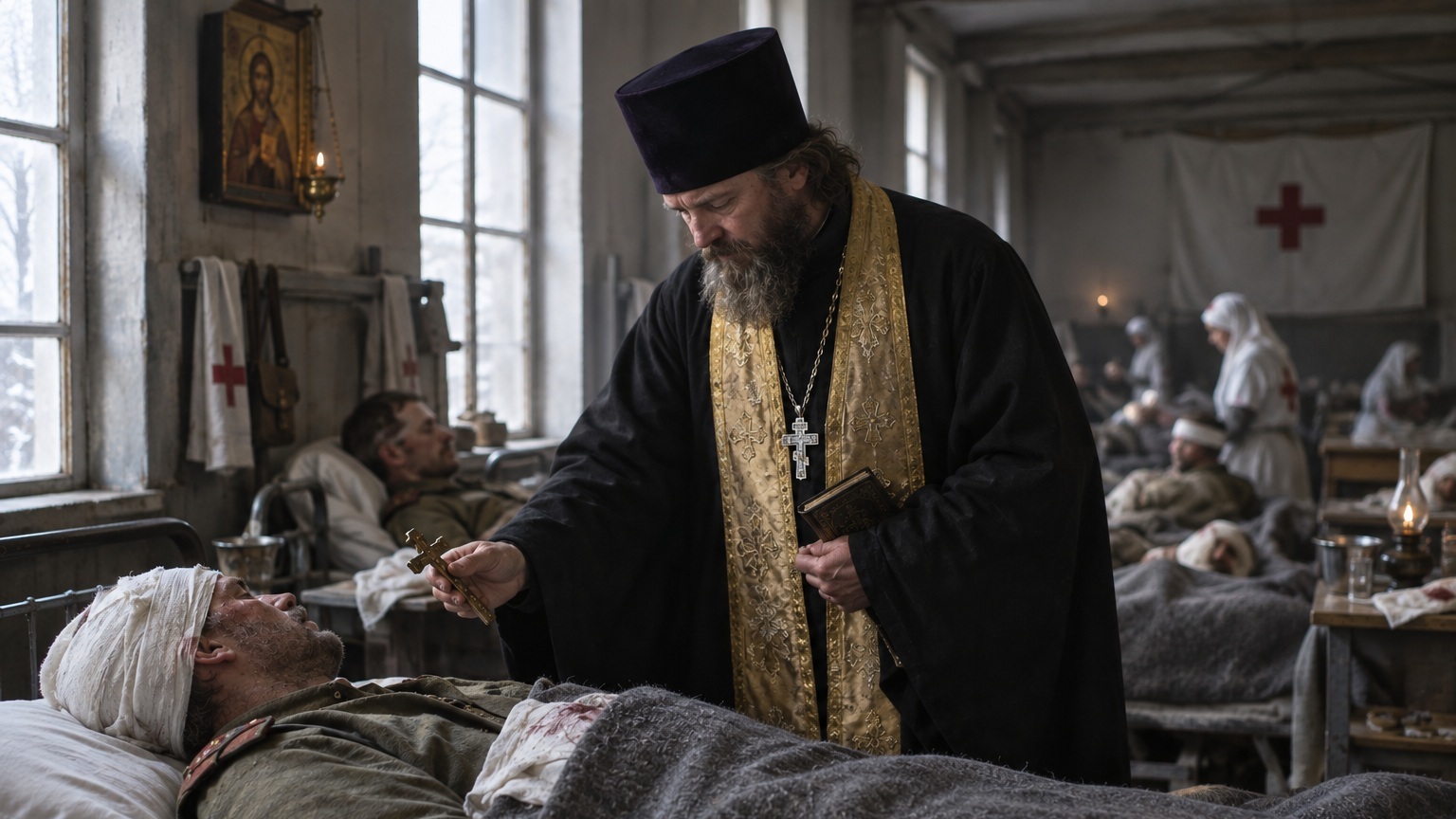
And far more than for the prisoners, it was necessary to care for their own soldiers, all the more so when the army had met with heavy losses and when among the fighting men themselves an enormous demand for spiritual care had arisen. One had to see how the soldiers hurry to the priest with a kind of particular impetuosity and joy — to confess and to receive communion: "Father, dear Father, if you only knew what it means, after two months of marching under the unbroken roar of the guns, the shriek of the shells and the whistle of the bullets, to hear the familiar sounds of prayer, you would understand why we weep tears of happiness".
Father Philip could not pass by; and indeed, how after such things could one refuse to be there beside them: "Forgive me and bless me, dear fathers and brethren — readers! With God's blessing I am going to the field of battle to serve a holy work. For a long time I held myself back and restrained myself, but at last I clearly understood that my place now is not here, not at home, but there, where my brothers bear the heavy labour of a soldier, suffer and die. If the Lord keeps me whole and unharmed, it means that I am still needed by the Church of Christ; and if He takes me to Himself, sending me death on the field of battle, then great is His mercy to me, a sinner. In all things may God's holy will be done. Pray then, dear brothers, that the Lord may help me to bear patiently and with love, to the very end, the labour I have taken up".
On 2 November 1914 Hieromonk Philip set out. He "took with him his field church and many gospels, holy crosses and icon-cards, and also little spiritual books and leaflets for the consolation and edification of the sick and wounded soldiers. The leaflets are a gift of the monastery, and everything else was partly bought by Fr Philip with his own means and partly donated by his friends".
Together with Father Philip there went from the Lavra to the front, for the spiritual care of the soldiers, the hieromonks Fr Flavian, Fr Vasoy, Fr Jason, Fr Theodosius, Fr Theodotus, Fr Paisius, Fr Boniface and Fr Callistus. And about 150 novices went off into the army as reserve soldiers.
