Letters from the front
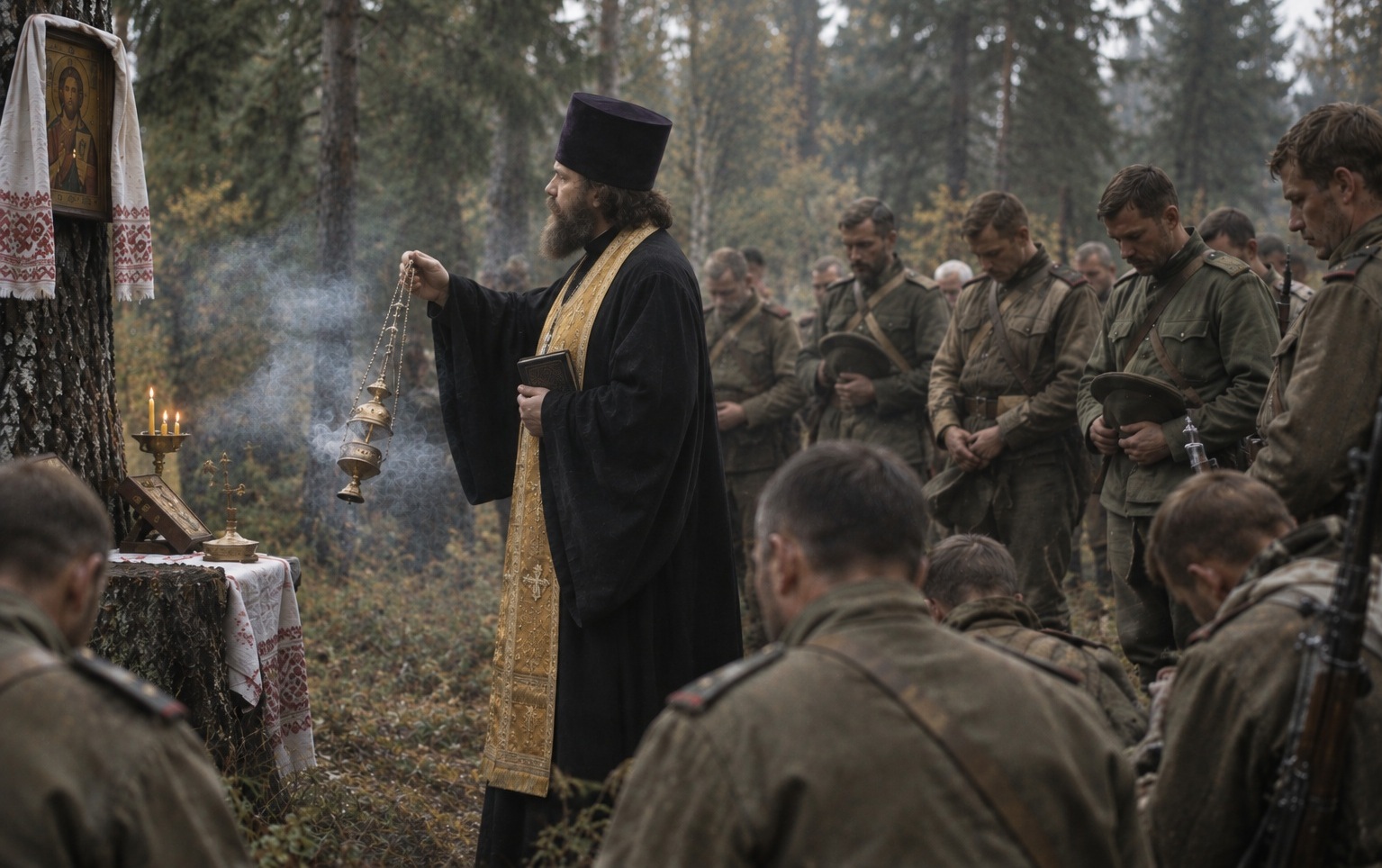
The greater part of the Lavra's hieromonks served in the field hospitals, but there were also those who often had to be in the forward positions, in the trenches, and there to pray together with the soldiers, to celebrate short services of God, to instruct the men, to bless them going into battle, and after the battle to hurry to the wounded, to help with the dressings, to give the last rites to the dying and at night to bury the dead.
"I most earnestly ask for your holy prayers, — Fr Flavian writes from the front to his home monastery, — I need them. Without help from above one cannot live long under 16-inch shells… At the New Year I gave communion to the wounded and the sick under the fire of these giants. The shells were bursting all around and men fell from the mere whistling roar of them as they fly, and especially when they pass over one's head. And so under that terrible din I gave communion to 43 men… The bombs are as much as 40 poods in weight, and such a shell has only to strike any house you like and nothing will be left of it but a trace. That is why I am writing to you, dear fathers, about all of this, so that you may redouble your holy prayers for me, a sinner. I am in great need of your prayers. And if the Lord has ordained that I should not return to the holy Lavra, then I ask you, write down my name and serve the memorial services. I write this letter under the thunder of terrible guns… I have just blessed the water. About 400 of the troops stood and sang the Creed and the Our Father. And two terrible shells burst very close beside us. It became very frightening. But I raised my voice so as not to show that I was afraid and in order to encourage those present. I implore you, pray for me".
All these letters usually became the common property of the whole brotherhood: together they rejoiced at joyful news and grieved at sorrowful news. Over every piece of news the brethren prayed earnestly to the Lord: "May joy increase, may sorrow cease".
"I thank you heartily for your kindness and your holy prayers, — writes another of the Lavra's hieromonks, — I rejoice that my sinful name too is not forgotten in the holy of holies at the Lavra. I live only by memories of it… Yes, you are right when you say: 'he who has never been at sea has never prayed to God'. But I will say more: he who has never been under 16-inch shells has never prayed either… The Lord has granted me both to be there and to pray. Under their thunder you are carried in thought to every tomb of the venerable saints of the Caves, that by their prayers the Lord may keep you from death".
"A very cruel war. This is not a war but some kind of utter hell. There is no describing all that one has to see and go through here. For whole weeks at a time there is sometimes no question of sleep or of rest, for how is one to sleep or rest when day and night the guns roar, the machine guns rattle and the bullets buzz. Still, in spite of the difficulties and the deadly danger, I celebrate the service of God almost every time close to the very positions, so that instead of bells the bombs very often howl over the heads of those at prayer… At each such service there are 500–600 penitents. Since it is impossible to confess each one separately, I confess all who wish it at once — with a general confession… I have also had to serve in the Uniate churches. The Galicians love our services and our singing very much and say: 'дуже гарно, дуже красно'. The people here are very humble and firm in faith. The present war has destroyed everything they had, but they do not lose heart and say: the Lord gave, and the Lord has taken away! And they endure… You look at them — real martyrs, and Christians of the first times…"
The brethren also received many letters from the soldiers themselves, who drew their courage, patience and consolation from their communion with the holy Lavra and with its holy things. Here, for example, is what the novice Terenty, who had gone off to the war, writes: "We were in Hungary, and now we have fallen back into Galicia… The Germans are very stubborn, they drink themselves full of vodka and drunk they come straight at us… We do not yield to them and beat them off with our weapons. In the mountains the snow has turned black with German corpses… We fight every day to a bloody sweat, to a mortal blow, in order to keep the faith of Christ until the coming of Christ… The enemy thinks that our weapons are guns and rifles, but we have a stronger weapon than that, a spiritual one — prayer and the power of the Cross… I thank you for the God-loving parcel, sent as a blessing from the monastery. It gladdened me greatly, and I rejoiced as at a feast".
And here is a letter from a soldier to a monk he knew at the Lavra: "I inform you, Fr A., that by the mercy of God, under the protection of the Queen of Heaven, I am alive and well. I thank you for your holy prayers… Many of our brother-soldiers receive a blessing through the reading of the holy leaflets that you send from the holy Lavra. They serve us instead of the oil with which our soul is anointed to warm our cold stone heart".
The edifying leaflets in question were for the most part offprints of articles from the journal "Свет Печерский". The monastery sent them in great numbers to the army in the field at the request of the regimental priests and at the request of the soldiers themselves. "When we read these leaflets, — the soldiers write to the monastery, — we feel that the divine power really does keep us from the terrible deadly weapons of the enemy. There was one such case with us. When we received your leaflets we were at that time in the forward trenches, in position, and were successfully beating off the enemy's attacks with rapid fire from rifles and machine guns. After that, little by little, the shooting on our side stopped and died away. Several of us gathered in a circle, sat down and began to read the leaflets you had sent. Suddenly a grenade fell into the trench and burst with great fury. The splinters whistled past our ears, but God preserved us ourselves, and of our little gathered group of soldiers not one was wounded or killed. After that a second grenade fell and landed right on two sleeping soldiers. This grenade tore one of the soldiers into small pieces. The sight was quite horrible: in one place a leg is lying, in another an arm, and around the place where he had been sleeping his whole body was scattered in small pieces for some five sazhens…".
Letters of thanks came from generals as well: "Together with the troops under my command… we heartily thank the brethren of the Lavra for the care given to our wounded and sick brother-soldiers, and we ask your holy prayers that the Most High may enlighten, strengthen and bless us all".
The hospitality of the Lavra
"As soon as the war began, the holy Lavra gave over all the blocks of its extensive guest house to the soldiers who were gathering into Kyiv from every side to go to the field of battle. And when the soldiers had gone, the monastery gave these same premises over to military infirmaries. Besides this, the monastery opened in its new hospital, only recently built, a temporary infirmary for 120 wounded… And now thousands of wounded soldiers, under the holy and warm roof of the monastery, by the intercession of the venerable fathers of the Caves, by the prayers of the brethren and by the skill of the doctors, find from the Lord relief, rest and healing for their wounds and their illnesses. These unusual guests of the Lavra show great faith, humility and trust in God. Every day the hieromonks go round all the sick, read them the rule of prayer, hear their confessions and give them communion… Many of the wounded come from the other hospitals of the city as well, especially on the days of the great feasts, when the metropolitan's choir under the direction of Father Iador visits the Lavra's pilgrims' hospice. So the brethren of the holy monastery give delight to their unusual but dear guests… Whoever has once been among the wounded knows how irresistibly one is drawn to return to them again… Here is where one must learn firmness in trials: a grievous wound, and he smiles as though nothing had happened. Not a shadow of despondency, not a word of murmuring; a beauty and strength of soul such as one rarely meets in the conditions of ordinary life".
At the same time there were appeals to the pilgrims as well: "Before us all stands the urgent duty of helping the wounded soldiers to bear their sufferings, of strengthening them in hope, of consoling them in sorrow, of bringing their thirsting lips near to the Source of eternal blessed life, the Lord Jesus Christ. Let us give of everything, each what he can and with what he can: let him who has no money give things, provisions for the infirmaries, linen, tea, sugar, useful books. God will accept it all as a candle of labour, as an offering from a loving heart, as a work of mercy. Whoever knows how, whoever is able — come and serve the sick for the Lord's sake, visit them, comfort them with a kind conversation, pray, read a good little book to a sick man at his bedside. And do not forget his family; do everything so that at least in your own parish every tear of a soldier's family may be wiped away, so that not one of them may be in want of daily bread, so that the Lord too may dwell invisibly among us. Oh, how this will ease the heavy sufferings of the soldiers".
Life in the monastery
The care of the wounded took much strength, but, as before, the course of the Lavra's life did not depart in anything from the rule of the venerable fathers. "In all the churches every service of God is celebrated. It has only grown quieter in the Lavra's courtyards. There are few visiting pilgrims. The war has taken up everyone. The extensive blocks of the Lavra's guest house, which were usually occupied by pilgrims, are now taken up by infirmaries for the wounded. But the churches are never empty. Townspeople come to pray, and soldiers come in still greater numbers. Many of them are preparing themselves for communion. People pray now with particular earnestness… When the litanies are read for God's help in our battle with the adversary, with a deep sigh and with fervour all cross themselves, and some fall on their faces and bow earnestly to the Lord… All in the monastery have the consolation of watching a living rise of faith among the people. It is especially touching to see how the young officers pray as they set out for the field of battle. Often they come to the monastery accompanied by their mothers, brothers and sisters. There are among them some only just married. They have prayer services of blessing served for the journey. Their fervent prayers mingle with many tears…".
In order to instil in people sound thoughts and courageous feelings by a kind word and by edification, a preachers' circle was formed at the Lavra. It consisted of several of the brethren who had the ability and the desire to preach the word of God, and for the most part it conducted talks outside the services with pilgrims and soldiers. Some of the preachers' instructions appeared in the pages of "Свет Печерский".
"War is a great teacher. It is the scourge of God, with which the Lord drives us towards a virtuous life… Since we did not want the war, and yet it has been forced upon us, its cause is a single one: it is God's allowance of it for our sins… For how many sins lay upon us, upon our people, before the present war: drunkenness, discord, strikes, riot… And amid all this abyss of sins there is one more sin, noticed by almost no one, of which as long as 26 years ago the Recluse of Vysha, Bishop Theophan, gave warning: 'A Western writer takes their fancy, and they begin to translate him… and they pour it all out, one after another… And with those writers, among the good things, their un-Orthodox views are set out as well. — Generally speaking, it is a pity to see how with our theologians… it is all Germans and Germans again. — And for this the Lord will send the Germans upon us, that with their guns and bayonets they may beat all the German (un-Orthodox) speculation out of our heads.' It would do no harm to trumpet aloud into the ears of our spiritual youth, and still more into those of their teachers, this prophetic presentiment of the hierarch".
"Let us wake ourselves, let us wake one another to rouse ourselves, to come to our senses, to recover feeling, and by fasting, tears and repentance to cleanse ourselves for a virtuous life, for the labours of goodness, for a new and better life".
"Perhaps nothing is so needful to us in these days as hope and patience.., the end of this heavy war must still be long awaited… Let us wait for it patiently, as Simeon waited for the Lord's Christ. Let us labour for this with fasting and prayer, not departing from the temple, as the prophetess Anna laboured. Let us be ready for every privation and every suffering, in expectation of a saving end, looking upon the meek image of the Mother of the Lord, who fulfilled all things, bore all things and suffered much".
Hope in the allies
But neither the accounts of the wounded nor the letters of the men at the front conveyed in full the intensity and all the horror that hung over the fields of battle. The year 1915 was extremely hard for the army. Germany threw all its might against the eastern front. It was precisely because the whole force of the blow fell upon the shoulders of the Serbian and Russian soldiers, who were steadily wasting away because of it, that on the western front all was "quiet". At the beginning of the war the Russian command did everything to save the honour of France. But when in the second year of the fighting they themselves had to turn to the allies for help, asking them to undertake an offensive in the west and so to ease the position of the Russian army, which was at that time perishing for lack of armaments, they received in reply only complaints about the difficulty of such a manoeuvre.
The misery of the trenches drove simple soldiers to despair. Counting up the dead, they asked again and again: "When will this leapfrog be over?" and only spread their hands when they heard what appeals were coming at that same time out of Kyiv: "Do not listen to foolish and idle talk of peace. Bear to the end the cross laid upon you by the Lord… it is not for us to speak of peace, nor to offer it to our enemies or to ask it of them, but to dictate it to them when they have been defeated". Yes indeed, it is easy to live through a war by way of newspaper dispatches about it.
Preparing for evacuation
The threat of retreat hung over them. The Germans had succeeded in creating an unbroken front — from Riga to Baghdad. In September 1915 "at the demand of the military authorities, the monastery must, within the stated term, remove everything that might be of value in the hands of the enemy… And so, part has already been taken away and part prepared for removal — but only what can be removed without loss to the prayerful labours of the brethren. The divine services were and are celebrated in all the churches of the Lavra without interruption… The Orthodox people fill the holy monastery as before… Work has fallen silent only in the printing house and the workshops. And even there they found a way to leave a small press in the printing house for the monastery's urgent needs and for printing 'Свет Печерский'".
"What will become of the monastery if the Lord allows the enemy to invade Kyiv? — the editors of the Lavra's journal tried to answer the pilgrims' frequent questions, — What will be, of course, is what God gives, and there is no guessing in advance. But we shall say this much. Of course, all will leave whom the spiritual authorities, at their own discretion, order to do so. Those of the brethren of call-up age will leave, so as not to serve their enemy against their own fatherland. Perhaps those too will leave who in the moments of mortal danger will not stand firm in the face of it. But the elders, and at their head one of the senior archimandrites, will remain; they will remain and will celebrate the service of God as long as God gives strength to serve… The holy monastery has more than once in ancient times lived through the invasion of foreigners, and the Lord raised it up from the dust and gathered its dwellers out of dispersion. So we believe it will be this time as well, if the Lord allows the ruin of the monastery".
Light in the darkness
Father Philip's military service was drawing to a close. For a whole year, until he was appointed rector of the theological seminary in New York, he laboured in the hospitals and infirmaries of Mogilev, fulfilling there the duty of garrison dean.
Behind him lay an experience beyond comparison of time wholly taken up: not only the whole day, but often the whole night through. It was necessary to sit down beside every wounded man and give him at least a few minutes of attention. He had to speak about everything — about matters of faith and about family matters; and there and then letters home were dictated, instructions about family affairs, spiritual testaments. "Many have been utterly reborn, — he writes in one of his letters to the monastery, — they have become different, new, good. God's spark, which had been smouldering under the rubbish of sin, has flared up and caught fire with a bright, heavenly flame. Here it is, the treasure! It is, it turns out, within us, in our soul, and we had not even noticed it. Life in virtue, for God, for heaven, has proved to be so blessed, giving so much joy, that the former life beside it seems something terribly repulsive and loathsome… I return to my room late in the evening, and although I feel tired after the service and the long strain of hearing confessions, yet my soul is light and joyful. I walk along and think: of course war, and especially this present one, is a great evil… Much blood, many tears and sufferings… But then how many are now being saved and have already been saved… These souls, which I have just now been receiving into my own soul — are these not redeemed by blood, by tears, by sufferings and by many labours?..".
It was evidently of this same hope that Father Alexander Schmemann spoke, summing up his reflections on war: "For centuries people argue and even shed blood, and still there is no way out of their disagreements. We shall not out-argue the world with proofs alone, and if we conquer it, it will be only by that joy which our faith gives us and whose whole distinctive quality lies precisely in this, that no one and nothing, neither people, nor sufferings, nor death itself can take it away from us".
… "On the first day of Pascha, in the Lavra's refectory, several captive Galicians began to sing, in harmony and beautifully: 'Христос Воскресе из мертвых'. All the captive Slavs rose as one man and, baring their heads, listened. In the eyes of many tears glistened. Some, unable to bear it, fell upon the tables and wept aloud. Others went up to one another, embraced and kissed, greeting each other with the Bright Resurrection of Christ"
