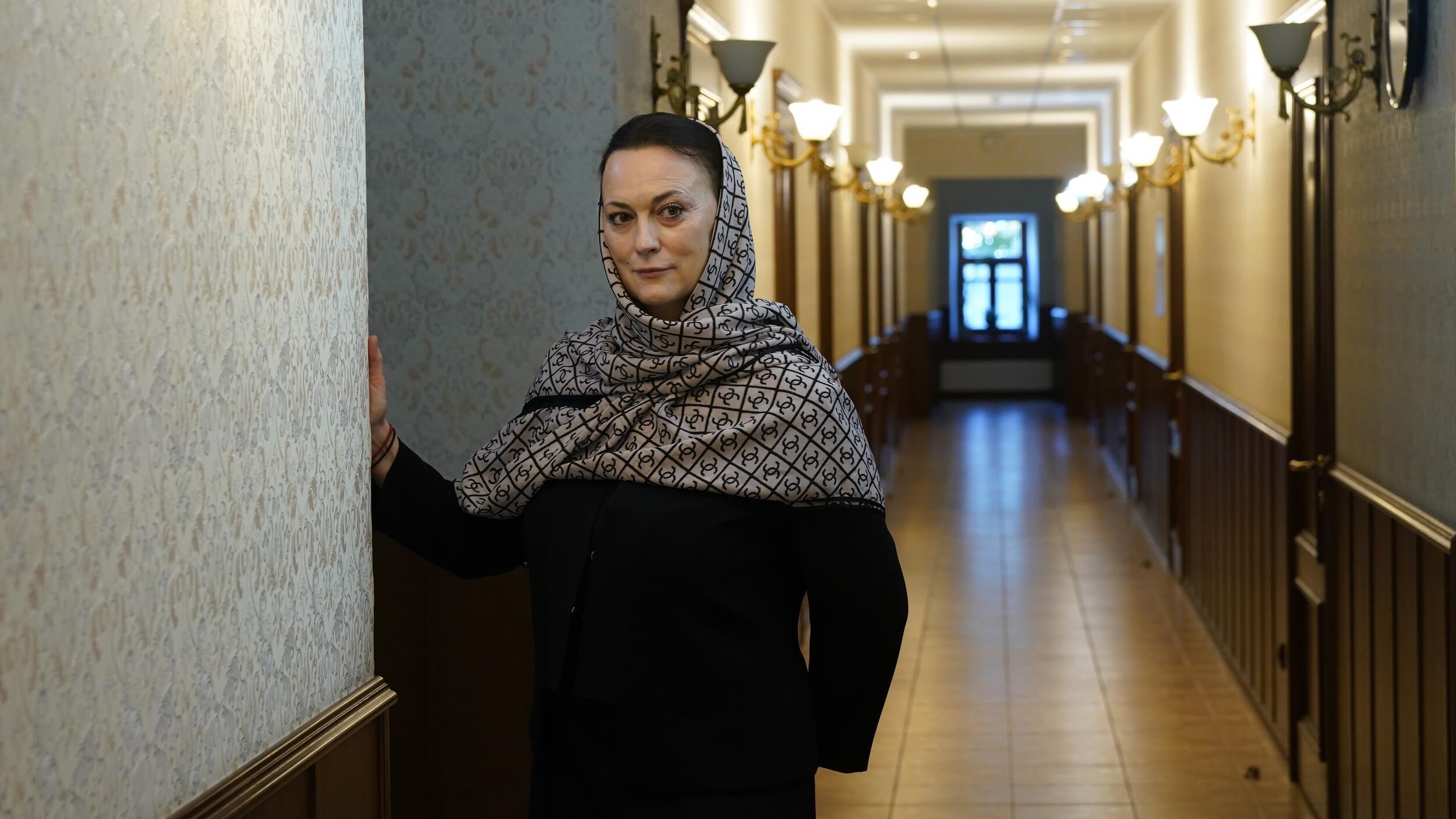
— For two years now you have been here in the Lavra, in what is, in part, a state of blockade… do you not regret that you have spent all this time here?
— Not in the least. On the contrary, it even seems to me that one day we shall miss this time. A time with more of something genuine and unfeigned in it. When Providence is seen somehow in a special way, closer perhaps, as though you were touching it… and everything works out for you so that it could not have been otherwise. And you also notice that in life you are not alone at all, not only where people are concerned, but also in what is called help from above. And this experience, which can be compared to nothing else, is worth a great deal… All this is hard to put into words. Many people think that as soon as we are thrown out of the usual course of life, all is lost. But no, it is here that everything new and good only begins.
— Well then, let us recall how it all began. So, on Wednesday, 9 August 2023, before the court hearing in the case of the eviction of the brethren, the Reserve sent a letter demanding that all three guest-house buildings be vacated by nine in the morning of the following day.
— Yes. I was here. It was my shift, and I remember how some of the people staying with us set off for the courthouse to support the brethren. They all came back quite late — after nine in the evening. And the next morning they were getting ready to go back to the court, since there was still no final decision. We had been warned about the Reserve's demands, but such conduct on their part was not only entirely unlawful, it also pointed rather to the distant Bolshevik past, especially where monks and believers were concerned. All this greatly outraged our church people: on 10 August parishioners gathered at the steps of the guest houses and the brethren came up as well, so that the representatives of the Reserve, who appeared at about 10 in the morning, had to go back again, having formally recorded that they were not admitted.
— At about the same time the court session began. Everything was predictable: the Reserve's claims were granted in full. All that was left to us was the possibility of lodging an appeal. But the surprises did not end there. On leaving the courthouse we learned that the entrance to the lower territory of the Lavra had been closed to everyone except the brethren.
— Well yes, that evening our pilgrims could no longer get into the guest house. Some of them were still allowed to collect their belongings, but the rest had to spend the night in the church of Ven. Agapit. And the next morning the deputy director hung on the door of our building a sign reading "Access to the building is prohibited", placing guards at the same time in the grocery shop that stood next to it. The guards were instructed to let nobody in to us and even to obstruct any attempt to pass us anything, food included. That is how our "seclusion" began on 11 August.
— And how did you survive here?
— First of all, we had some supplies in the guest house, what are called the bare necessities, and food was passed to us through the window all the time. Besides, when they learned what had happened, our sensitive Orthodox people at once began to send parcels. We were supplied with everything we needed and even more, especially in the way of kitchen things. We felt the support very strongly. The brethren also supported us with prayer, with a kind word and, often enough, simply with a treat from the brothers' table or garden.
— And how did things stand with spiritual guidance. It is clear that being in a monastery is in itself already an obligation in many ways, and yet you were deprived of the possibility of going to church, of receiving Communion…
— Around the fifth day Archimandrite Varnava managed to arrange services inside and to commune people with the Reserved Gifts. But that applied only to the 58th guest house. With us, by that time, there was no priest left at all. What is more, when Archimandrite Samuil came up to our building after the Liturgy with the Chalice, he was not allowed to give us Communion even through the little window. In such conditions all that was left to us was to connect to the video broadcast and follow the service all together. Naturally, we had a prayer rule of our own. We decided that we had to walk in cross procession and read special prayers, so that our building would not be taken from us. And so we have walked in cross procession through the building to this day: that is, we read the morning prayers, then go up to every floor, read the Gospel there and walk along the floor with prayer. In time, not without the help of Father Varnava, we worked out a prayer rule of our own. Only at the end of August was there the one occasion when one of the Lavra priests took the risk and got into our building "in a mystery-making way", heard the confession of all of us and gave us Communion.., but that was the only time.., after that we plucked up courage and began to attend the services in the same "mystery-making" way… We had to get up very early so as not to be noticed. But then again it was always dangerous, because there were guards at the posts.
— How did relations with the guards work out, were there any among them who treated you with understanding, who met you halfway?
— We had no conflicts at all with the guards. We were, in effect, breaking nothing and did not go beyond what was not allowed. We did not use the central exit and had grown so used to going by our hidden ways that we did not even have to open the front door… The guards were always in plain view to us. They told us that we were free to leave. We were allowed to leave; it was simply that we understood we would not be able to come back. Of course, the guard shifts varied. Someone would carry out raids over the territory looking for parishioners who had come in without being on the list, but nothing really outrageous ever happened between us and them. Only once, near the church, they began to check us and to question us — who are you, where are you from.., we talked with them for a long time and they were even ready to escort us outside the monastery, but then the conversation somehow took a different turn. We explained our situation, our personal circumstances, that we have this possibility, and they, for all their strictness, somehow softened, treated us with understanding and let us go.
— The next significant moment is the visit on 1 September of the Verkhovna Rada Commissioner for Human Rights, after which food was allowed to be handed over directly — through the door.
— Only that decision did not affect us in the least; it applied only to guest houses No. 57 and No. 58. With us everything stayed as before. And our well-wishers, those who supplied us with food, also had to bide their time so as not to catch the guards' eye.., but we were never left hungry.
— And how did things stand with the daily order?
— We worked out a routine: the morning prayer rule, then breakfast, then the cleaning of the whole building, at one in the afternoon the akathist, then a little rest, time for personal matters, supper and the evening prayer rule.
— In conditions where walks have become impossible, has the habit not developed of pacing the room endlessly, sometimes covering kilometres, as was Dostoevsky's habit?
— Of course one misses walks, but they can be made up for with gymnastics… I caught myself thinking that I once had an acquaintance who was put in prison as a young man, and he came out of there so athletic that I could not help asking how that was possible, and he said then that you do not need much space for it. I often remember those words of his. And, yes, we make up the prescribed daily norm of six kilometres with the daily cleaning. That is physical labour too: we are constantly vacuuming and washing all the floors, even where nobody lives. Go into any room — with us everything is tidied and washed. The care of the flowers, which have grown unbelievably over all this time, is a story of its own.
— Well, here we are coming to yet another turning point: after seven months of blockade the guard was removed from the guest houses. Since 4 March 2024 your buildings have not been guarded by anyone.
— Yes, life has become somewhat easier, but all the same we cannot walk too freely about the territory, because at any moment a police car can drive up to you and a document check will begin with questions: why are we here at this hour?.. Naturally, to avoid all that we try not to go out, although there are no such harsh measures any more now and we can calmly open the door, yet there is still no full freedom. And getting onto the territory of the Lavra is just as difficult. Not all of us can stay here without ever leaving: one has a family, another a flat, some other obligations, and if only a few times a month, one still has to get home. One has to climb over the Lavra wall, and that is always a risk, because it is not enough merely to climb over, one must also walk quietly and watch whether there is police nearby, or wait for the right moment. And we, again, try to come when it is already growing dark. Yesterday, for instance, I came at half past nine — at that hour the guards are resting and they are not so vigilant.
— How do acquaintances and friends react to this life, which to many may seem an adventure?
— To be honest, this sometimes embarrasses me, because many people simply do not understand all the seriousness and the weariness one has to face here. Take, if only, the exhaustion from the constant, by now chronic, stress, or the anxiety that pursues you when you are making your way in here. I even had to film the whole of that route, because in the minds of many I am simply going to work, as I did years ago. So I have to show them and explain. I have even thought out how to answer the frequent questions about what I am doing here and what my duties are now. I say: we are watchmen here, not administrators as we were before, we only guard and maintain this building so that it stays fit to live in. It cannot be abandoned. The moment you abandon premises, they fall into decay. We have already seen that in the case of the 34th building taken from the monks, where there is mould everywhere on the walls and the parquet floors have swollen. It is the same story with the former seminary dormitory. And then there is the smell of mould in the Dormition Cathedral, the raised damp in the caves… And all the other buildings seized from the monks are left, at best, without proper care. One has to explain all this — some understand, but far from all.
— And in general, is it difficult to remain true to yourself when the people you know do not understand you?
— It is difficult. There was even a moment when I asked myself: well, how long can this go on, what and whom is it all for, since in effect we are not working, matters are not being resolved, the court cases drag on, there is no salary, because it is clear that the Lavra is not fully functioning. And I even said once to our parish priest, Father Sergiy, perhaps it is time for me to end my labour? And then he asked me: "Tell me, perhaps you have problems, perhaps you are in acute need of something, need to go to work, to earn money?" No, I say: I am in no extreme need, my children help me, they understand everything. "Then let me pray for you every day, only please do not leave that place"… Support helps a great deal. Besides, I am a responsible person, and for me, over so many years as an administrator here, all this has become almost my own child, almost like a flat or a home of my own, and you cannot simply up and abandon it.
— Has your attitude to God changed over this time?
— When I first came to the Lavra, it seemed to me that I would work here for only a year. It was to some degree a continuation of my churching; I was interested then in working out what sort of Orthodox faith this is that we have. And at first I too was asked questions: "And with what purpose did you go there?" And, to be honest, I still find no clear answer to them. And yet there is a firm understanding — I am on the right path, none of these were chance steps, everything led up to this, and even the losses that came to me in life were not by chance either, hard as that is to accept. Evidently there is some purpose in all of it. So yes, I have come to trust God more. Besides, the path of those who voluntarily give up the accustomed order of life, freedom of action and of desires has become much clearer to me. Before, that seemed to me difficult and inapplicable to myself. And now I am learning to draw profit even from such circumstances of life, and in the first place spiritual profit.
— And as regards yourself, have you learned anything new? After all, the situation is, to put it mildly, an uneasy one; it depresses some and, on the contrary, makes others stronger.
— Yes, this seclusion here, forced in part, is exactly what I need, because it is not clear what I would be doing if none of this had happened. To be honest, I would never have stood and read so many evening prayer rules, would not have walked in cross processions… And now, when I get home, I already miss it, so that more than once the thought has come to me: why not walk in cross procession round the flat? (laughs). There, for me there is a definite benefit in it; besides, you begin to think about things more deeply. So all of it is needed by us for something.
— How did you react to the news that about twenty of our residents had left the monastery, while you remain and live in the Lavra practically as its residents?
— I understood that the situation could be serious… they were labelled "Moscow priests", made into something close to enemies of the people. So no, I do not condemn them in the least. We are all different, after all: one is afraid of something and another is not…
— But then, by and large, the matter never went further than threats. Of course, our abbot Metropolitan Pavel got the worst of it: both temporary confinement in a pre-trial detention centre and the refusal of entry to the Lavra, but the rest of the brethren, for the most part, got off with threats alone. With some, of course, these turned into imagined frightening scenarios.., but all the same it was only a foreboding, often exaggerated and blown up…
— Everyone has moments of weakness… Anna Andreyevna Akhmatova was once asked whether one may leave one's homeland to escape death, or whether that is betrayal all the same. And she answered: "And what, in your view, was the flight of the Holy Family into Egypt, if not emigration… What matters is to understand what you are fleeing from and where you are going"… On the whole it is hard to say. But I repeat, we are all different.
— The threat of the seizure of the Lavra still hangs over us all. How do you answer for yourself the thought, which comes unbidden, of the final closure of our monastery?
— And do you remember what the elder Porfiry, the spiritual father of the Gethsemane Skete of the Trinity-Sergius Lavra, said in the days when the threat hung over them that the Bolsheviks would deal with Orthodoxy? "The enemies think to overcome the Church and set senseless people against the Truth. But in the end sin will be defeated by the suffering and the steadfastness of those children of the Holy Church who have remained faithful to Orthodoxy. See, it is in struggle and in labours that love for God and for the Church is known… Yes, I am very sorry for our Church. It may well be that all the churches will be closed and the last monasteries destroyed. But that is no misfortune. Even in her closing she will shine with such a light that she will overcome the darkness of those who close her, and those who now persecute the Church will bow down before her." There is so much hope, cheerfulness and strength in the elder's words. Of course, each of us hopes that in general not only the war will end, but also the trials that are taking place here, and that we shall undoubtedly still work here…
— Wonderful thoughts. Thank you very much!
