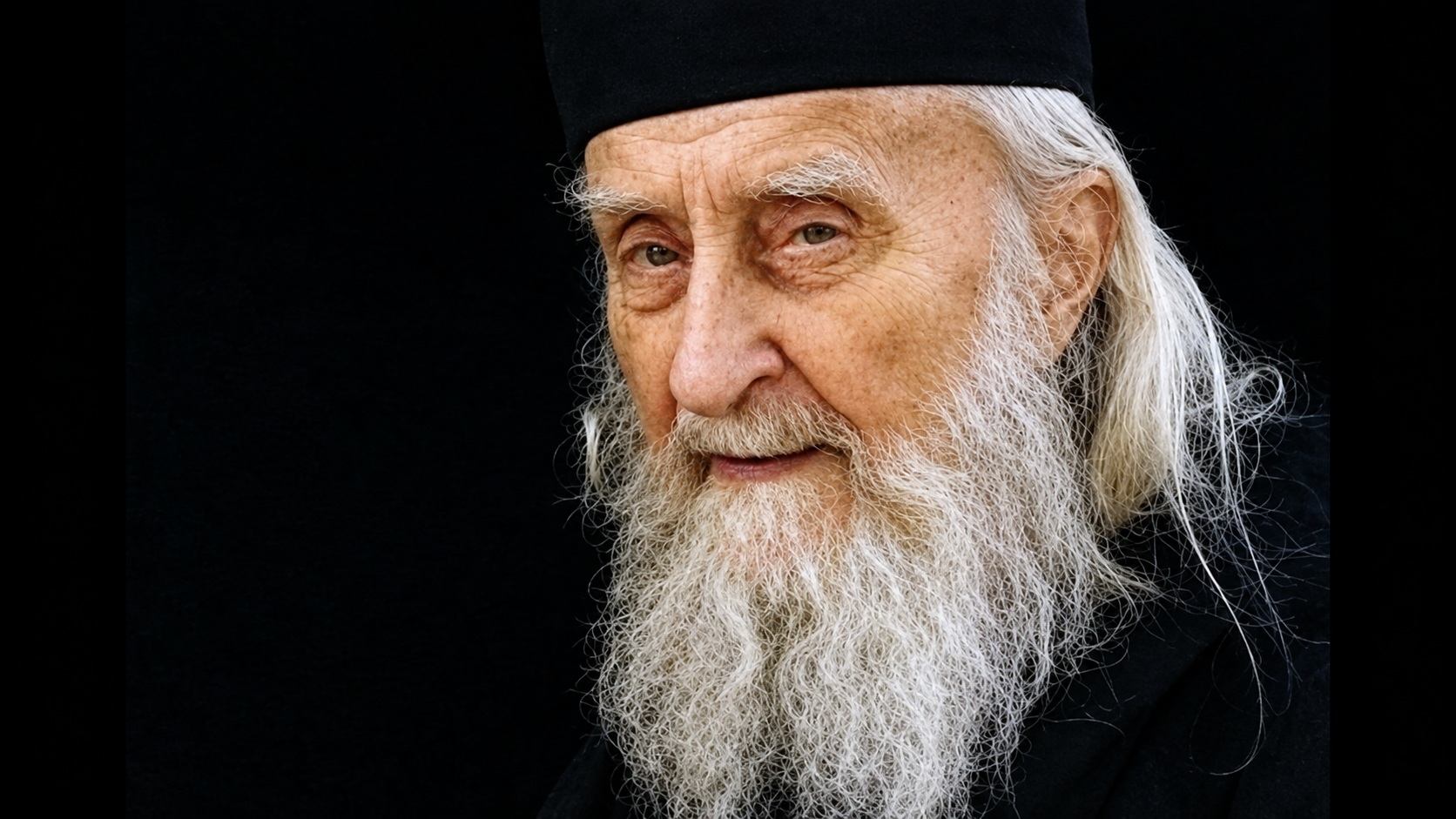
— What are your personal impressions and recollections of your conversations with your uncle, Archimandrite Sophrony (Sakharov)?
— A whole book could be devoted to my recollections of Father Sophrony, for I spoke with him every day for four years. Every word of his was a discovery for me; that, indeed, is why the monastery came into being: people heard the words of Elder Sophrony and decided "to whom shall we go" (John 6:68).
Let me tell you very briefly how we met. I was born in Russia in Soviet times, when any contact with the West was very dangerous. Father Sophrony used to come to Russia then as a member of a tourist group. But, in secret from the "minders", he managed to give an hour or two to being with his family. And on one of those visits, when I was already a young man of some understanding, he came to see our family. I was studying at a music college then and had no notion whatever of religion, of Christianity or of monasticism. When I saw Father Sophrony his appearance, of course, seemed strange to me. For the first time in my life I saw a man in a cassock, a monk with a long beard and long hair. It seemed strange to me; I wondered what it was all for. We talked a little about music. He knew musical culture beautifully, he knew poetry and literature beautifully. There was always something to talk about with him. Then he left. Later I learned that when he returned to England he said of me: "I have met a young man who may perhaps join us later." At that time I did not really even believe in God. After that meeting my life took an entirely different course... Already in the army the desire to enter monastic life ripened in me. After the army I was given the opportunity to visit Father Sophrony.
What struck me in Father Sophrony was the Athonite cast of mind itself, and that spiritual freedom which we so lack and of which the Apostle Paul writes: "Stand fast in the liberty wherewith Christ hath made us free" (Galatians 5:1). But this freedom also holds dangers within it. And only people of high spiritual awareness can live in such spiritual freedom.
— What is the essence of his teaching on eldership and his teaching on obedience?
— Father Sophrony used the word "obedience" extremely rarely. He never demanded obedience of people. Everything people did, they did out of love for him. I think that this was obedience, because when you love a person you fulfil his will. This is so not only in monasticism, but in life and in the family. Father Sophrony was, of course, very easy to love. And to do anything for him, to fulfil his will, was a sincere joy for every one of us. That is why we heard the word "obedience" seldom. Father Sophrony always held that obedience is, above all, a free act of the will. But obedience imposed upon a person from outside, especially if it is imposed by force or by threats — such obedience bears no spiritual fruit. Father Sophrony writes: "All that is attained by violence has no eternal value; only that which is attained through love and free, conscious obedience." It was precisely such obedience that he considered to have spiritual value... And such love for an elder as his disciples had cannot be imposed by any canons. It can only be earned. A man can find the key to another's heart only through love. And then obedience already "flows like living water", in the words of John the Theologian, into life eternal (cf. John 7:38). We are speaking with you now, of course, about ideals. But what I saw in Father Sophrony, and what was in Saint Silouan, who was Father Sophrony's elder, is that not the slightest word of compulsion ever came from them. Rather, they themselves rendered obedience to everyone else.
Another thing that struck me in Father Sophrony was the exceptional accessibility of this man — precisely accessibility, openness and the absence of any distance in conversation... You know, the energy of love in the monastery was felt constantly by all and by each: by the monks, by the parishioners, by those who simply came to the monastery. By the monks especially... When Father Sophrony sent someone to some work or labour, he thought first of all of that person's spiritual benefit and not, let us say, of the practical needs of the monastery. That is why he could often change a person's obedience. I remember a sister who came to us and at first worked in the vegetable garden of her own wish, since Father Sophrony always respected a person's wish, their will. Then he saw that she had a gift for theology. All that time he was with her in his thoughts in the garden, as he was with all of us; he asked how the day had gone, what we had done. (And then he gave her his blessing to take up theology.) When I first came to England I did not know English at all, and Father Sophrony began above all to care for my education. When he sent me to school in the nearest town, Colchester, absolutely everything interested him — how I travelled by bus, what the classes were like, what the teachers were like, how my time passed there... And he cared in this way for everyone, so that a person might have the opportunity in life to realise himself as a person and be deprived in nothing.
— Are there any particular features in his teaching on prayer and in his practice of prayer, in the practice of contemplation?
— Father Sophrony described this experience in his books, especially in the book "We Shall See Him As He Is". It is his deepest confession, which he dared to set down on paper a few years before his repose, and for which he received a great deal of censure and misunderstanding from some believers. But the undoubted benefit which his texts on prayer bring speaks for itself... As Father Sophrony was sincere in absolutely everything, so he was sincere in his prayer to God. He told God absolutely everything and trusted Him with it. And he taught us too, above all, sincere prayer, so that prayer, and liturgical prayer especially, should not be a mere "reading through", a detached running of the eyes over the text. He wanted us to learn to live every word of the liturgy, because prayer for us is above all liturgical prayer. This is the foundation of life in our monastery. Everything is around the liturgy, around the communion of the Holy Mysteries of Christ.
People often say: "But what about the prayer rule? It has to be read through." When Father Sophrony was still on Athos he once asked Elder Silouan whether the reading of the canon could be replaced by the Jesus Prayer. Father Silouan answered that it could. This episode is described in the book "The Mystery of Christian Life". The abbot, seeing Father Sophrony's gift for prayer, was afraid to speak of it openly. For the sake of the other monks he did not approve of such a replacement of the prayer rule by the Jesus Prayer. But this did not apply to such men as Elder Silouan and Father Sophrony — to men who had attained a certain height of the labour of prayer.
Father Sophrony once wrote to a parishioner who had asked him: "I have to say my prayers, but my whole disposition towards God is quite different. I have questions, I want to ask Him why this is so in my life, why that. Lord, give me understanding. I do not want to read 'Lord, I thank Thee', because at this moment I am even in something of an argument with God." And Father Sophrony wrote to her: "Do not be afraid to question God; be afraid of being insincere with God."
Father Sophrony once had a dialogue, even an argument, with God. He was praying on Athos and said: "Lord! How can I fulfil Thy commandments? For I am a man. How wilt Thou judge me? Thou art God, the Almighty, all-powerful, all-knowing. Thou hast the fullness of being, Thou art the source of life, the source of creation. And who am I? I am a little man. If I do not eat, I die; if I am struck, I die; if I fall ill, I die. I walk constantly under the fear of death. My infirmity does not let me draw near to Thee. How wilt Thou judge me?" Then he heard God's answer in his heart: "The Father judgeth no man, but hath committed all judgment unto the Son (John 5:22), because He is the Son of Man." Then Father Sophrony understood that he had lost his argument with God. He would be judged not by a "distant and almighty" God the Father, but by our Lord Jesus Christ, the God-Man, Who is both God and Man, Who felt upon Himself all the conditions of our life. Remember how the Evangelist writes that He did not have even time to eat bread, no time to pray. The Lord would go up at night to the mountain to pray, to solitary places. If we say, "Well, we have no time to pray", the Lord will look at us and say: "You had no time? I had no time either." Very often people run from prayer, from converse with God, not because they have no time, but because they have no desire, because there is a certain spiritual sloth — I say this from my own experience. And so one can pray always and everywhere. Prayer is always an inward standing before God, and not simply a reading through of rules or canons. That is far from enough.
— You spoke of Father Sophrony's accessibility, of his simplicity. But we know that he was a most highly learned man. How were the two combined?
— Yes, he knew a very great deal; he was in the full sense a theologian of academic stature. His teaching has now become part of academic Orthodox theology. We see this in the works of Metropolitan John (Zizioulas), who drew spiritual and theological nourishment from Father Sophrony, and in the writings of Metropolitan Hierotheos (Vlachos), and in Bishop Kallistos (Ware), and in many other Orthodox theologians. But in conversation with Father Sophrony there was never any sense that he was looking down on you. He always repeated: "Love does not love from above; it always humbles itself before a person."
— Father Sophrony associated with and learned from people whose theology is rather questionable — from Father Sergius Bulgakov, from Metropolitan Anthony (Khrapovitsky). To what extent does Father Sophrony's theology depend on them, and did he manage to filter out the questionable things in their teaching?
— It must be said firmly and with confidence that the foundation of all Father Sophrony's theology is the Tradition of the Church, and above all the ascetic Tradition. All his theology rests also on the ascetic experience of Athos and on his own personal experience. Although he could draw, and did draw, certain means of expression and certain themes from the theology of his own time, in no case did he draw its spirit, its ideas or its tastes. That is why he treated with extreme caution everything that would go beyond the bounds of the Tradition of the Church. The witness to this is his correspondence with Father Georges Florovsky. When he had in fact taken shape as a theologian, when his triadology and his christology — which he had not only lived through but lived — were able to crystallise into words, he then sent his whole theological scheme, if one may put it so, with humility to Father Georges Florovsky, who was at that time a leading light of Orthodox theology, a luminary of Orthodoxy. Because of Father Georges's thorough knowledge of the holy fathers, no one could accuse him of being unorthodox. Father Sophrony wrote to Father Georges Florovsky: "Look and see whether I have written anything there that does not accord with Orthodoxy." Father Georges Florovsky, having read his letters and his theology, answered with a deep mutual understanding of many questions and with a deep solidarity in rejecting nationalism in the Church. It was precisely from this that Father Georges suffered greatly. I think that our knowledge of patristics, compared with the knowledge of Father Sophrony, who knew Greek and the holy fathers perfectly, sometimes makes us consider how deeply we really know the patristic tradition. For Father Sophrony would quote works of the holy fathers which in those years did not yet exist in Russian — for example, the "Ambigua" of Saint Maximus the Confessor. When he quoted even simply the thoughts and ideas of the holy fathers without referring to them, those ideas themselves could sometimes cause someone a certain incomprehension or perplexity. But if a person is unable to grasp some teaching of a holy father, Father Sophrony is not to blame for that. What is to blame is our own insufficient knowledge of the patristic tradition.
— What is the present position of the monastery in Essex founded by Father Sophrony, what is its canonical order and its internal structure?
— The monastery is in many ways unique. This uniqueness was born of the teaching of Saint Silouan the Athonite, who prayed for the whole world, for the whole of Adam. Remember his prayer: "Lord, grant that all the world may come to know Thee, all the peoples of the earth." This universal scale of thought was very close to Father Sophrony. For him any diminishing of Orthodoxy by nationalism was blasphemy. That is why our monastery is multinational; we have people of fifteen nationalities: Orthodox from Greece, from Cyprus, from Romania, Denmark, Sweden, Finland, Germany, France, and our abbot is from New Zealand. And in this lay the problem for Father Sophrony — to which Church should the monastery belong? The Ecumenical Patriarch Athenagoras met him halfway, writing in a letter to Father Sophrony that, since the monastery was multinational, he was ready to grant it stavropegia so that the monks might live freely. This was a great support.
Our monastery cannot be called Greek, Russian, Romanian or English. I think that such an idea of a multinational monastery in an Orthodox country is a utopia. But in the conditions of emigration it is possible. This does not mean, however, that the duty to have such a universal Christian consciousness does not rest upon the monks of any Local Church. Saint Silouan prayed for the whole world, for the whole of Adam. For him there were no enemies. For him there were no ungodly. For him there existed only one division within mankind — those who had come to know God and those who had not. And so for those who had not come to know God he prayed with tears, laying down his soul in prayer. That is how Elder Silouan prayed.
— Thank you, Father Nikolai, for this interesting conversation about Archimandrite Sophrony (Sakharov).
The interview was conducted by Hieromonk Adrian (Pashin)
