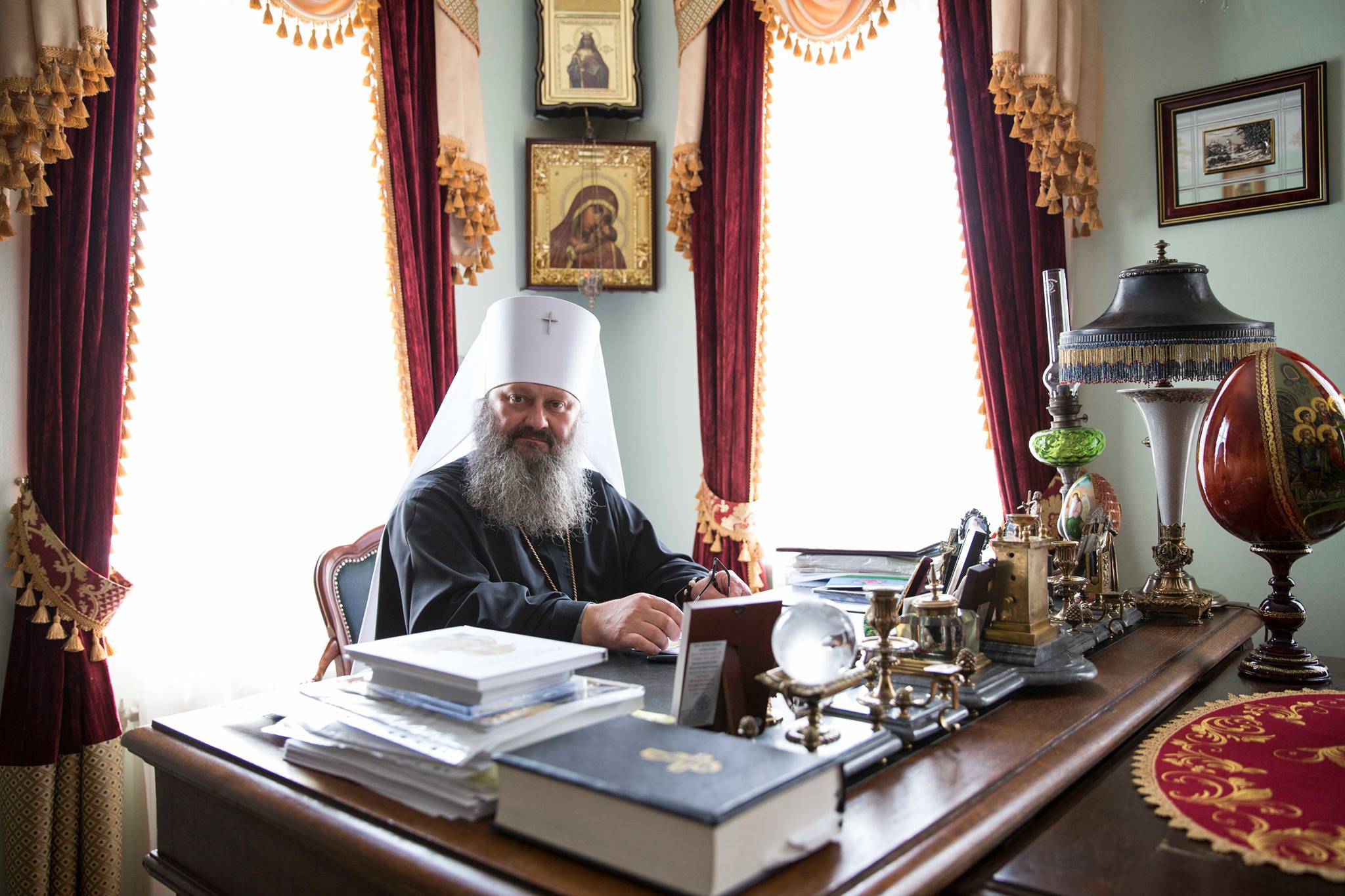
— Your Eminence, in your view, what is monasticism? Why did it come into being? What is its purpose? For the Lord said to the first human beings: "Be fruitful, and multiply…" (King James Version)
— I thank you for raising such themes. My answers will of course be of a particular kind, because monasticism is a hidden life within a man, and every man is unique.
The first woman monastic, earthly and heavenly, was the Mother of God. She is the Abbess of all monastics. And in this She fulfilled the blessing of the Heavenly Father, for, having loved God with all Her heart, the Most Pure Virgin lived from Her earliest years at the Temple in Jerusalem and so perfected Herself in obedience, in prayer and in ascetic labours that the Lord looked upon Her humility, and, saving us, "the Word was made flesh" (John 1:14, King James Version).
Many of God's holy saints, without being monastics in form, bore the labour of monastic service in spirit: John the Forerunner, the other prophets, the forefathers. We know the labours of many people of a high and holy life who laboured and pleased God even before monasticism was formally established.
If we speak of monasticism in the broad sense, then what belongs here above all is the Lord's teaching on virginity (Matt. 19:11–12) and the words of the Apostle Paul which shape a right understanding, that "he that is married careth for the things that are of the world" (1 Cor. 7:33, King James Version), while a monk is a man who has voluntarily taken the vow of celibacy, the vow of high ascetic labours, the vow of service to God, like the holy saints, so that nothing may hinder him from going by the royal road into the Kingdom of Heaven.
Monasticism is the path of a whole lifetime… It is very hard, because if in ordinary life people more often struggle with outward circumstances: career, daily life, family, wife, children… — then here there is a particular warfare against oneself. It is a challenge to step away from all vanity and to choose the thorny but true path…Monasticism is the highest degree of love for God.
— And what are the marks of a true monk?
— They can be traced from the very rite of receiving monasticism, from the profession of the monastic vows. A true monk, an ascetic of piety, is thankful to God for everything; he lays up no treasure, he gathers nothing for himself — he loves everyone, he prays for everyone. But most of all he values the labour of prayer and of self-instruction — the labour of constantly developing himself. Because no ascetic can teach anyone anything except by his own living example.
We have the vivid example of the wise thief and of Judas. The first was on a depraved and terrible path — and entered the Kingdom of Heaven, while the second was, I would say, in the Saviour's own arms — and perished.
One may have everything in life in its season and at the same time cleave to nothing with the heart. We see the labours and the ascetic feats of the right-believing Prince Alexander Nevsky and of other saints, of people great in the world, who received the tonsure in the last days and even hours of their lives and stood before the Lord as true monks. And one may live for years in a monastery and cling to empty, needless things, learn nothing, and so perish spiritually.
And so a true monk is one whose eyes always look down to the earth, seeing nothing around him, while his mind is constantly in heaven with God.
— Vladyka, and how did you yourself decide that monasticism was your path?
— I did not know how it would be. You know how it was in Soviet times… I come from a half-Protestant family. My father's mother, my grandmother, was a believer, but she went to some sect or other — Pentecostals? — I do not know. I was perhaps a 12-year-old boy when my late grandmother took me to the Lutsk cathedral — and there I saw Vladyka Damian. And out of a child's folly I said to myself: "I do not know how it will be, but I shall become such as that father is." And when I had understood the meaning of what I had been striving for… I felt ashamed before myself.
My fate was decided by the fire at the Moscow theological school, in which five of my fellow students perished and I survived. It was then that I made a vow that I would receive monasticism. My mother was against it at first. My father was not; he said: "You are grown up; see that I am not ashamed of you if you do something wrong. This is a holy and great rank and office."
Of course there was a great deal of trouble over me. I wanted to go to Athos — they would not let me. In the end I came to Lutsk, to my ruling bishop — a man of holy life — Vladyka Varlaam (Iliushchenko), and said that I wished to receive monasticism, and so my present path began.
I never thought of being a superior. I did not think of being a bishop — because that was unattainable in Soviet times, and I set myself no lofty goal. I simply lived… As the late Metropolitan Volodymyr used to say: "Ask for nothing and refuse nothing." And that is how I acted.
And today I cannot say that I am a worthy monk, because, unhappily, vanity of vanities often takes up a great deal of time… I greatly dislike paperwork — and there is plenty of it: documents have to be drawn up, and the correct running of the whole household has to be organised…
I look at our brethren: today monks are confessors. In former times a man went out into the desert — no hours-long confessions of our pilgrims, no telephones for you, no company. You and your Creator. But today there is vanity and sin everywhere and on every side! Above you, before you and on either hand. All of this wounds the human soul. Though, in the words of the venerable Anthony the Great, we — the monks of the last times — will be very poor ones compared with our predecessors, yet God's all the same, because blessed is he "who could transgress — and did not transgress, and could work evil — and did not work it."
— Monks often speak of the importance of humility and obedience. People who do not know monastic life sometimes understand this as a humiliation of human dignity, as weakness of character. Is that so?
— I would not say so. It is a high ascetic labour. Look how many billions of people there are on the planet, and how many of them are monks? Not to everyone is this labour given. Monasticism is the flower of the whole universe, it is the greatest of gifts. And humility too is a gift, "according to thy faith." Not everyone is able to humble himself.
I cannot say that I am a humble man. But I greatly dislike scandals and intrigues of every kind, although at times one has to be drawn into them in order to defend the holy monastery's right to its own churches and buildings. For centuries the monks built everything here, and today we are compelled to rent what is in essence our own…
Speaking of humility, it is important to understand what sort of property of the human soul this is. Through the humility of the Mother of God we received salvation. Through the humility of Christ, who went up onto the Cross, we are delivered from eternal torments and sufferings. Humility is the greatest of gifts.
— The experience of humility of which you have just been speaking is passed on only by experience, is it not? And if we speak of the importance of passing on this living experience, monasticism has always been inseparable from such a notion as spiritual guidance, eldership. What sort of phenomenon is this? Who are the elders? Are there such men in the world today?
— Eldership has always existed. Eldership is a gift to us sinful people, to see holy people with our own eyes. Elders are, before all else, men of prayer. Not every old man with a beard is an elder. There are many crafty ones, especially today, and the main thing is that such "elders" want to make a name for themselves.
The genuine elders are the venerable Fathers of the Kyiv Caves, the Glinsk elders, Seraphim of Sarov, Sergius of Radonezh, Job and Amphilochius of Pochaiv — they withdrew from the world and from glory, they did not press their teaching on anyone. They simply showed by example how one ought to live. No prudent elder will prophesy openly: he will say a thing casually — you will not even notice, and it all comes to pass… Elders are people who entered into themselves, into their own heart. As the Apostle Paul says: "Set your mind on God" (Col. 3:2). They saw nothing but the Lord alone.
And in our own time there are elders. I had the opportunity to talk with them. I saw Fathers Avramii (Kuiava), Nektarii (Kovalenko), Kirill (Pavlov), Naum (Baiborodin), Matfei (Mormyl)…
One could sit beside Father Avramii or Father Kirill and not hear a word from them except the way he says his prayer — and willy-nilly you too begin to say the Jesus Prayer, because it is shameful to sit beside him and do nothing. By their silence they parted the heavens, and the Lord sent down His mercy and His enlightenment. I had the opportunity to see such elders; I am a very fortunate man.
— And how are they to be sought, and ought people to do it?
— They ought. But not in order to ask health for oneself, not so that everything should go well at work, in one's service and the like. First of all one asks through an elder for mercy from God, who knows what we need.
Eldership is God's gift to mankind. Unhappily, such people are already growing scarce, because no one listens to them and no one hears them.
— Vladyka, is absolute obedience to one's spiritual father obligatory for a monk?
— It is obligatory. Christ "became obedient" to His Father "unto death" (Phil. 2:8, King James Version). From obedience all the other virtues are born. As from pride and envy everything bad is born, so from obedience — all the virtues.
Here, I want to drink some water, and the father says to me: "No, bear with it." — "But how? I shall fall down!" — "Bear with it!" And when you cross that line of your own stubbornness and submit to the will of God through an elder — everything will be given you. You will not lose consciousness, thirst will not torment you, and the Lord will send springs of living water in the Holy Spirit.
— And for a layman, are such relations with his own spiritual guide fitting, are they useful?
— They are needed and they are useful. A layman and a monastic differ in nothing as to faith, as to the pleasing of God. It is only that there are different ways of this wondrous ascent. And the family's ascetic labour may be higher than the monk's, as Anthony the Great revealed. Look at the life of the martyrs Faith, Hope and Love and of their mother Sophia: before your very eyes your whole nature, in the form of your children, is being put to death. And the wise mother entreats: "Bear it, my child. He who created heaven and earth, who gave you life, will reward you. Bear it." This wisdom of motherhood a man cannot acquire in monasticism.
— It is said that the health of the Church, if one may put it so, is measured by how many active monasteries and monks it has. Do you agree with that?
— No, I do not agree. Why? Because there may be many monasteries, but…
Look: what deserts of holiness Egypt had — and it did not stand. What churches there were in Constantinople, how many holy things were gathered there — it did not stand.
— Vladyka, if we recall the first decade after the Church in Ukraine became free — the 1990s, the beginning of the 2000s. It seemed then that a rebirth of Orthodoxy was under way, the churches were filling up in great numbers, a great many people, having read their fill of spiritual literature, were going into the monasteries and receiving the tonsure. If we survey the last ten years of our Church's life — have we attained that rebirth?
— The Church is always holy and unspotted. And of course, when it became safe, many gathered into the Church of Christ as to a marriage feast. But in what garment? Some came because they sought earthly goods. Others came because they liked some bishop or priest in a purely human way, and were seeking not spiritual but emotional consolation. Others again came simply for the sake of a beautiful tradition. And in the end, when the hour of the testing of faith came, there remained in the Church only those who were in the wedding garment. Those who had come to the foot of the Cross of Christ for their own salvation.
Those who were not in the wedding garment fell away. They simply lived according to the spirit of the age.
In the end, after the upheavals permitted to us, there has remained in the Church of Christ only the true wheat, which the Lord is quietly gathering into His barns.
I remember my old women, the grandmothers whom I still found here when I had only just been appointed superior. And they, like God's dandelions — trembling already, already 90 years old — remained faithful both in the terrible godless time and in the troubled days of the schism, because they had a firm faith. Not the spirit of the passing age, but faith.
— In former times the monasteries were replenished chiefly from the rural population, that is, from people who had been accustomed to work from childhood. Such people were easier to teach to pray as well. But the present generations live quite differently — television, computer, sofa… Civilisation, in a word. Is there a difference between the monks of the past and those of today?
— In 28 years I have not known in this monastery any problems or any deprivations. The Lord and the Mother of God are so much with us! I simply cannot convey to you what happens to a man when he plainly feels that "O taste and see that the LORD is good" (King James Version).
If a man has found Christ, no matter who he is — the head doctor of a hospital, a prime minister, anyone else — if he comes to the monastery not for the sake of a crust of bread but for the sake of Jesus, then he will learn everything.
First of all, all of us need to learn humility — the very thing for the sake of which we go into a monastery. I myself could do nothing, and still cannot. But if you want to learn to pray, you will always learn. God will give according to the striving of the heart. When I was ordained to the priesthood, once only — I am not ashamed of this and say it "as at confession"… once only I had such a moment during the Eucharistic canon: I was not standing on the earth, I saw that I was not on the earth, and when the Gifts had been changed I stood upon the earth again. How much I afterwards wanted to feel that, how hard I tried to bring back even for an instant such a state of spirit — and I never did! That is why the holy fathers say: "If even once you have prayed from the soul, from the heart, you will always be seeking that moment." I have lived through this myself.
In a monastery there must of course be labour, both mental (for those who are able) and physical (if there is any, of course…) Here in the capital we have practically no physical labour today. In former times a man had to work in the vegetable bed, to grow things, to gather them, to process them… But we live on everything ready-made. And that is a terrible thing, because we can no longer do anything with our own hands. If the electricity is cut off, it is the end of the world! Because we have become dependent on this whole bloc of economic and technological development which, while supposedly caring for man, destroys him and makes us incapable of action.
Today, if there is no bus, no car, we do not go to the service, because it is far. But in former times people made the effort, they suffered, and they went. Look at the old black-and-white photographs, how they went on pilgrimage on their knees.
I remember, in Pochaiv in former days: how many beggars there were there! How they wept, how they prayed! How they glorified Christ! Today there is none of this. Today everyone is on the telephone. A telephone at the service, in the church, in the sanctuary a telephone. Faces are lit not by grace but by a screen… And that is how we perish!
— How do you see the immediate future of our monasticism?
— I believe that there will be holy people until the very last moment. Both in the monasteries and in the parishes. If only we do not lose our faith. Today everything is trying to knock the holy faith out of a man, out of society as a whole.
But monasticism has been, is, and will be. It will meet Christ, who will come in glory.
— The internet has now filled every sphere of life. It conceals dangers, of course, but there are also more opportunities for communication…
— You know, St John, Archbishop of Novgorod, flew to Jerusalem on a demon. Television — why, today the whole world could be saved by television! Give people a sermon, give them the Liturgy, switch off all these "bandit Petersburgs", put on historical films, put on the commandments of God, give the interpretations of St John Chrysostom and of the other saints, how parents are to be honoured, how the state is to be respected — that is all, and there are no problems whatever. No, they teach people to hate and to kill!
For everything that has been created, all progress, is there so that man might see and give thanks to God. But man sees everywhere and builds himself a hell.
— In the media and on social networks the clergy, and simply believing people, often say now that over the years there comes a getting used to holy things, a burning out, an automation of the spiritual life. After all, you are constantly, as it were, in one and the same round… And the risk of this is probably especially great in a monastery, because the cycle of services has to be carried out in full; it is denser, it is daily…
— Look: no one has grown tired of the sea, have they? Now consider, O man: it does not overstep its bounds, it keeps itself within its shores. Think about that.
In a monastery nothing is ever repeated. Only a man must set himself in such a way that there is not a single free minute. Except the bed, when you are falling asleep. That is all.
You cannot imagine what colour and what beauty there is in monastic life! Sometimes, outside the services, I walk through the garden and I see where something needs to be done, to be put right… I like everything to be exact. And at first you think: "I shall give an order, I shall teach him a lesson." And then: "Well, go and do it yourself, and do it better!" And so a single small action or word changes little by little both my own life and the life of the whole monastic organism… It is astonishing!
Life is so beautiful! It is only that we cannot understand it. Have you a family? A wife, children? And has anything ever been repeated with you, one and the same thing every day? Never. Now your wife is scolding you, now you are scolding her, now the children surprise you, now something at work — is that not so? And if everything is arranged harmoniously — how beautifully we complement one another! Life is so beautiful — I simply cannot convey it to you!
I wish everyone to see the beauty of this world. Look how beautiful the sun is: it never rises at one and the same time, nor in one and the same place. But as the venerable Anthony the Great used to say: "Little sun, do not rise! Bear with it a while longer, that I may look upon the Sun of Righteousness — Christ!"
— If God is in the first place, everything will be in its own place…
— Just so! When I served in a parish in former days, I was rather afraid of the monastery. But today I am so afraid of leaving the monastery! There is such an abyss all around! Nowhere do I feel so well as in a monastery. I go out into the world — and how heavy it has become! Oh, to be back in the Holy Lavra as quickly as possible! And here simply to sit down and listen to the silence. And silence speaks of so much!..
The interview was conducted by Protodeacon Oleksandr Karpenko
