
Background. Archimandrite Gregory (Zoumis), abbot of the monastery of Dochiariou on the Holy Mountain of Athos, was a close relative of the renowned Athonite Elder Joseph the Hesychast. He received his monastic tonsure from the well-known ascetic of piety Elder Amphilochius of Patmos. He revived the monastery of Dochiariou, which had fallen into desolation and of which he was elected abbot.
On my first teachers in the monastic labour
My first teachers were Elder Philotheos Zervakos, a holy ascetic of the Longovarda Monastery on the island of Paros. A very important role in my life was played by my two aunts, the nuns Anastasia and Parthenia. The first thing I learned from them: an elder must be called "holy elder", and one must love Christ with all the strength of one's soul in order to be happy, so that the heart is full of joy. And the second — an important one: one must obey the elder's first word. The elder says to do something — I must say: "May it be blessed." But if one begins to hold forth, as in: yes, it could be done this way, but it is better done that way, — that is not obedience, but my own will.
I am very happy that I lived in the world of monasticism. Although my village was a worldly place, where one could learn both the bad and the good.
At the age of 12 I came to Elder Amphilochius. Many other children came too. But I stayed with him until his very death. All those years, all 15 years, his goodness, his tenderness pierced my tender heart. And I left strict monasticism and followed the monasticism of Amphilochius, who was a great "fisherman". And although at that time in Greece there was a certain cooling towards monasticism, Elder Amphilochius tried to do everything humanly possible to draw children's hearts to monasticism.
He believed that both male and female monasticism is an entry into a pure marriage with Christ, a union with Christ by family bonds. A nun becomes a bride of Christ, and a monk His child, His son. The ancient typika say that a nun should dress like a widow. But Elder Amphilochius did not agree with this; he said that a nun is not a widow, she is a bride of Christ, and he changed the nuns' habit. And to us monks he returned the monastic mantle, which the venerable fathers had worn since ancient times, as it was handed down in Eastern Orthodox monasticism.
And so, as a boy, I became a fish in the nets of Elder Amphilochius. I was not always a good and fine fish. But I tried. I struggled always to remain in the nets of Elder Amphilochius. And I was never disappointed, never turned back. And I came to love the elder more than father and mother. To this day my Elder Amphilochius is my love.
Although he tried to teach me love for Christ, I first came to love him, to love the one who taught me to love Christ. At first I came to know the elder. And it is wonderful — to have a father! And this fatherhood is wonderful! Always to carry him in one's heart — that is a great joy! I love and honour my father to this day. I do not feel that he has died, that he is gone. He is just a little further away. As he himself used to say, a paradise where my children will not be is not paradise. I want to go to paradise with all my children. And this is true fatherhood, which never passes away. Glory to God that when I myself became a father, I did not lose my sonship and I go on calling my elder father. I feel that I have achieved nothing myself — only by his prayers. And if I became abbot, I agreed to it only in order to continue the traditions of Elder Amphilochius.
I glorify God that I am a child of Elder Amphilochius. I glorify God that He has given me so many children, whom I bring as grandchildren to Elder Amphilochius. His love, his blessing gathers these children and strengthens them in this garden of the Most Holy Theotokos, on the Holy Mountain of Athos.
May the Most Holy Theotokos, Who has gathered you too in this place today, keep your hearts pure in the disposition of love for Christ. And for His Church. The Church means Christ Himself. Your love, your reverence and your disposition towards the Orthodox ark, Athos — never lose these. And do not be upset if you see our shortcomings; we too are human and wage war with our passions. If you did not see our mistakes, you would say that we are hypocrites; but in simplicity we show you our mistakes, so that we may be humbled. So that you too may have the boldness, looking at your own mistakes, to rise up and live through this Mystery of the Resurrection. And the Mystery of the Resurrection means to bury our passions and to raise up the virtues, as St Symeon the New Theologian says. Bury the passions, in order to live through the resurrection.
We thank you for praying together with us, fasting, struggling, worshipping Christ and celebrating the Resurrection. The Resurrection is the centre of the spiritual life of the whole Eastern Orthodox Church. If there is no resurrection, then everything is vanity, everything is a lie. Let us all together celebrate the general resurrection! And let us await it: "I look for the resurrection of the dead…" ...
Before he reposed, Elder Amphilochius poured himself a glass of water and said "Christ is Risen!", and this was long before the Pascha of Christ. And we Christians must always live the Resurrection. If you want to rise with Christ — bury your passions.
How good it is to be forgotten!..
It is a beautiful, good thing to feel life as you carry the Cross. Whatever it may be: illnesses, sorrows or some privations, or else the blessed disregard of people (when you are disregarded).
That is simply paradise. How we ought to want it. How we ought to demand it. How good it is to be forgotten! There is no straighter and surer road into the Kingdom of Heaven than to bear disregard from people...
On Athos, as Geronda Gregory once said, the best thing is to hide in a monastery. If you go to live in a separate cell, in a cave, you will quickly become famous; people will spread the rumour that there is such-and-such a monk, a desert-dweller, a hermit who does not mix with the world, and they will queue up to see him.
Once at the refectory meal Geronda Gregory asks: "Is such-and-such a monk at the meal?" — "No, he is ill." — "Look, brethren, — the geronda was speaking on purpose in that monk's absence. — Do you ever hear his name in the monastery, at the services?" — "No." — "And why is it not heard, what do you think? Because he is always everywhere on time: at the Divine services, at work — he does not stand out, is not late, tries to be even, unnoticed. And so for years, year after year. Nobody hears anything about him, nobody knows anything. That is how people hide from the world today. It is not because they are so modest or "cool", but because they are certain: there is nothing in them of the kind that could be advertised".
On monasticism
From my childhood I heard the words of St John of the Ladder: "Monasticism is constant self-compulsion." And my late grandmother Zacharo often repeated to me the saying: "The working day begins at night." You make a mistake if you put today's work off until tomorrow.
I began to marvel at the virtue of self-compulsion and came to love it before I knew it in practice. And to this day I long to acquire it as suited to my character like nothing else.
Once I asked Elder Amphilochius:
— How does a monk differ from a layman?
To this he answered me:
— A monk differs by constant self-compulsion.
After that he spent the whole evening telling me about monks who had struggled in self-compulsion...
For me monks, regardless of country and nationality, are wanderers. And our monastic struggle is to become friends of Christ. But since we cannot bear this, then at least — let us become servants of Christ...
Monasticism is not a human institution, as some think. People often write about this now. Not at all, no. Monasticism is a charismatic state of man, a charismatic calling by God. It is a mystery. Yet everyone admits that it is a supernatural state.
The world cries out to monks: "The world needs you to serve it. Why have you shut yourselves up in monasteries?!" But it would be more correct to say that it addresses this not to the monks but to God Himself: "What, Lord, have You called them off to the wrong place, into caves and monasteries... Do You not see how many needs we have in the world?!"
Truly, here man, blinded by the European way of thinking, demands that God justify Himself.
In Greece too there was a similar movement in the 50s. I remember reading as a child a book called "Open Your Way", where monks were called upon to serve people... These people tried to bring a Protestant spirit into the church.
But I would like to explain what is meant by the expression "charismatic calling". It means that the final goal of a monk cannot be seen in the present; it will be revealed only in the future. That is, monasticism is eschatological. In this lies its mystery. But in this lies the mystery of Christianity too.
Make monks serve the sick and infirm, and the whole Church will lose its bearings and be left without a future. The Church will become like a ship without a helmsman, rushing over the waves at sea. A ship without a future...
If you have chosen to become a monk — be a monk in everything: in your clothing, in your words, in your behaviour, in your food, in your sleep and, above all, in the service of God. Because a monk is, first of all, God's psalm-singer ...a monk must constantly sing to God in order to draw His mercy down upon the earth. This is a great and very hard struggle...
On attacks "from the right"
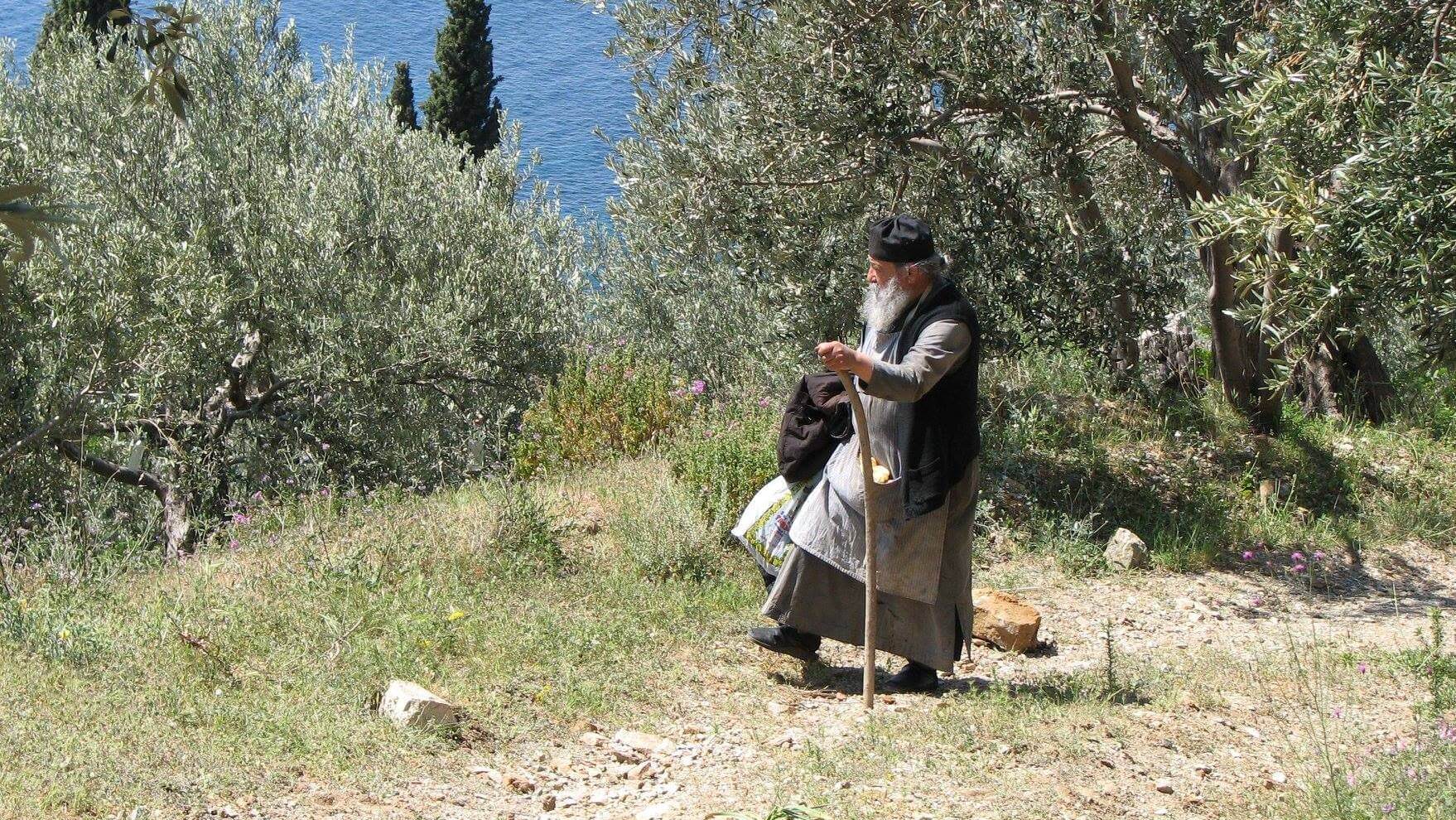
Dear ones, fear above all the warfare "from the right". When thoughts of fornication assail you, when thoughts of jealousy assail you, when thoughts of blasphemy assail you — that struggle is open, and it is not so frightening.
But when it seems to you that you are experiencing something divine, something holy, something radiant — here danger lies hidden. Because the devil is able to make black white and white black. The most cunning of beings!
When you labour, when you have the responsibility of laying the table, of managing to feed the hungry animals, of managing to receive the guests — you are humbled. When you listen to me scolding you — and I am a harsh man and can season my rebuke with a hot word — then, with God's help, with GOD'S help, something in you still stirs.
But when you are left alone, and frivolity and idle thinking are brewing inside you, then you exalt yourselves and fall into spiritual delusion.
You, brothers, come to me and describe your lofty spiritual states of prayer. But let a brother needle you with some word, and at once you pull a gloomy face, and your whole state is laid bare. Know that this is a pseudo-spiritual state, which must be fought and avoided.
Fear the warfare "from the right". Because the devil makes white black and black white...
On patience in hardships
There is no need to despair. Our struggle is to overcome the world and sin. Christ, by the prayers of the Most Holy Theotokos and all the saints, will not allow us to be tried more than we can bear. Do not be afraid! Believe! Trust in the prayers of the Most Holy Theotokos and all the saints.
I will tell you what hardships we faced when we moved into the monastery: there was no roof, there was nowhere even to shelter from the rain... I glorify the Lord that with God's help we became not enlighteners but builders. On every stone here the work of our monks can be seen. I thank the Lord for this! Every time we said that tomorrow would be easier and better. But it became harder and harder. Often there was not even bread, nor oil to light the lampadas. But the Most Holy Theotokos did not abandon us. Never at our refectory did we show that we lacked anything. Always the Theotokos and the Archangels sent us something for the table. I remember how at our first Pascha in the monastery we barely gathered a hundred eggs. And today — glory to God!
Here, in the monastery, we are far from the world, and the world cannot know our hardships. There is a troparion which sings that in the monasteries there is everything. Like the ancient monks, we live from tilling the land and from the mercy of God. And that mercy is expressed in your love for our monastery. We would not have lived to see this day without mercy.
There is a saying of the elders of Dochiariou: "We are poor, but we are proud — not in a bad sense, we are worthy of respect. We never ask, we give thanks for everything."
We must be lamps...
Each of us must become a lamp for his neighbour, to light the way to Christ. If this does not happen, it is bad. We are like little candles. If a candle burns always, it lights the way both for itself and for its neighbour. But if the candle goes out, then, alas, darkness covers that way. Each of you lay people must be a candle that burns before Christ, a candle that burns, melts, but gives light.
Let each of us keep this candle lit, guard it from the strong wind and from the scorching sun. Let our life be a lit candle. And let each show his neighbour the way to Golgotha and to the Resurrection. And they are, in truth, close — the Cross and the Resurrection.
But there are people who keep lamps lit in order to lead traitors to Christ. We must not keep such lamps. We must keep the lit candle of the Eastern Orthodox Church. Though we are little candles, we do not go out. I think it is because we live the life of the Sacraments — Confession and Communion. From there, like the good virgins, we take oil and light our candles. For if there were no confession, man would not be saved, there would be no saints and righteous ones, and the Church would not know the Resurrection. I wish that you too may be a burning candle — in the family, in society, at work.
Many of us shine in the world, yet in our own home, in our own family, not only do we not shine, we cannot even see the light. I am glad that you have the holy tradition of frequent Communion.
Come regularly to the churches, examine yourselves, test yourselves — and receive the Body of Christ. You will not betray Christ by this. But, like the thief, say each time: "Receive me, O Lord, in Thy Kingdom!".
The gaze
With nostalgia I recall a certain hill which got the name Matia after a man passing over it stopped and said: "From here one can take in the whole world at a single glance!".
I also often recall the great painter and restorer Antonios Glinos, who, having seen in the Sinai monastery an icon of Christ painted in wax, long marvelled at the iconographer's mastery, and then, looking Him in the eyes, exclaimed in amazement: "In this gaze everything can be read!".
More and more I am convinced of the truth of the saying that the eyes speak and express thoughts even when the lips are closed and the voice is not heard. With a single glance one can convey to another person both one's thoughts, and what is on the tip of one's tongue, and even what lies deep in the heart.
On wealth
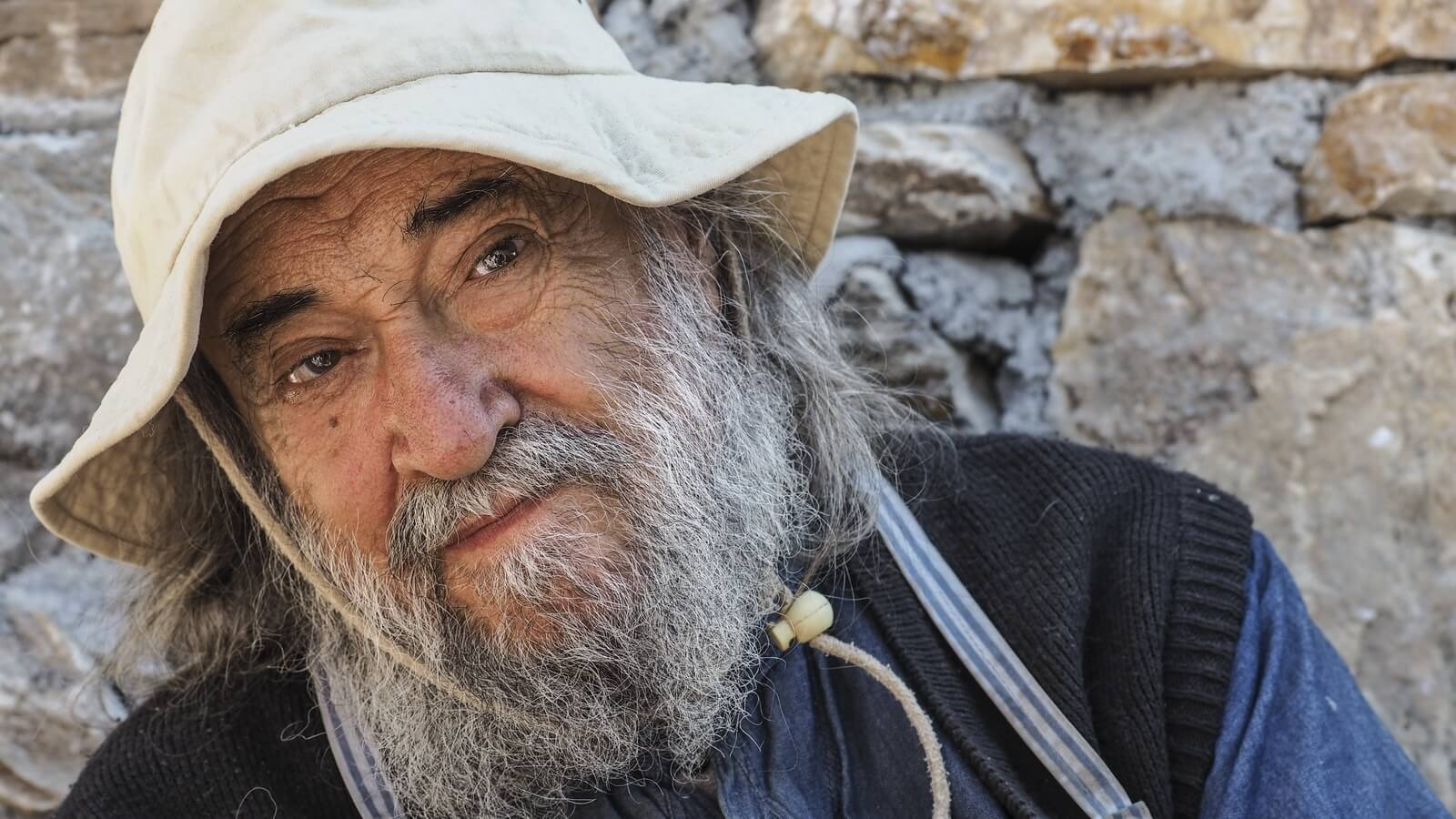
The Lord did not condemn wealth; He condemned the abuse of wealth. Abuse is what is characteristic of most oligarchs. And yet one must understand: all the good things that God bestows are gifts of God. And if a rich man helps people, he will have still more, and the people will only rejoice at his success. And the angels will be pleased.
There have been cases when archangels appeared to rich people and said: "Help those in need!".
The Prophet David says: "The righteous is ever merciful." Once I travelled to the town of Drama to a man who owns marble factories, and mentioned in conversation with him that I needed marble for a church I was building. He answered me: "Walk around the factory grounds, and whatever you like you shall take, and I will deliver it to you." I told him that we needed to agree on a price, because I am poor and may not have the means to pay. To this the factory owner replied that he was already advanced in years and was waiting for a person to come to him whom he could help, who would ask him for help: either to build a house or to raise a church. And he took nothing from me. Will the Lord judge such a man for having become rich? I do not believe it. He will have a good place in paradise.
On the state of the Church and modern theology
We can only lament the new dogmatic teachings and the so-called metapatristic (post-patristic) theology. Indeed, the term post-patristic has been chosen very aptly: this theology has nothing in common with that of the holy fathers.
Who are the "new fathers of the Church"? Dressed in expensive clothes, having eaten and drunk their fill? Who never in their lives lived on rusks, but ate only fresh bread from the bakeries of this world, and not of the desert?
That is precisely why, when one reads their theological works, the human mind is not enlightened but darkened, the heart does not expand but contracts, as if you had suddenly found yourself on the edge of a precipice and looked into the abyss.
Until now we turned to the heritage of the holy Fathers and strove to bring it to the people. But today every theological book is full of references to the godless, rationalistic and scholastic West. We have mixed heavenly truths with the Western inventions of a darkened mind and a barren heart. Now our only concern has become the question: "was this gospel written by Luke or not? Does this work belong to this saint or not?" We have devoted ourselves to barren research. The world around us is collapsing, and we are working out on which island exactly the ship carrying the Apostle Paul to Rome was wrecked!
Now is the time of confessors...
The Orthodox Church is now under persecution, wherever it may be. This is a very fearful time now. And humility and prayers are needed from us. But also confession. Now must be the time of confessors. There is a period of apostles, of prophets, of martyrs. Now — of confessors. Every Christian must confess Christ. Without this confession there will be nothing. The cross I make on the road — that is confession. The cross I make over myself when I eat in a restaurant — that is confession. Church life is confession too. Fasting is confession. And we must take up this weapon in order to humble our enemy, the devil.
And, as a pastor, I must say that now is a period of disobedience. But if the novices do not obey, what are we to do? Then the monks — when do they carry out their obediences? Never. I am always living through this torment, the disobedience of the monks. They have not understood that it is not the bishop or the abbot who has need of obedience, but the monk himself who has need of it. Or, let us say, the priest. To me he does it, he does not do it… It is he who gains the benefit.
This is an epoch like the one when Adam and Eve fell, an epoch of disobedience. The great problem in the Church is disobedience. Obedience nurtures humility, and humility is paradise. The safest road into the Kingdom of Heaven is humility and poverty.
On His Beatitude Metropolitan Onufriy
I greatly love and revere His Beatitude Metropolitan Onufriy. We have known each other for many years. If only we had such a Primate in Greece.
Some people, however much they may try to hide it, draw others to themselves as honey draws bees. Vladyka Onufriy is exactly that kind of attractive person. A gentle, good man. Calm, but resolute.
Outwardly it may seem that he is a naive good-natured man. But in reality he is very firm. He does everything the Church needs competently, and does everything rightly.
I do not believe that he loves the "shop window", the show. He always comes to us on Athos in one and the same cassock. He never agrees to carry the staff of office. I once even thought of making him a staff out of reed, but here on Athos we simply do not have any. And in my village the old men and women always walked with such staffs.

Comments