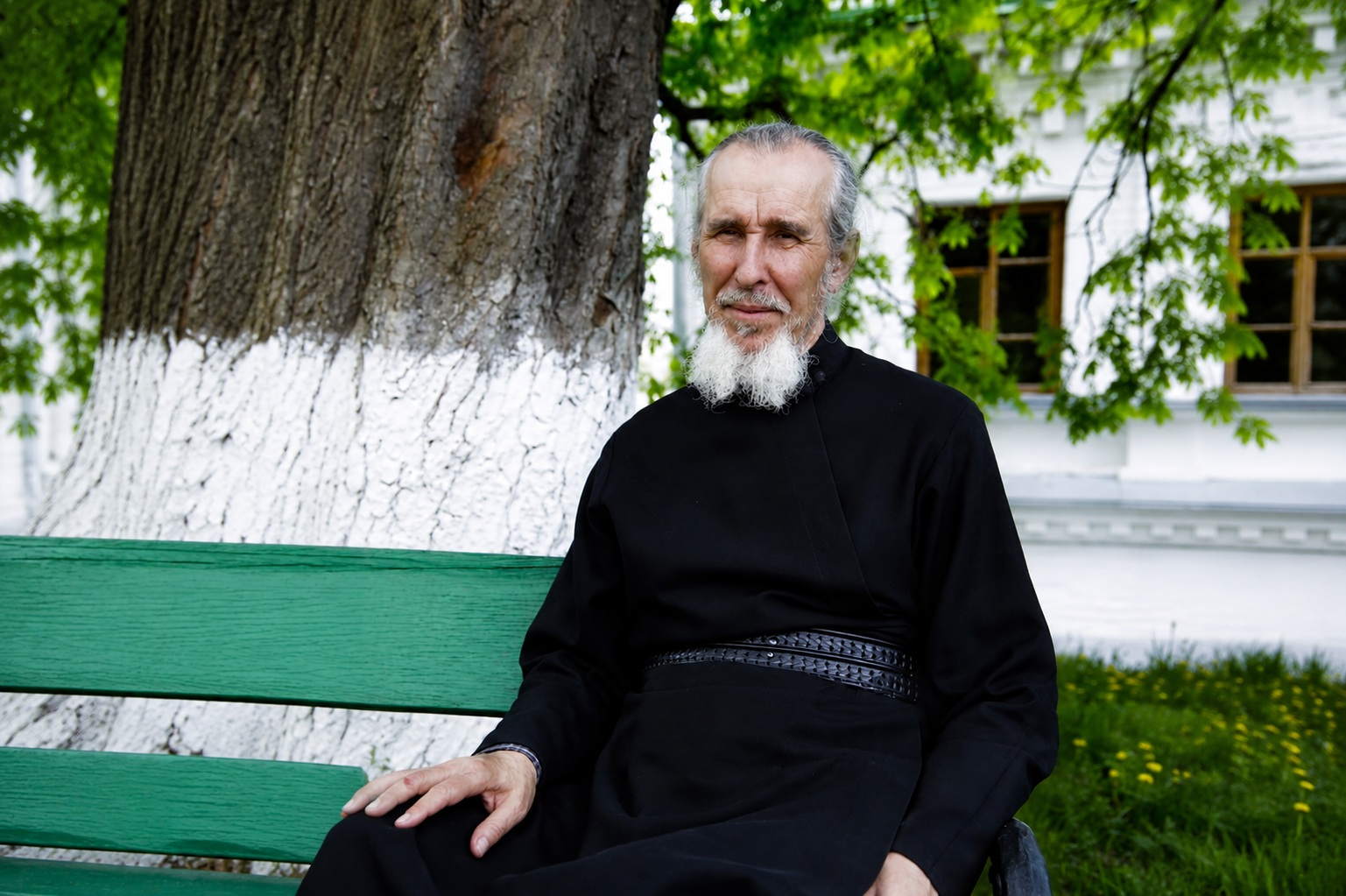
— When the Lavra was returned, the former brethren who had struggled here before the closure gathered here again at once. Father Sophrony (Shynkarenko), an archimandrite, who is now the abbot of the Transfiguration monastery at Kniazhychi, was appointed treasurer. Father Ruf (Rezvykh) was blessed to sell icons. He stayed a year, it is true, and left. Then before his death he returned and lived another year or a little more in the Lavra. He always sat below the kliros. He was settled in the schema block, where Father Polikhronii, in the schema Prokhor (Dubrovskyi), his spiritual father, had once lived.
The repose of Father Ruf († 2009) was blessed. He received the unction and Communion, folded his little hands, closed his eyes and fell asleep.
Fathers Ihor (Voronkov) and Pavel (Chuprun) returned to the Lavra; together with Ruf they had been put in prison when in 1961 they defended the Lavra against provocateurs. After prison Father Pavel lived in the Pskov Caves monastery. And when the Lavra was opened he came here. They gave him a little cell. But after some time he went back again. There remained Schema-Hegumen Agapit (Karmaz) and Archimandrite Pafnutii, in the schema Feofil (Rossokha), who from 1993 was setting the Kytaiv hermitage in order.
In 1991 Father Avraamii came, the spiritual father of the Lavra. Among the old monks there was also a father from Athos — Father Serafim, who afterwards left for Orenburg, to his native place. He said that Chornobyl was here and it was hard to breathe.
Father Agapit, who before the closure was the canonarch, was himself from the Zhytomyr region, born in 1916. After the war he worked at a factory in Kyiv, then came to the Lavra and lived here 16 years until the closure — to the very last day. The monks were then resettled from the Lavra to other monasteries.
At St Volodymyr's cathedral we had Hierodeacon Sophrony, one of the Lavra monks, on the obedience of duty attendant. He was a zealot. He played the Lavra chants on the harmonium and grieved much for the Lavra. Nowadays the people are no longer the same, they have not the zeal the former ones had. They have grown weak, they have no strength either spiritual or physical, they are all ill.
In the spring of 1961 a notice was nailed up at the Near Caves saying that they were going for repairs. And Vladyka Nestor, the abbot, said to him: "Sophrony, go and hang up a notice at the Far Caves too." But he said: "No! I do not want it to be on my conscience." Vladyka said that the Lavra would be closed: take from the church whatever you want. Then Sophrony took two sticharia and icons. And that was all.
Father Agapit used to recount: "We came up outside with our little bundles. Where to go — God knows. Neither house nor home." They went to a parishioner of the Lavra, the servant of God Anastasia, on Observatorna street. And afterwards they settled at St Volodymyr's cathedral. There are two little rooms on each side upstairs. In one of them the choir rehearsal was always held, a small church library was kept there, a sewing machine stood there, and I even sewed on it. And on the other side Metropolitan Ioann (Sokolov) of Kyiv fitted out five small cells, so that a little bed could stand there. And there our fathers Agapit, Anthony and Sophrony lived. The last of them also went to the Caucasus. The brethren had set up a skete in the mountains of Abkhazia and received Communion there. But they were driven out, hunted with helicopters, thrown into the ravines. One Lavra hierodeacon, Father Isaakii, perished in the mountains — he was killed. And the Glinsk brethren also suffered.
And afterwards they gave Father Agapit a little room at the Metropolia. There he swept the yard and went round to people's houses, digging wells to earn his bread. Such a devout little elder he was. Terrible sores formed on his legs from his labours. Then he served in the village of Lytvynivka, at the parish in the Vyshhorod district. There he had a little cell on the second floor, and he used to say: "I am up in the choir loft." In it he prayed, and sat, and read the akathist. Father Agapit was a chanter; he and I later sang together on the kliros in the Lavra. He had a very beautiful voice — a first tenor, high and resonant. The father loved to recall the Lavra, how things had been here before. He had received the schema even before he came back here. When I came to visit the little elder at Syrets, he said that he had written a letter to the metropolitan asking to be tonsured into the schema. Father Agapit was a fine man, a zealot; he stayed in the Lavra from the first day he came until his repose in 1991. And the other brethren afterwards lived in various places.
— Perhaps their strength was no longer what it had been?
— It was different for each of them. Father Ihor (Voronkov) received a flat at Lukianivka and lived there for a time. There he was paralysed and lost his speech. Afterwards they would bring him in a wheelchair to Father Avraamii for confession. He wrote it out on a sheet of paper. Archimandrite Ihor († 2004) was a very good tailor and sewed splendid vestments. Later the abbess of the Florivskyi monastery took him in. There they looked after him, and they buried him in the cemetery of the Florivskyi monastery.
— Tell us about your spiritual father. He too was from the former generation of the Lavra brotherhood, was he not?
— I served as a deacon at St Volodymyr's cathedral. And at the age of 40 I was transferred from the cathedral to the Lavra. My spiritual father became Father Isaiah (Korovai), a schema-archimandrite, who was my sponsor at the tonsure. I had known before that there was a Father Isaiah, but I came to know him closely at the Protection monastery, where his spiritual children lived. He always stayed there when he came back to Kyiv during his journeys about the country. And I was then working at a civilian job, in the shop "Ukrainska Palianytsia" on Khreshchatyk. Now everything there has long been different, unrecognisable. For six years after the army I served in the Ministry of Internal Affairs, then I caught a chill in my leg and changed my work. It was a short journey for me to Khreshchatyk — three stops. I lived then on Kudriavska street.
I remember, I once came out of the Protection monastery, saw Father Isaiah and said to him that I wanted to go to Pochaiv, to an elder. And he said to me: "I will tell you this for your whole life: do not seek out clairvoyants, seek God. God is near us. And as for clairvoyants, they will talk until pears grow on a willow."
Father Isaiah had a great many spiritual children all over the Union. When he went to his native place at Nosivka, half of Kyiv went after him. And for the funeral all believing Kyiv came. I too was present at the funeral. Schema-Archimandrite Isaiah was a very strong spiritual father; he was loved. He and the brethren struggled in the mountains of the Caucasus, bore the ascetic labour of hermits, prayed there and were saved.
— What else about the life of the Lavra did you hear from the old monks?
— The old priests, who had been through everything, did not tell much. The times then were such that one still had to know to whom one could tell a thing. I know that our spiritual father, Father Avraamii, was from the Kamin-Kashyrskyi district of the Volyn region, from the western lands, right up by Belarus. He worked at a factory in Zaporizhzhia, then came to the Lavra. His spiritual father was at first the old Father Gerasim, and then Father Nikon. That father I knew. I was present at his funeral. After the closure Father Nikon served in St Nicholas's church at Vasylkiv and was the dean of the Vasylkiv district. And Father Avraamii, after the closure of the Lavra, was at the Ascension church at Demiivka, taking out the particles from the prosphora. He came to St Volodymyr's cathedral for services too, but for some reason he kept away from Filaret.
— You have such a melodious, distinctive way of speaking; where do you come from?
— I was born in the Kyiv region, in the Korsun district; now it is already the Cherkasy region. My parents, who were born before the revolution, believed and did not renounce God. My great-grandfather on my mother's side was a sacristan for forty years. And my great-grandfather on my father's side always went to church. It was by their prayers, I suppose, that the Lord brought me to the Lavra.
— And when and how did you come to the church?
— By God's Providence. As a child I was brought to church by my believing aunt, my father's own sister Iryna, who was a barely literate widow. She always went to our Dormition church and told me how beautiful it was there. The first time I went with her was at the Nativity of Christ in 1957. Our church is wooden, large, beautiful, ancient. The iconostasis is high, there are many icons. To this day I remember how I opened the doors — and just then they began to sing the troparion of the Nativity: "Рождество Твое, Христе Боже наш, возсия мирови свет разума…" And such beauty! The chandeliers shining, the candles burning, the banners raised high, icons beyond counting, people standing in the church in their festal clothes. It was cold, they stamped their feet. I liked it all so much that on the second day I went by myself.
— You liked it so much in the church then that after that you became churched?
— And to this day I like it. When I came back from the army I said to my younger brother Vasia: "Vasia, I am going to be a hieromonk." He was astonished: "A what, a what?" At the time I did not myself understand what a "hieromonk" was, but so the Lord laid it on my heart. (smiles) And so I did become one. Wherever I was, I always remained a Christian. I never said that I was an unbeliever. When I served in the army in Kyiv I stood in the guard of honour. And my company commander respected me greatly and even allowed me to apply to the seminary. I studied by correspondence at the Trinity-Sergius Lavra. I served as a deacon and studied.
And at first I asked to go to the Lavra myself, but the metropolitan refused me. And then he says: "Go to the Lavra tomorrow, a commission is coming there, they are going to open it." The three of us — Father Ionafan (Yeletskykh), the first abbot, Father Ihor (Voronkov) and I — came here in our cassocks. People looked at us as at some sort of wonder; they had already lost the habit of a priest walking along the street in a cassock. And from that day I have been in the Lavra. All the years I have lived here — 30 already — I have been through everything: joys, and tears, and consolations. And I have made my prostrations. Glory to God for all things! I sing on the kliros every day, morning and evening. At first there were two Liturgies: the early one in the caves, and the second one up above. Later they made three Liturgies.
— Was the opening of the Lavra an unexpected joy for you?
— I already knew that the Lavra would be opened, because in the autumn of 1987 I had a dream, and I even told a nun at the Protection monastery about it, Mother Yelikonida. I remember they were walking with Mother Ioanna near the St Nicholas cathedral in the evening, and I came up and said to them: "Mothers! The Lavra will be opened!" They did not believe it: "What is he babbling about? Who will open it?" And I say: "The Lavra will be opened when the chestnuts blossom." That is what the voice of God told me. And so it came to pass. The chestnuts blossomed — and the Lavra was opened. I also knew when the Near Caves would be given back to the monastery. Of that too there was news in a dream, in '91. I am walking to the Near Caves to do something and I hear: "The Near Caves will soon be given back." That is how the Lord gave me to know.
— And how did you discover the myrrh-streaming of the heads?
— With the heads it was like this: in the autumn of 1988 I had tidied up there, put things in order, and I say to Father Pafnutii (Rossokha): "Let us go and serve a moleben at the myrrh-streaming heads." We came, opened the partition and served a moleben to the venerable fathers of the Kyiv Caves. Father Pafnutii was such a zealot, a fine man. Though he had a temper too — he would shout at times, but we must forgive one another. And after that moleben, on the next day, a head began to stream myrrh. I went and told Father Ionafan that oil had begun to flow there. The abbot came, took the vessel in which the head with the myrrh stood, poured some into a test tube and took it to the Kyiv Medical Institute. There, in the laboratory of the biochemistry department, they made an analysis and gave him a conclusion that the substance which constitutes the myrrh has 70 percent protein. That is as in living matter. In the Far Caves there stand 29 heads. Many people were healed according to their faith, being anointed with the myrrh. And how else! They came, they wept, they prayed and they were healed. Glory to God for all things!
Interviewed by Valentyna Serikova
